The Employees' Provident Fund Organisation is rolling out its long-awaited EPFO 3.0 upgrade to make life easier for eight crore salaried employees in India. Soon you'll be able to withdraw your provident fund money directly using UPI apps or ATMs. But this convenience has attracted a wave of cybercriminals. Online fraudsters are now launching fake EPFO 3.0 UPI withdrawal scams to empty your bank account before you even realize what happened.
What are fake EPFO 3.0 UPI withdrawal scams?
Look, the promise of getting your PF money in seconds is amazing. It really is. Normally, PF withdrawals take days or even weeks. You had to wait for your employer, deal with bank delays, track claims constantly, and hope for the best. So the government wants to use UPI and ATMs to cut that waiting time to zero. It sounds like a dream. (Which makes sense, actually, because the old way was a mess.) Sadly, scammers are using this exact transition phase to catch you off guard. They know millions of us are waiting.
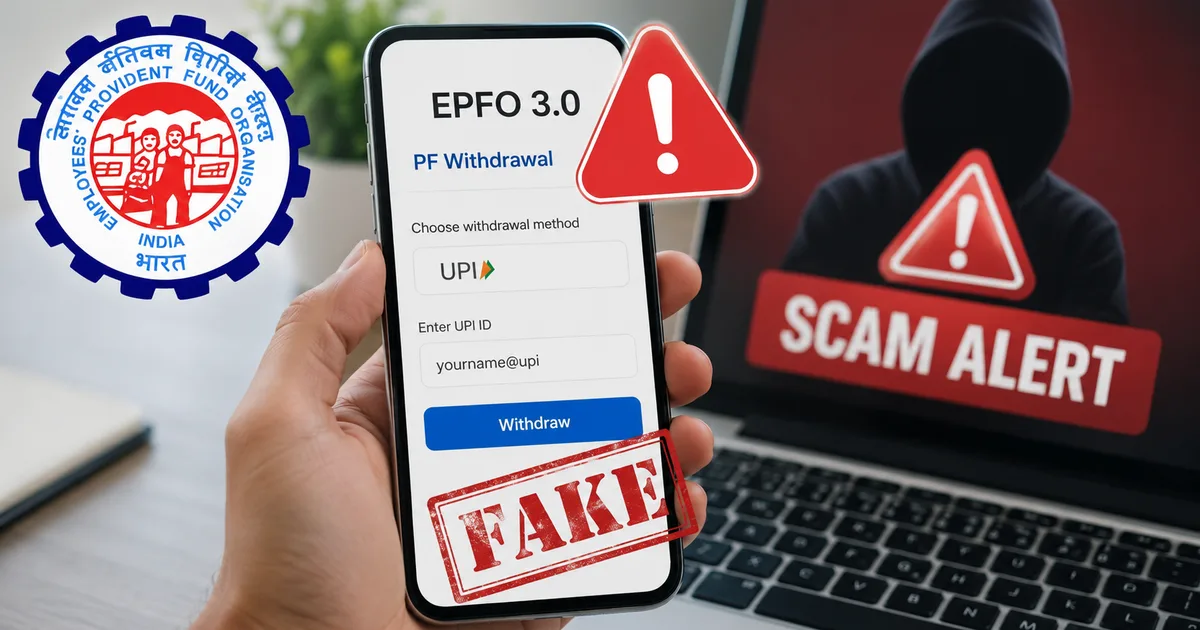
This fraud doesn't target the EPFO servers directly. The attackers don't have the strength to break government firewalls. Instead, they target you. They create copycat websites, distribute sketchy Android apps, send fake SMS alerts that mimic official EPFO alerts, and hope you click. I think they exploit the fact that you want your money quickly. By showing a fake portal that looks identical to the member home page, they steal your login details. Then they drain your bank account. It is simple and rising fast across major Indian cities.
How instant PF withdrawal fraud works in 2026
If you want to protect your savings, you need to know exactly how these guys operate. The whole scam relies on speed and pressure. Honestly, in my experience, they follow a very specific pattern.
- The fraudster sends a text message or a WhatsApp message to your phone number. This message usually states that your EPFO account has been credited with an interest payment or a special advance of Rs 50,000, but you need to activate the new UPI payout channel to claim it.
- The message contains a link that looks official but leads to a cloned website. The domain name might look like epfo-upi-login.in or epf-withdrawal-portal.co instead of the official government domain.
- When you click the link, the fake portal asks you to enter your Universal Account Number, your password, and your registered mobile number.
- Once you submit these details, the website prompts you for an Aadhaar OTP. This OTP is actually being generated in real-time on the official EPFO portal because the scammer is trying to log in as you or change your bank details.
- Alternatively, the scammers call you directly claiming to be EPFO desk officers. They offer to guide you through the instant withdrawal setup and send you a UPI collect request on apps like PhonePe, Google Pay, or Paytm.
- They tell you that entering your UPI PIN on this request will authorize the EPFO to transfer the funds to your bank account.
- As soon as you enter your UPI PIN, the transaction goes through. Instead of receiving money, you lose the entire amount from your linked bank account.
In my experience, anyone can get tricked; a friend of mine almost fell for this last week. He got a text about some pending COVID-19 advance. The site looked real. It had the national emblem and the official blue colors. But he stopped when the page asked for his UPI PIN. Saved him. If he'd typed those digits, his account would've been cleaned out instantly.
Warning signs of EPFO UPI withdrawal scams
Honestly, spotting these scams isn't hard if you know what to look for. These crooks always leave clues. The biggest warning sign is when they ask for a UPI PIN. Remember the golden rule in India: you don't ever enter a PIN to receive money. It's only for sending money or checking your balance. So if someone tells you to enter a PIN to claim your PF money, they're lying. They're just trying to rob you.
Also, look at where the message comes from. Official government SMS alerts come from registered headers like BH-EPFOHO or AD-Union. If you get a text from a regular ten-digit number, or a WhatsApp message with the EPFO logo, it's fake. The EPFO doesn't use personal numbers to text you. They don't ever message you on WhatsApp to check your identity. If the message has spelling errors or uses urgent words like 'deactivation within 24 hours', delete it.
- The website address does not end in '.gov.in'. Every official government portal in India uses this extension.
- The caller asks you to download a remote desktop sharing app like AnyDesk or TeamViewer to assist you.
- The app you are told to download is hosted on a personal Google Drive link or a third-party website, not the official Google Play Store or Apple App Store.
- You receive an unexpected Aadhaar OTP when you are not actively trying to log in to the official member portal.
Security guidelines for EPFO UPI withdrawal safety
Staying safe means you've got to double-check everything. Don't trust Google blindly when you search for customer care numbers. (It's a trap.) I'm not sure exactly why, but scammers love uploading fake helpline numbers on Google Maps. Type the address yourself to go to the official site. The real portal is epfindia.gov.in.
Here's a warning you should memorize. Never share your Aadhaar OTP, UAN password, or UPI PIN with anyone claiming to be an EPFO official. The EPFO doesn't have access to your private PINs, and officers will never ask for them. If you want to check your balance or claim status, use the official Umang app on your phone. It's a secure government app that connects to your PF account. You can also view your passbook on the official portal without any third-party tools. Check out our other scam alerts to protect your digital identity.
Let's look at the NPCI verified-name UPI rule. It's a handy security feature. When you start a transfer, the app shows the name registered with the bank, not what the sender typed. If you're ever asked to send a small test amount of Re 1 to check your account, check the name that pops up. If it's a personal name or some company name instead of a government account, stop. Scammers use mule accounts to collect this cash.
- Keep your UAN password complex and change it every few months.
- Enable two-factor authentication on your mobile banking and UPI apps.
- Never click on links received via SMS or WhatsApp to update your KYC details.
- Use the DigiLocker app to store and verify your official documents securely.
- Regularly check your registered email and SMS inbox for login notifications from the EPFO.
How to report PF fraud in India
If you've lost money to these scammers, you must act fast. Every single minute counts. First, call the national cybercrime helpline number 1930. The Ministry of Home Affairs runs this line to freeze stolen money in bank accounts if you report it quickly. So the faster you call, the better your chances of getting your cash back.
After that, file a complaint online. Go to the official cybercrime portal at cybercrime.gov.in. You'll need to share details like screenshots, UPI IDs, bank statements, and the scammer's phone number. This info helps the cyber police track down the gang. Report any suspicious activity on cybercrime.gov.in immediately. For updates, read our latest news section.
You should also tell your bank to block your UPI ID and cards. If you shared Aadhaar details, lock your biometrics using the mAadhaar app. Finally, report the technical details of the scam to CERT-In. They track phishing campaigns and take down fake sites to protect citizens. We also have a library of safety guides for Indian internet users.