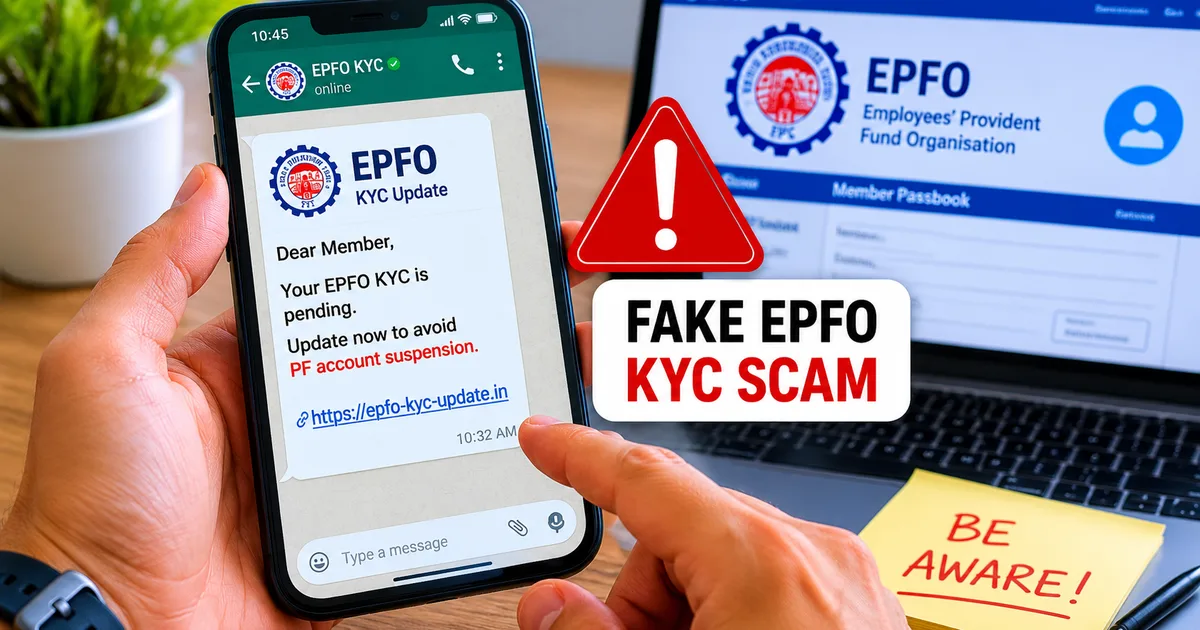
The fake EPFO KYC update scam is one of the more dangerous frauds circulating in India right now. If you have a Provident Fund account (and most salaried employees do), you're a potential target. Fraudsters are sending convincing SMS messages and WhatsApp texts claiming your EPF account will be frozen unless you complete a KYC update immediately. The message looks urgent. It has an EPFO logo sometimes. And the link looks almost right.
The whole thing is designed to panic you into acting fast and thinking later. By the time you think later, your savings could be gone.
What exactly is this scam?
EPFO, the Employees' Provident Fund Organisation, manages PF accounts for over 6 crore active subscribers across India. That's an enormous pool of targets. Scammers impersonate EPFO by sending fake SMS or WhatsApp messages claiming your KYC is incomplete, your bank account isn't linked, or your PF account is about to be frozen or deactivated.
EPFO has warned about this repeatedly. Business Standard reported in early 2026 that EPFO issued new standard operating procedures specifically to handle the growing problem of fraudulent account freezing and scam third-party agents. NDTV Profit separately covered a wave of EPFO scams where third-party agents charged money for services EPFO provides for free.
The fake KYC variant is different from a simple agent scam. It's a phishing attack. It's designed to steal your bank credentials, UPI PIN, or Aadhaar OTP directly. No middleman taking a small fee. They're going for the whole account.
How the EPFO KYC fraud unfolds, step by step
Understanding this sequence helps you recognise it before you're already in the middle of it.
- You receive an SMS or WhatsApp message saying something like: "EPFO ALERT: Your PF account KYC is incomplete. Account will be frozen within 24 hours. Update now: [link]." There's always a deadline. 24 hours, 48 hours. Sometimes they say your account has already been flagged for review.
- The link opens a fake EPFO website. Same colour scheme as the real site, EPFO logo in the corner, fields asking for your UAN number and registered mobile number. The URL will be something like epfo-kyc.in or epfindia-update.com, never the real epfindia.gov.in.
- You enter your details and an OTP arrives on your phone. The moment you share that OTP, scammers can log into your actual EPFO account, change the bank account linked to it, and initiate a PF withdrawal to their own account. Or they use your Aadhaar OTP to drain your linked bank account via AePS transactions.
- Some versions skip the website entirely. The message contains a link to download a "New EPFO KYC App," an APK file to install outside the Play Store. SBI has specifically warned customers about this APK fraud pattern. Once installed, these apps read your SMS messages in real time, including every OTP your bank sends you.
- Within hours, the damage is done. Your PF balance or savings account is empty. EPFO does allow online partial withdrawals, which is a convenient feature for members and unfortunately the exact mechanism scammers exploit once they have your login and OTP.
This isn't hypothetical. A woman in Bengaluru lost Rs 7.69 lakh after clicking a fake WhatsApp link that led to exactly this kind of attack. That's years of accumulated PF contributions, gone in one afternoon.
Why this scam works so well on Indian workers
Honestly, this works for reasons that have nothing to do with the victims being careless.
EPFO genuinely sends SMS alerts. Real EPFO messages arrive from sender IDs like AD-EPFOHO. So people are already used to getting legitimate texts from EPFO, and the fake ones slot right into that mental category without triggering any suspicion.
KYC is also something EPFO actually requires. Aadhaar-UAN linking, bank account seeding: these are real, mandatory steps. A message about incomplete KYC triggers genuine concern instead of immediate scepticism. You think, wait, did I miss that step? And once you're second-guessing yourself, the scammer's job is mostly done.
The stakes are real and stressful. Most salaried workers know their PF account has a significant balance, often lakhs of rupees built up over years. The threat of it being frozen is genuinely alarming. Stress overrides careful thinking every time. (I'm not sure exactly why our brains short-circuit so reliably under financial pressure, but they do.)
And many workers, especially older employees and those in manufacturing or blue-collar jobs, aren't fully comfortable navigating the EPFO portal themselves. They rely on HR departments or agents for PF tasks. Being used to intermediaries makes the scammer's approach feel familiar rather than suspicious.
Warning signs that a message is fake
Stop immediately if you notice any of these.
- The message comes from a regular 10-digit mobile number instead of an official sender ID like AD-EPFOHO
- The link in the message is not epfindia.gov.in. Domains like epfo-kyc.in, epfindia-update.com, or anything that substitutes .gov.in with .net or .org are fake
- You're asked to download an EPFO app from a link in a message. The legitimate EPFO-linked app is UMANG, available only on Google Play Store and Apple App Store
- The message asks for your UPI PIN, Aadhaar OTP, or net banking password. EPFO will never ask for any of these
- There's a countdown: "account will be suspended in 24 hours" or similar urgent, panicky language
- The helpline number in the message is different from EPFO's official toll-free number, which is 1800-118-005
- A WhatsApp contact claims to be from EPFO customer support. EPFO doesn't offer support through personal WhatsApp messages
From EPFO's official advisories: EPFO never asks members to share their UAN password, Aadhaar OTP, or bank account details via SMS or WhatsApp. All KYC updates happen through the official Member e-Sewa portal at unifiedportal-mem.epfindia.gov.in, or through your employer's HR department. Not through a link sent to your phone.
How to protect your PF account from EPFO KYC fraud
Concrete steps, not vague advice.
Log into the EPFO member portal at epfindia.gov.in directly and verify that your registered mobile number and linked bank account details are correct. If anything looks unfamiliar, contact EPFO immediately and ask your bank to block outgoing transactions.
EPFO has an account freeze feature that lets you lock your PF against withdrawal claims. Business Standard reported in 2026 that EPFO's new fraud prevention SOPs include these freeze and de-freeze procedures. Ask your HR department about activating this, or find it in the member portal under account settings. (It's a bit buried in the interface, if you ask me, but worth finding.)
Make one firm rule: any message about EPFO KYC gets ignored until you check the portal yourself. Type epfindia.gov.in directly in your browser. Bookmark it. Never follow a link in an SMS or WhatsApp message to get there. That single habit closes most of what makes this scam work.
If any message asks you to download an APK file, delete it immediately. The official EPFO-linked service runs through UMANG, installed from official app stores only. Anything sent over WhatsApp that requires a manual installation outside an app store is malware. No exceptions.
And if someone has already gotten your details — if you clicked a link and entered your UAN, Aadhaar, or OTP — act right now. Call your bank to freeze your account, then dial 1930 immediately. Don't wait to see what happens. Here's a complete guide on what to do after falling for a phishing scam.
Where to report this fraud
If you received a fake EPFO message, or worse, already clicked and shared information:
- Call the National Cyber Crime Helpline: 1930 immediately. It's a 24/7 line specifically for financial cyber fraud and is your fastest route to flagging the incident
- File a complaint at cybercrime.gov.in. Screenshot the fake message before filing so you have evidence ready
- If you suspect malware was installed on your phone, report the incident to CERT-In
- Raise a grievance on EPFO's portal at epfigms.gov.in with your UAN and full details of what happened
- File an FIR at your nearest cyber crime police station. Bring screenshots and any available transaction records
- Forward the fake message to 1909 to help TRAI block the sender at the network level
EPFO has been paying attention. Their 2026 fraud prevention SOPs and new account freeze procedures are real, practical responses to this growing problem. But regulatory action is slow and fraud volume is high. Your protection, right now, comes from knowing what these messages look like and having a firm personal rule about how you access EPFO services.
If you work in HR, share this with your workforce. Factory workers, retail staff, older employees who've spent decades contributing to PF without ever needing to interact with the digital portal are being specifically targeted because their balances are substantial and their familiarity with phishing patterns is lower. Walk them through these warning signs in person if you can.
See other government impersonation scams that use the same playbook. And if you want to understand how phishing attacks work at a deeper level, this explainer covers it without the jargon.