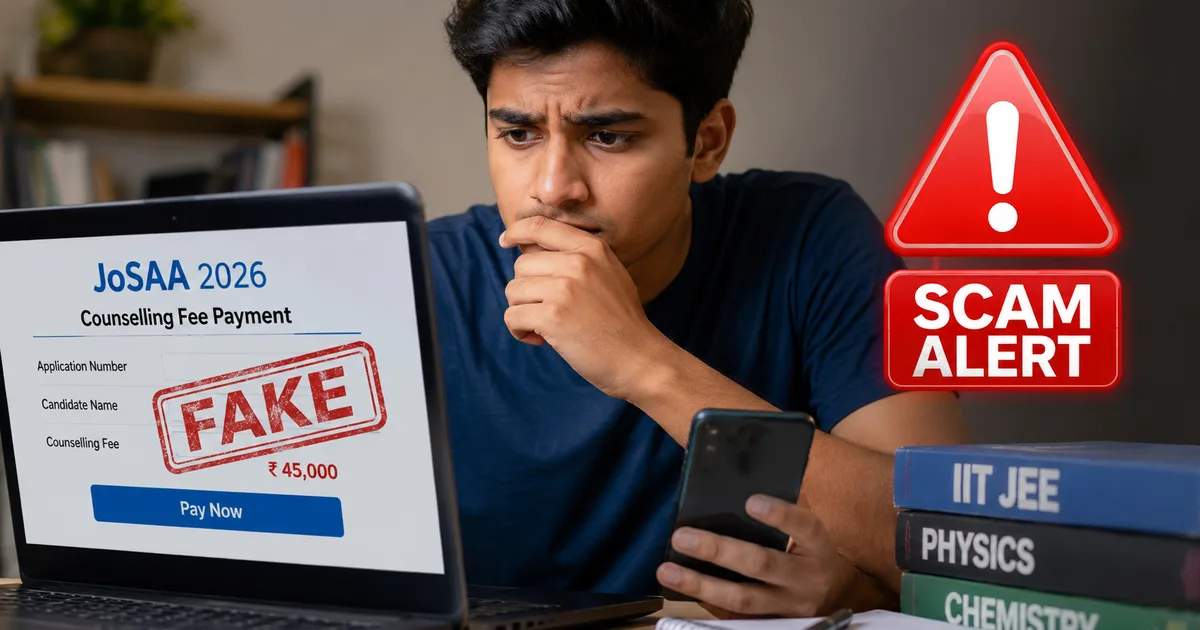
JoSAA counselling 2026 has just opened. Registration and choice filling started June 2. And fake JoSAA fee payment scams are already circulating on WhatsApp and Telegram. If you or your child just cleared JEE Advanced or JEE Main, read this before you open your next message from an unknown number.
Over 48,000 seats are on offer this year across IITs, NITs, IIITs, and GFTIs through JoSAA and CSAB. That's a lot of anxious students and even more anxious parents. Fraudsters know this. They've been waiting for exactly this moment every single year, and 2026 is no different.
What this scam actually is
Scammers create fake WhatsApp groups and Telegram channels that look like official JoSAA helplines. Some pose as "seat agents" who claim they can get you a better branch or college for a payment. Others impersonate NIC officials or JoSAA coordinators. And a few go as far as building websites that look almost identical to josaa.nic.in, with slightly different domain names designed to fool you if you're not paying close attention.
The end goal is always money. Paid via UPI to personal accounts that vanish the moment the transfer goes through.
This isn't new. Versions of this scam have run every JoSAA cycle for years. What's different in 2026 is the use of AI-generated voice calls that mimic official-sounding bureaucratic language, making fake "helpline" calls harder to immediately dismiss (annoying, I know). Some scammers have also started using scraped JEE rank data to address students by name and rank, which makes the initial contact feel unnervingly real.
How the fake JoSAA counselling fee scam works, step by step
Here is the typical flow:
- You get added to a Telegram group or WhatsApp community called something like "JoSAA 2026 Official Help" or "IIT NIT Seat Booking Group 2026". These groups often have hundreds of members, many of them fake accounts, to look legitimate at a glance.
- An "admin" messages you directly, congratulating you on your JEE rank and offering help with choice filling. They may correctly mention your rank, scraped from publicly available rank card data or JoSAA registration details that circulate in these fraud networks.
- They explain that there is a "seat reservation processing fee", a "document verification charge", or a "counselling facilitation fee" that must be paid before your choices are submitted. Amounts typically range from Rs 2,000 to Rs 15,000, sometimes higher if they are targeting a specific IIT branch.
- Payment is requested via UPI to a personal UPI ID, something like name@paytm or name@ybl, not an official government payment gateway.
- Once you pay, they either disappear immediately or continue the scam by asking for more money: a "seat confirmation fee", an "original document scan charge", or some other invented cost.
Some variants involve phishing links. You get a URL that looks like josaa.nic.in but isn't, where you "log in" and hand over your credentials. After that, scammers can change your choice preferences, access your registered email, or lock you out of the system entirely during the most critical window of the whole counselling process.
Warning signs you should not ignore
Honestly, most of these scams have obvious tells if you're not panicking. The problem is that JEE aspirants and their families are almost always in some state of panic during counselling week. That's exactly what the fraudsters count on.
- Any WhatsApp or Telegram group claiming to be an "official JoSAA helpline" is fake. JoSAA doesn't operate on WhatsApp or Telegram, full stop.
- Any request for a fee outside of the official josaa.nic.in portal is fraud.
- UPI payment to a personal ID for government counselling fees. This never happens in any official process.
- Promises of a guaranteed seat in a specific college or branch. Completely impossible since allotment is algorithmic and no human can override it.
- Urgency tactics like "pay within 2 hours or your slot will be cancelled". Classic pressure scam language.
- Links that look like josaa.nic.in but have subtle variations: josaa-nic.in, josaa2026.in, josaacounselling.com, or any variation. Check the domain character by character.
If anyone tells you they can "fix" your allotment for money, they're lying. The system doesn't work that way.
What JoSAA actually charges and how legitimate payment works
JoSAA has no pre-registration fee, no choice-filling fee, and no document verification fee before allotment. The seat acceptance fee, roughly Rs 45,000 for general category students and Rs 20,000 for SC/ST/PwD candidates (with category-specific variations), is paid only after you receive a seat allotment. It's paid only through the official josaa.nic.in portal. And it's paid only through the official payment gateway there, which accepts net banking, debit card, and UPI through an official interface.
There is nothing to pay before you get a seat. Nothing. Any message, call, or WhatsApp chat asking for money before allotment is a scam.
The official website is josaa.nic.in. That's it. CERT-In (cert-in.org.in) has consistently warned in previous years about fake government portal URLs being one of the most common phishing tactics during exam and admission seasons. 2026 is not an exception. In my experience, people who bookmark the real URL early are far less likely to fall for a sketchy lookalike domain when they're stressed.
How to protect yourself and your family right now
If you're a JEE aspirant or a parent handling this process, do these things today:
- Bookmark josaa.nic.in right now on your phone and computer. Every communication, payment, and status update, do it only through that URL.
- Leave any JoSAA-related WhatsApp or Telegram group you didn't join through a verified coaching institute or school channel. Don't just mute it. Leave.
- Tell your parents explicitly: no one from JoSAA will call or message asking for money. Not on WhatsApp, not on a phone call, not in a Telegram DM.
- Check every URL carefully before entering login details. josaa.nic.in ends in .nic.in which is India's government domain. Anything else is not official.
- Enable UPI transaction alerts on your phone so you get an immediate SMS if any payment is initiated from your account.
- Screenshot and save any scam messages you receive before reporting them. Evidence matters when you file a complaint.
Also worth keeping in mind: if someone in your coaching centre or college WhatsApp group shares a "JoSAA helpline link", don't assume it's legitimate just because someone you trust forwarded it. These links spread through social proof. The person who shared it probably didn't verify it either (which makes sense, actually, because everyone's just trying to be helpful in a rush).
If you have already paid: what to do right now
Don't panic. Act fast.
- Call 1930, India's National Cyber Crime Helpline, immediately. Tell them it's a UPI fraud and give them the transaction ID and the UPI ID you sent money to. The sooner you call, the higher the chance they can freeze the fraudster's account before the money is withdrawn.
- Call your bank's customer care and ask them to initiate a UPI transaction dispute or chargeback. Have the transaction reference number ready.
- File a complaint at cybercrime.gov.in. Use the "Financial Fraud" category under "Report Cyber Crime". You'll need the UPI transaction ID, screenshots of all conversations, and the UPI ID or phone number involved.
- Report the scam account on the platform itself. On WhatsApp: open the chat, tap the contact name, scroll down, tap Report. On Telegram: forward the scam message to @notoscam or use the Report option in the group.
- File an FIR at your local police station. Bring printed screenshots and bank transaction records. This is especially important if the amount is significant.
Important: UPI reversals after fraud are not guaranteed, but acting within the first 24 hours significantly improves your chances. Banks can flag and sometimes freeze recipient accounts if you report quickly enough. Do not wait to see if the scammer "comes through".
A note for coaching institutes and school counsellors
If you run a JEE coaching centre or guide students through admissions, please send a clear, direct warning to students and parents right now. A simple message, "JoSAA has no fee before seat allotment, don't ever pay via WhatsApp or Telegram," could save a family from losing Rs 10,000 or more during what's already a stressful and expensive time. Basically, one forwarded message from you carries far more trust than anything a stranger sends.
You can also read about other education and exam-related scams we've covered. The tactics used in JoSAA fraud overlap heavily with fake NEET refund scams and fake scholarship phishing campaigns, and understanding the pattern helps you spot new variants faster.
Students who cleared JEE Advanced 2026 went through months of gruelling preparation. The last thing any family needs is to lose money to a scam on top of everything else. I'm not sure exactly why these scams keep working year after year, but part of it is that counselling week is a mess of deadlines and the pressure makes people skip basic checks. Understanding how official government portals work before you start the counselling process is genuinely one of the more useful things you can do this week.
Stay on josaa.nic.in. Everything else is noise, and some of it is theft.