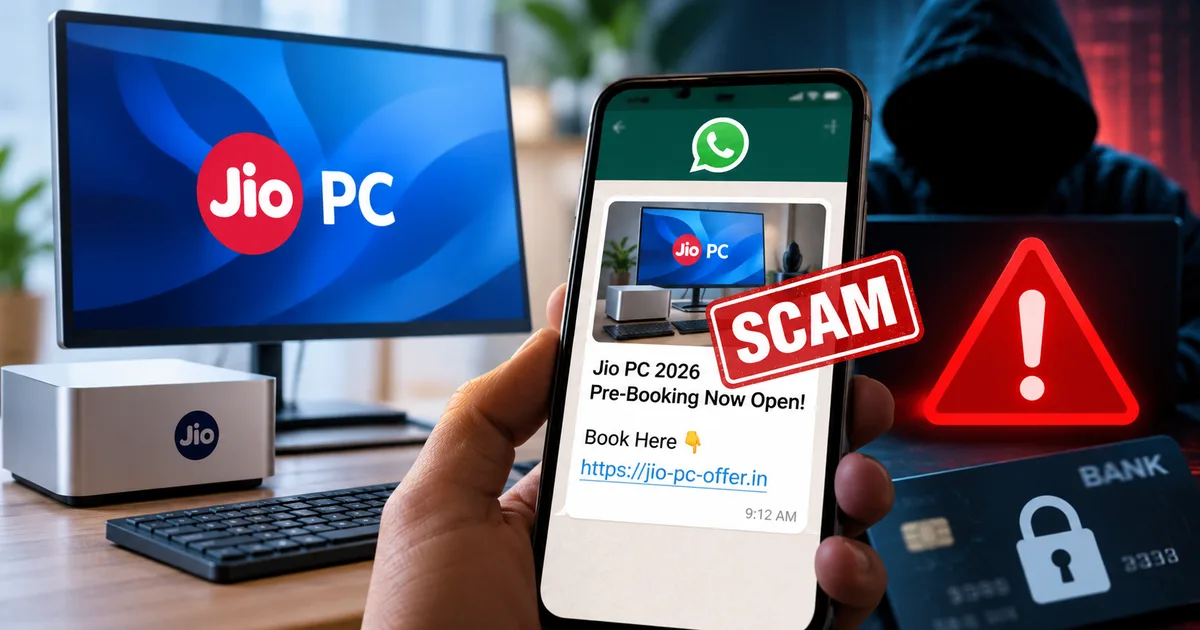
Look, I get it. Everyone wants a cheap computer. When news broke about the upcoming Jio PC 2026 India Launch, I knew immediately what was coming next. Scammers were going to have a field day. And right on schedule, my family group chats are suddenly full of messages about a Fake Jio PC 2026 Pre-Booking Link WhatsApp Scam. I'm calling it that because that's exactly what it is. A complete fraud designed to empty your bank account while you think you're securing a budget laptop for your kid's college assignments.
This isn't just some harmless spam. People are losing serious money right now. Honestly, the scammers are getting incredibly smart. They build fake websites that look exactly like the real Reliance Jio portal. They ask for a tiny booking amount, maybe Rs 999. It seems believable for a pre-order reservation (which makes sense, actually). But the Rs 999 isn't the real goal. The real goal is getting access to your UPI PIN. Or they want to trick you into installing dangerous malware on your phone.
I want to break down exactly how this trap works. We've seen similar tactics before, like the Fake ChatGPT Astra 2026 Early Access WhatsApp Scam: Protect Your Bank Account, but the Jio brand name makes this one really sketchy. People trust Jio in India. Millions of households use their fiber connections and mobile networks. So scammers weaponize that trust to bypass our natural skepticism. I'm not sure exactly why it works so well every time, but it does.
What exactly is the Jio PC WhatsApp scam?
Basically, you get a message on WhatsApp from an unknown number. Sometimes it even comes from a friend or an uncle who blindly forwarded it to the family group. The message claims Reliance is offering an exclusive early bird pre-booking for the new Jio PC. It's heavily discounted under some fake Digital India Anniversary Offer. And it usually includes a picture of a sleek laptop and a link that says something like jio-pc-prebook-offer.in or some other fake URL.
The message creates a massive sense of urgency. It'll say the offer is limited to the first 10,000 customers. Or that the link expires in exactly two hours. That's classic scammer behavior. They want you to panic and click before you have time to think critically about it. Because they know if you stop and search for the offer on Google, you'll figure out it's a scam.
You might think you're too smart to fall for this scam. Trust me, highly educated professionals are getting duped every single day. In my experience, nobody is totally immune. The Times of India recently reported that Reliance Jio itself had to issue a cyber fraud warning to its customers about these exact types of phishing attacks. The scammers are running this operation like a professional business. They even have customer support chatbots on their fake sites to guide you through the process of giving them your money.
How the scam drains your bank account
The fraud happens in a few distinct steps.
I've looked at several of these links. The numbers here are a bit fuzzy, but the playbook is almost always the same.
First, you click the link. It takes you to a webpage that perfectly copies the official Jio branding. The fonts and the colors are stolen directly from the real site. There is usually a fake timer ticking down at the top of the screen to keep you stressed. They might even show a fake notification ticker saying Rahul from Mumbai just booked his Jio PC.
Next, you're asked to fill in your personal details. Name and phone number. Maybe even your Aadhaar number for KYC verification. Stop right there. Never give your Aadhaar details to a random website (annoying, I know, how often we have to say this). Scammers collect this data to sell on the dark web. Or they use it to create fake bank accounts in your name.
Then comes the payment page. This is where the real damage happens. The fake site asks for a token advance payment of Rs 500 or Rs 999 to confirm your booking. It gives you an option to pay via UPI. That feels familiar and safe to most Indian users today. When you click pay, it opens your Google Pay or PhonePe app.
Here's the trick. If you aren't paying close attention, the amount requested in your UPI app might secretly be Rs 50,000 instead of Rs 500. Or worse, the payment page asks you to manually enter your UPI PIN directly on their fake website. Never type your UPI PIN anywhere except inside your official banking or UPI app. The moment you type it on their site, they capture it.
Sometimes they use a completely different method. Instead of a website, the link downloads an APK file to your Android phone. They'll call it the Jio Pre-Book App. If you install this, you're handing over complete control of your phone to a criminal. We saw this exact same trick with the Fake Ola Electric Battery Subsidy WhatsApp APK Scam 2026: Protect Your Bank Account. The malware reads your SMS messages in the background and intercepts your bank OTPs. Then it quietly empties your accounts while you sleep. They can even bypass two-factor authentication because they have your messages.
Warning signs you should never ignore
You need to know how to spot a fake message instantly. Train yourself to look for these red flags.
- The link itself is the biggest giveaway. Official Jio communications will always send you to jio.com. Not jio-offers.in, not prebook-jiopc.com, not some weird shortened link. Always read the URL carefully before clicking. If it looks strange, it is strange.
- Watch out for the Forwarded many times label on WhatsApp. If a message has that double arrow icon, be extremely suspicious. Real companies do not launch major hardware products via viral WhatsApp chains.
- Spelling and grammar mistakes are another huge clue. These scammers are often operating from massive illicit call centers. They make silly grammatical errors that a corporate marketing team never would. But honestly, they are getting better at this. With modern translation tools, you can't rely on bad spelling alone to spot a fake anymore.
- The pressure tactic is your final warning. Any message demanding immediate action or threatening that you will miss out is usually a scam. Real sales events have clear, advertised timelines on official channels. They don't randomly text you at 10 PM telling you to buy within five minutes.
How the scammers get your number
A lot of people ask me how these scammers know their phone numbers in the first place. Thing is, our data is everywhere.
Sometimes it's a random bulk blast. They buy databases of millions of Indian phone numbers from sketchy brokers online. These numbers often leak from local shops or poorly secured apps.
Other times, the targeting is more specific. If you recently searched for budget laptops on a less secure e-commerce site, that search data might have been sold. Scammers buy this intent data and target you specifically because they know you're already in the market for a cheap PC. It's a highly organized crime network.
How to protect yourself right now
First, delete the message immediately. Don't forward it to your family just to ask if it's real. You're only helping the scammers spread their net. Just delete it and block the unknown number.
If you really want to know about the new laptop, open a web browser and type in jio.com yourself. Check their official social media handles on X or Instagram. If a massive pre-booking event is happening, it'll be plastered all over their actual website and the front pages of national newspapers. Keep an eye on our Latest Tech News section, we'll cover the actual launch when it officially happens.
Turn off the ability to install unknown apps on your Android phone. Go to your settings and search for Install unknown apps. Make sure it's disabled for Chrome and WhatsApp. This stops those malicious APK files from installing themselves even if you accidentally click a link.
Remember the golden rule of Indian digital banking. You only enter your UPI PIN to send money to someone else. You never, ever need a UPI PIN to receive a refund or get cashback. If a screen asks for your PIN, money is leaving your account. That's a hard rule with zero exceptions.
What to do if you clicked the link
If you realize you made a mistake and clicked the link, you have to act immediately. Don't wait to see what happens. Minutes matter.
If you installed an APK file, turn on airplane mode instantly. This cuts off the scammer's internet connection to your phone, preventing them from sending your data back to their servers. Then go to your settings and factory reset the device. Yes, you'll lose your photos and messages if they aren't backed up to Google Drive. But that's far better than losing your life savings.
If you made a payment on a fake site or typed in your PIN, call your bank immediately. Ask them to freeze your account and block your debit cards. Don't wait until morning. Most banks have 24-hour fraud helplines for exactly this reason.
Then, you must report the crime officially. Call the National Cyber Crime Helpline at 1930. This is a dedicated emergency number set up by the Indian government for financial fraud. The faster you call 1930, the higher the chance the authorities can freeze the money in the scammer's mule account before they withdraw it at an ATM.
You should also file a formal written complaint online at cybercrime.gov.in. Keep screenshots of the WhatsApp messages and the fake website URL. You'll need these pieces of evidence for the police report. The CERT-In (Computer Emergency Response Team) constantly tracks these phishing campaigns. And reporting helps them coordinate with telecom operators to block the fake websites faster.
Stay alert out there. Check out our Scam Alerts & Safety hub for more warnings on current threats. The internet is a brilliant tool, but you have to keep your guard up constantly. If an offer seems too good to be true, it is.