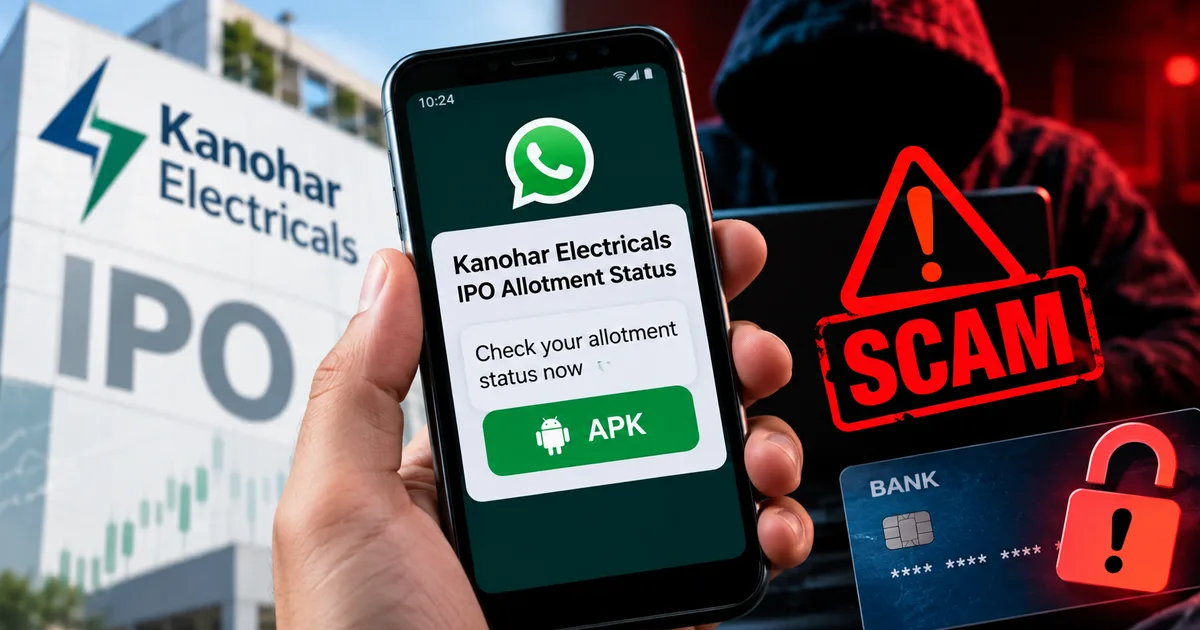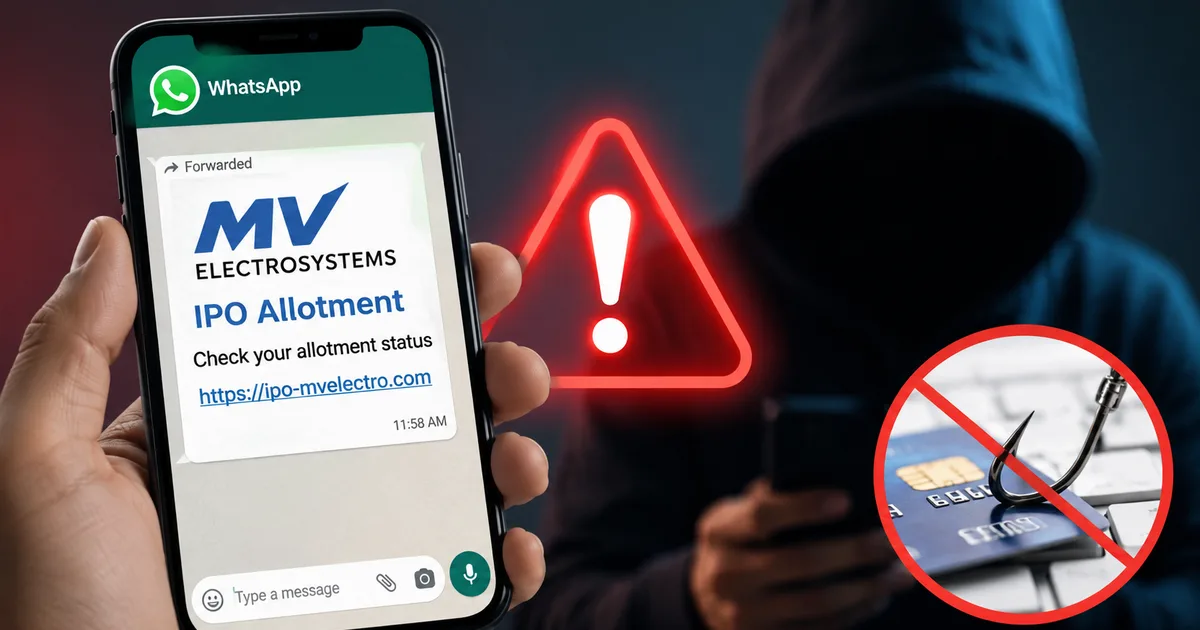
So, the MV Electrosystems IPO has been making serious waves. On day three alone, the issue was subscribed 12.03 times. The grey market premium is sitting at a comfortable 27% potential listing gain. And honestly, wherever there's easy money to be made, the scammers are never far behind. If you've received a WhatsApp message claiming you've won an allocation and urging you to check the fake MV Electrosystems IPO allotment link WhatsApp scam 2026, stop right there. You're being targeted.
This is a serious threat. The people running these operations are organized and well-funded, and they know exactly how to exploit the FOMO that grips Indian retail investors during a hot IPO season. Honestly, they want your bank details. They're after your UPI PIN and your money.
I've been looking into how these syndicates operate. It is terrifyingly simple (and a bit sketchy, actually). Just recently, the UP Special Task Force arrested a man in Nagpur linked to a pan-India fake IPO scam. That scam tracked back to over 3,000 complaints. In my experience, these guys aren't messing around. You shouldn't either.
What's the fake MV Electrosystems IPO allotment link scam?
This is a highly targeted phishing attack. If you ask me, it's a mess. Instead of sending out millions of generic emails hoping someone bites, the scammers are focusing on people who track the share market. They know the MV Electrosystems IPO is highly oversubscribed. Everyone who applied is anxiously waiting for the allotment status. So they wait.
They send you a WhatsApp message that looks incredibly official. It has the logo of the Bombay Stock Exchange or a well-known broker. The message will confidently declare that the allotment results are out. It says you've been allotted shares.
To claim those shares or check your exact status, you need to click a specific link. That link is the trap.
Never click on an allotment link sent directly via WhatsApp, especially from an unknown number.
The moment you click, you're redirected to a spoofed website. It looks exactly like the real registrar's website like KFintech or Link Intime. It asks for your PAN number and your application number. Then it asks for your banking details. They might ask for your UPI ID for verification. Sometimes they say it's to process a fake refund for unallocated shares.
How the scam works step by step
Understanding the mechanics is your best defense. I'll explain exactly how they pull this off. It's terrifying, honestly.
The initial lure
You get a WhatsApp message. It might even come from a fake investment group you were added to without your permission. The text will say something like: 'MV Electrosystems IPO Allotment OUT. Check your status immediately to claim your shares.'
The fake urgency
Scammers always try to panic you. The message will probably say that if you don't confirm your bank details within 24 hours, your allotted shares are canceled. They claim the shares go to someone else. This is a complete lie. But when you're looking at a potential 27% listing gain, your brain stops thinking logically.
The spoofed portal
You click the link because you want those shares. The website that opens looks legit. It has the right colors and the right fonts. You enter your PAN. Then, the site says it needs to verify your bank account to either deposit the shares into your Demat account or process your refund.
The final theft
This is where the actual theft happens. The site asks you to enter your UPI PIN or internet banking password. They claim it is to authorize a one-rupee transaction for account verification. Or worse, it asks you to download an APK file. This file supposedly gives you direct access to your portfolio.
If you enter your UPI PIN, you aren't approving a small check. You are authorizing a massive withdrawal. If you download the APK, you install malware that reads your OTPs. It wipes out your bank balance while you sleep.
The Indian Computer Emergency Response Team (CERT-In) has repeatedly warned against clicking unsolicited links or downloading APK files sent via WhatsApp. These are primary vectors for financial malware in India.
Warning signs you're being scammed
It's actually pretty easy to spot these frauds once you know what to look for. Look at these warning signs.
- Unsolicited WhatsApp messages are the biggest red flag. Legitimate registrars and stock exchanges don't send you direct WhatsApp messages with clickable links for allotment status unless you explicitly opted into a verified WhatsApp business account.
- Pressure to act immediately is another common tactic. Your IPO allotment doesn't expire in 24 hours. If a message tells you to hurry or lose your shares, it's a scam.
- Requests for a UPI PIN should make you stop immediately. You never need to enter a UPI PIN to receive money, get a refund, or check an allotment status. UPI PINs are only for sending money.
- Weird URLs are a dead giveaway. Check the web address. Scammers use long, strange URLs that try to look official but aren't the actual linkintime.co.in or kfintech.com domains.
- APK downloads are extremely dangerous. If checking your status requires downloading an app directly from a website instead of the Google Play Store or Apple App Store, abort immediately.
Why the Indian IPO market is a goldmine for scammers right now
If you're wondering why we see a massive spike in these specific frauds, look at the broader picture of the Indian stock market in 2026. I'm not sure exactly why the spike is so huge this specific month, but the numbers here are a bit fuzzy. The participation of retail investors is skyrocketing. Millions of new Demat accounts open every month. This growth is largely driven by Tier-2 and Tier-3 cities. People who kept their savings in fixed deposits or gold are now trying their luck in the equity markets.
This is a fantastic shift for financial inclusion. It also creates a massive pool of inexperienced investors. These new entrants are unfamiliar with the official processes of the Securities and Exchange Board of India. They don't always understand the exact mechanics of the ASBA system used for IPOs.
When an IPO like MV Electrosystems or Kusumgar comes along and generates massive buzz, the desperation to get an allotment hits a fever pitch. Scammers track this sentiment perfectly. They monitor financial news portals and social media chatter. When they see the hype peaking just before the allotment date, they launch their WhatsApp blasts. It's wild.
They know that India's digital public infrastructure is confusing for newcomers. The rapid adoption of UPI means moving money is frictionless. This is great for buying groceries. But it is terrible when a scammer tricks you into approving a transaction. The scammers exploit the seamless nature of UPI. They mask payment requests as verification steps.
The sheer volume of spam in India makes it hard to distinguish between real alerts and fake ones. We get SMS messages for every tiny transaction and OTPs for every login. Amidst this noise, a fake message from a broker easily slips past our mental spam filters.
Security analysts at CERT-In point out that the sophistication of these phishing portals is increasing. Five years ago, a scam website had typos and broken images. Today, they clone the exact HTML structure of the official registrar sites. They replicate the CAPTCHA verifications to make the process feel authentic. It is a highly professional criminal enterprise. They run out of sophisticated call centers (which makes sense, actually). The UP STF recently busted a major syndicate operating out of Nagpur that defrauded thousands of people across the country using these exact methods.
The role of mule accounts in moving stolen money
You might ask where the money goes once you enter your UPI PIN. It doesn't sit in a scammer's personal savings account.
The moment you authorize that fraudulent transaction, the money goes into a mule account. These are bank accounts opened using fake KYC documents. Sometimes they belong to innocent people who rent out their accounts for a small monthly fee without understanding the legal consequences.
From the first mule account, the funds are rapidly split and transferred across dozens of other accounts in different banks within minutes. This layering process is designed to confuse investigators. It makes the money incredibly difficult to trace.
Finally, the cash is withdrawn from ATMs in different states. Increasingly, it is used to buy cryptocurrency on peer-to-peer exchanges. Once it is converted to Bitcoin and moved to a non-custodial wallet, recovering that money becomes nearly impossible.
This entire money-laundering sequence happens at lightning speed. This is why the 1930 helpline is so important. If you report the fraud within the first couple of hours, the authorities can issue a freeze order to the banks. They can stop the chain of transfers before the money exits the banking system. If you ask me, you have to act fast. If you wait a day because you're embarrassed or confused, that money is gone for good.
How to protect yourself and your bank details
Honestly, the share market is risky enough without handing your money over to cybercriminals. Here is how you keep your bank account safe during this IPO season.
First, only use official channels. If you want to check the MV Electrosystems IPO allotment status, go directly to the BSE website or the official registrar's website. Type the URL into your browser yourself. Don't rely on links sent to you on WhatsApp or Telegram.
Second, ignore the hype groups. If you're randomly added to a WhatsApp or Telegram group promising sure-shot IPO allotments or insider trading tips, leave the group immediately and report it. I can't stress this enough. We've seen reports of people losing lakhs because they trusted some random expert in a WhatsApp group. Just this week, an 80-year-old man in Bengaluru lost Rs 2.51 crore to a fake IPO investment scam that started with a simple Facebook ad.
Third, secure your devices. Don't install apps from unknown sources. Keep your phone's software updated. If you think you clicked a bad link, run a security scan. And change your banking passwords from a different, safe device.
And finally, be highly skeptical of any communication asking for your Aadhaar details or PAN card outside of a highly secure, verified platform like DigiLocker or your actual broker's app. Check out our digital safety guides for more information.
What to do if you've already clicked the link
If you're reading this and realizing you just gave your details to one of these fake sites, take a deep breath. You need to act fast. Panicking won't help.
1. Block your cards and freeze your accounts immediately. Open your banking app or call your bank's emergency number right now. Tell them your account is compromised. Don't wait to see if money disappears.
2. Uninstall any weird apps. If you downloaded an APK file, delete it immediately. To be totally safe, you should probably factory reset your phone (annoying, I know). Make sure you back up your photos first.
3. Report the fraud to the authorities. This is the most important step. The Indian government has set up specific channels for this.
You need to file a complaint on the official National Cyber Crime Reporting Portal at cybercrime.gov.in.
More importantly, call the national cybercrime helpline at 1930 immediately. This is the golden hour hotline. If you call them quickly enough after a fraudulent transaction, they can often coordinate with banks and payment gateways. They freeze the stolen funds before the scammers can move them out of the system.
It's a tough lesson to learn. With the market booming, these scams are only going to get more common. Be smart and be skeptical. Protect your hard-earned money. If a deal or an allotment seems too good to be true, it probably is. Check out our explainer section to understand more about digital safety.