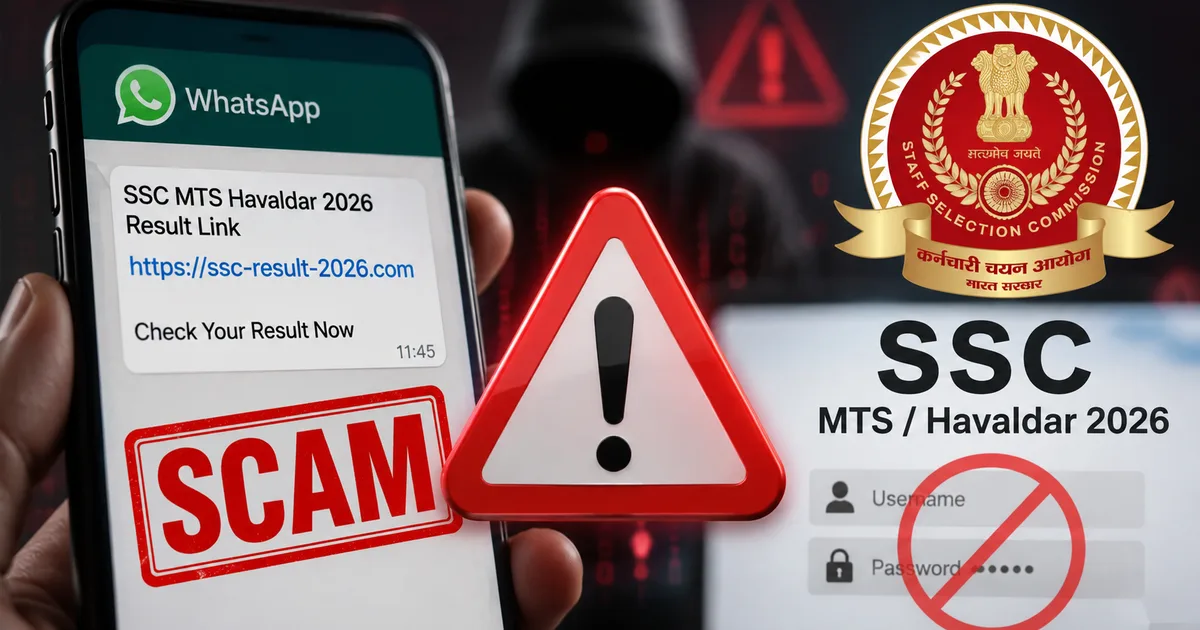
Millions of candidates are anxiously refreshing their browsers waiting for the Staff Selection Commission to drop the news. But while you wait, cybercriminals are busy. The fake SSC MTS Havaldar 2026 result link WhatsApp scam is spreading fast across student groups right now. I received three forwards about this just yesterday from different coaching groups. They prey on the anxiety of job seekers. And they're getting worryingly good at it.
Honestly, the sheer volume of these attacks is staggering. You spend months preparing for a government job. You give the exam. Then you wait. That wait is the hardest part. Scammers know this perfectly. They track the news. They see legitimate reports that the result is expected shortly. Then they blast thousands of messages. They claim they have a direct server link to bypass the heavy traffic on the official website. In my experience, this happens after every major exam.
Don't click them. Don't forward them to your friends. This isn't a harmless prank. It's a highly coordinated operation designed to steal your financial data and empty your bank account. Basically, it's a trap.
How the fake SSC MTS result 2026 official link scam actually works
The operation is simple but effective. You get a message on WhatsApp. It usually comes from an unknown number. Or worse, from a friend who thought they were helping you out. The message claims the SSC server is down due to heavy load. So it offers an alternate server link to check your marks immediately.
Here's the deal. There's no alternate server. The government doesn't host results on random third-party domains. But when you're panicking about cutoff marks, logic takes a backseat.
You click the link. One of two things happens next.
The credential harvesting portal
The link takes you to a webpage that looks exactly like the official SSC portal. It has the logo and the exact same color scheme. It asks for your registration number and password. You type them in. It throws an error saying the server is busy and you should try again later (which makes sense, actually, given the panic).
You think nothing of it. But the scammers now have your login credentials. They can access your profile, download your application forms, get your phone number, and steal your Aadhaar details. This data is then sold in bulk to other fraud syndicates. They'll target you with more personalized scams later.
The malicious APK download
This is the more dangerous variant. You click the link. A file starts downloading automatically. It's usually named something like SSC_Result_Server2.apk. The webpage tells you to install this app to view the merit list because the website is crashing.
If you install that app, you're in deep trouble. I'm not sure exactly why phone operating systems allow this so easily. The app asks for permissions to read your SMS messages. Once you grant that permission, the app hides itself. It intercepts your bank OTPs. Scammers sitting somewhere in Jamtara or Nuh initiate a UPI transaction. The OTP comes to your phone. The hidden app reads it and sends it to the scammers. Then it deletes the SMS before you even see it. Your bank account is drained in minutes.
The psychology behind the SSC MTS Havaldar merit list fraud
Why do smart, educated people fall for this? Because desperation overrides critical thinking. I've spoken to victims of similar scams. They aren't stupid. They're just anxious.
The Staff Selection Commission handles massive exams. Millions apply for a few thousand posts. The competition is brutal. When the news hits that the results are out, the official website often crashes. Scammers use this reality to their advantage.
They manufacture a crisis. They offer a solution. They say the official site is down and you should use their VIP link. It sounds plausible in the heat of the moment.
And then there's the forward culture. WhatsApp is the primary source of news for many in India. When a message says it was forwarded many times, some people wrongly assume it must be true. They pass it on to their family groups. A father sends it to his daughter who took the exam. The daughter trusts her father. She clicks the link. The chain of trust is weaponized against you.
The underground market for student data
Consider what happens if you just enter your details on the fake site without installing anything. You might think you're safe because no money was stolen. You're wrong. Your data has immense value on the black market.
Scammers compile massive databases of student information. Your name, phone number, date of birth, and email address are bundled and sold on Telegram channels. Because you're now a verified, active target. The criminals know you're a job seeker. The numbers here are a bit fuzzy, but we know millions of records are traded daily.
A few weeks later, you might get a phone call. The caller will claim to be an official from the SSC or another government department. They'll speak in professional Hindi or English. They'll tell you that you missed the cutoff by two marks. But they can adjust your score for a small fee of INR 50,000. They'll quote your exact roll number and date of birth to build trust. This is a secondary scam. It's built entirely on the data you handed over on that fake WhatsApp link.
I can't stress this enough. Treat your personal data like cash. Don't hand it out to sketchy websites. The consequences go far beyond a simple phishing attempt. We've covered similar tactics in our latest news section about fake job offers. The pattern is always the same.
Why WhatsApp is the perfect vector for scams
WhatsApp has over 500 million users in India. It's how we communicate and share news. But its end-to-end encryption makes it a safe haven for scammers. Meta can't scan the contents of your messages to block malicious links automatically (annoying, I know).
The platform relies on user reports. By the time enough people report a fake SSC result link for WhatsApp to flag it, the scammers have already moved on to a new number. They buy thousands of virtual numbers for pennies. Banning one number does nothing to stop the operation.
This means the responsibility falls entirely on you. You have to verify everything. If a message has a forwarded tag, treat it with extreme suspicion. If it has a double-arrow tag, assume it's false until proven otherwise. If you ask me, just ignore forwarded links completely.
You should also review your privacy settings. Restrict who can add you to random groups. Scammers often scrape numbers from public Telegram channels and add them to WhatsApp broadcast lists. Don't make it easy for them to reach you.
Warning signs you are looking at a phishing attempt
You need to train yourself to spot these fakes. It isn't that hard once you know what to look for. Here are the immediate red flags.
- Check the URL carefully before doing anything. The official website is ssc.gov.in. Scammers use domains like ssc-gov-result.in, ssc-nic.com, or random IP addresses. If it doesn't end in exactly .gov.in or .nic.in, close the tab.
- Watch out for urgency and panic. Messages that say the link is active for ten minutes only are always fake. Government results don't disappear after ten minutes.
- Beware of requests for irrelevant information. If a result portal asks for your UPI PIN or a fresh OTP, it's a scam. The real SSC website will never ask for financial details to show you a PDF.
- Never accept forced app installations. The government will never force you to download an Android APK file via WhatsApp to check a result.
How to protect yourself from these exam result scams
Prevention is always better than cure. Getting your money back after a UPI scam is a long, frustrating process that often leads nowhere. You have to lock down your digital life.
First, go to your Android settings right now. Search for install unknown apps. Turn this off for WhatsApp and Chrome. This simple step stops those malicious APKs from installing even if you accidentally download one.
Second, rely on official sources. Bookmark ssc.gov.in. Check it directly. Ignore the WhatsApp noise. If the site is down, go make a cup of tea. Try after an hour. The result isn't going anywhere.
Third, read up on how these frauds operate. Check out our detailed explainers on how UPI malware works. Knowledge is your best defense against social engineering.
"Cybercriminals frequently exploit the anticipation surrounding major competitive exams by distributing malicious links disguised as result portals. Candidates must exercise extreme caution and only rely on the official government websites for updates."
That's the standard advice from cybersecurity agencies, and it holds true. You can also read our safety guides to understand how to secure your smartphone properly.
What to do if you clicked the fake link
Look, mistakes happen. If you clicked the link or installed the app, don't panic. But act immediately. You have a very narrow window to stop the damage.
Step one is to disconnect from the internet. Turn off Wi-Fi and mobile data. Put your phone in airplane mode. This severs the connection between the malicious app and the scammers server. They can't steal your OTPs if your phone has no network.
Step two is to remove the app. Go to your settings and uninstall any app you don't recognize. If you can't find it, a factory reset is the safest option. Yes, you'll lose some photos. But it's better than losing your savings.
Step three is to call your bank. Use another phone to call your bank immediately. Freeze your UPI access and block your net banking. Tell them you suspect your device is compromised.
Step four is to report it. This is critical. Call the national cybercrime helpline at 1930. Don't wait for tomorrow. Call them immediately. You also need to file a formal complaint at cybercrime.gov.in. Keep screenshots of the WhatsApp message and the fake website if you have them. The police need this evidence to track the syndicates.
The Indian Computer Emergency Response Team often issues advisories about these phishing campaigns. But the reality is that the scammers adapt faster than the authorities can block them. They register new domains every hour. They change their tactics constantly.
You have to be the firewall. When your friends forward you these links, tell them it's a scam. Break the chain. Don't let your hard work for the SSC exams be ruined by a momentary lapse in judgment on WhatsApp. Stay alert, and trust only the official sources.