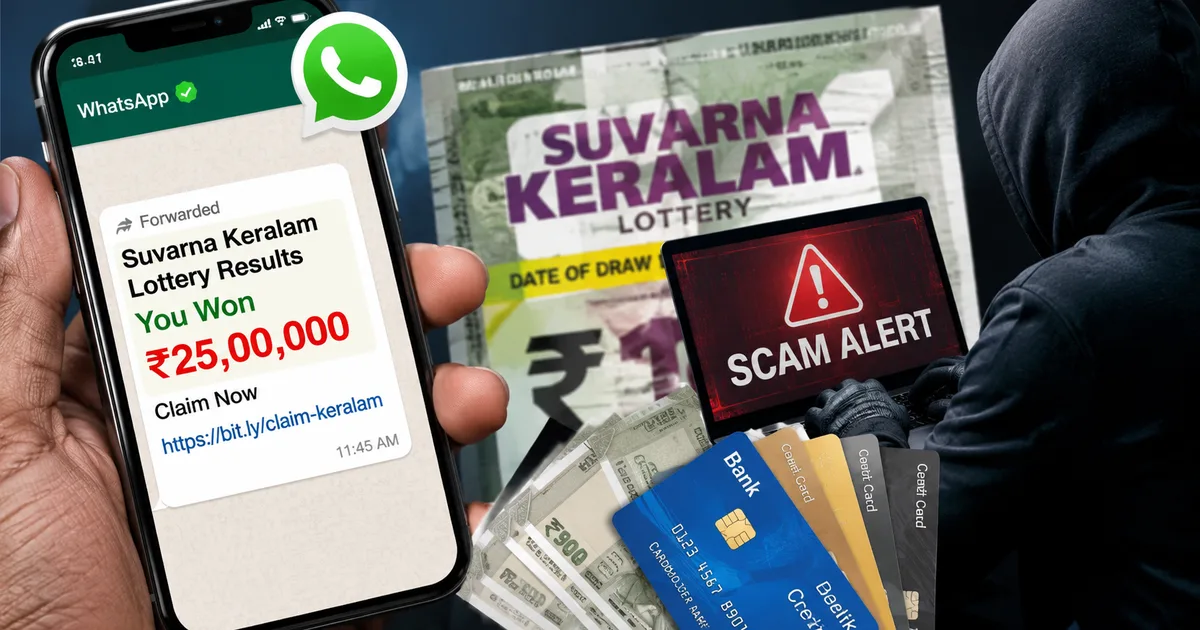
I know exactly how it happens. You're just sitting there, scrolling through your phone, drinking your evening chai, and your WhatsApp suddenly pings. It's a message claiming you've won the first prize in the Suvarna Keralam lottery. Maybe it's SK-55, or maybe SK-54, because they keep changing the numbers to match whatever real draw just happened today.
It looks incredibly official. There's a seal. Maybe a photo of a government official, and a link to claim your ₹1 crore. And for a second, just one tiny second, you think, "What if? What if this is real?"
Don't click it. Seriously, don't. This Fake Suvarna Keralam Lottery Results WhatsApp Scam 2026 is tearing through India right now. And it's draining bank accounts faster than you can say jackpot. I've seen too many people lose their hard-earned savings to this garbage. Just recently, a man in Hyderabad lost over ₹7.73 lakh to a scam exactly like this one. He thought he was paying taxes and processing fees for a massive payout. But instead, he lost everything he had saved.
And he's not alone. This isn't just a random accident. It's a highly coordinated fraud operation targeting regular Indian internet users. People from Gadag to Vashi are falling into these traps every single day. Honestly, the numbers are staggering. The financial ruin is very real. I've heard stories of families taking out personal loans just to pay the scammers' fake fees because they're convinced the ₹1 crore prize would solve all their problems. It never does.
What is the Suvarna Keralam WhatsApp scam?
Here's the deal. Scammers are piggybacking on the real Kerala State Lotteries. The Directorate of Kerala State Lotteries is a legit government operation. They run daily and weekly draws like Karunya and Suvarna Keralam. People actually win those. But the scammers know you've heard of these lotteries. So they send out millions of WhatsApp messages claiming you've won.
They aren't actually running a lottery. They just want your bank details. Or they want you to pay a processing fee or tax upfront. Sometimes they even want you to download an APK file that literally just steals every OTP your phone receives.
Honestly, it's infuriating. They target everyone from students hoping to pay off education loans to seniors looking for retirement security. They don't care who you are. They just want your money. And they have zero conscience about how they get it. They use the trusted name of the Kerala government to build instant credibility, and then they weaponize your own hope against you.
The Kerala government has even tried to warn people about this. They constantly publish notices stating that lotteries are only sold as physical paper tickets by authorized agents within the state boundaries of Kerala. There are no online ticket sales. There is no WhatsApp draw. If you're sitting in Mumbai or Hyderabad, and you didn't physically travel to Kerala to buy a ticket, you can't win. It's that simple. But these facts often get buried under the excitement of a potential windfall. Scammers rely on your lack of information. They know most people outside Kerala don't understand how the state lottery system actually works (which makes sense, actually). They use that ignorance to their advantage. They spin elaborate lies about special promotional draws or random mobile number selections.
How this scam actually works
These guys are organized. They run operations like businesses, often operating out of places like Jamtara or using proxy servers to hide their tracks. They have scripts and fake websites. They even have customer support centers. Here is exactly what happens when you get that message.
Phase 1: the bait
You get a message. Often it's an image file, basically a fake certificate with your phone number printed right on it. It says something like "Congratulations! Your mobile number won the Suvarna Keralam SK-55 lottery." They use real dates, like mentioning the June or July 2026 draws. So if you google it, you see real news articles about the draw from legitimate sources.
They often include fake audio notes too. Someone speaking in Hindi or English pretends to be a bank manager or a government official. They try to sound busy and important. Sometimes they even send fake video clips of news anchors announcing the results. These are heavily edited to make it look like they're talking about your specific phone number. It's a complete psychological manipulation from the very first second.
Phase 2: the trap
The message tells you to call a specific manager or click a link to claim your prize. If you call, a very professional-sounding person answers. They congratulate you warmly. They might even ask you to verify your identity, just to make the whole process feel more official. Then comes the catch. They tell you that to release the ₹1 crore, you need to pay a 1% registration fee or GST.
Think about it. Why would you need to pay them to give you money? But in the excitement, people don't think clearly. The scammers create a false sense of urgency. They tell you that if you don't pay within the next hour, your prize will be given to the runner-up. So you panic. You don't want to lose ₹1 crore over a measly ₹10,000 fee. You just send ₹10,000 or ₹20,000 via UPI. And that's exactly what they want. In my experience, panic is the scammer's best friend.
Phase 3: the drain
Once you pay the first fee, they've got you. They know you're willing to pay. So suddenly, there's another fee. An RBI clearance fee. An income tax advance. They keep stringing you along. The sunk cost fallacy kicks in because you've already paid ₹30,000, and you don't want to walk away now and lose everything. So you pay more. You keep paying until you run out of money or finally realize it's a scam.
And let's talk more about those APK files. This isn't just about losing a few thousand rupees anymore. The Jamtara-linked APK fraud networks are getting terrifyingly sophisticated. Gujarat police recently busted one such operation. They don't just ask for UPI transfers now. They send you an app that looks perfectly legitimate. It might even have the Kerala government logo on it. But the moment you grant it permissions, it starts quietly forwarding every single SMS you receive to a remote server. When you try to log into your real bank app, the scammers get the OTP. They bypass your two-factor authentication effortlessly. They can drain your entire savings and max out your credit cards before you even realize what's happening. The financial damage is catastrophic. This is why you must never, under any circumstances, install apps sent via WhatsApp links. Only trust the Google Play Store or Apple App Store.
Warning signs to spot the fake lottery
Look, I get it. We all want to win the lottery. The idea of sudden financial freedom is intoxicating. But you have to be smart about this. You have to protect yourself. Here are the red flags that scream scam. Keep these in mind, and you'll never fall for this trick. I'm not sure exactly why people still fall for this stuff, but they do.
- You didn't buy a physical ticket. This is the biggest one. You cannot win a Kerala lottery without actually buying a physical paper ticket in Kerala. The government doesn't just randomly pick phone numbers out of thin air. There is no such thing as an international mobile number lottery draw. If you didn't buy a ticket, you didn't win. Period.
- They ask for money upfront. Real lotteries deduct taxes from your winnings before they pay you. They never, ever ask you to send them money first via UPI, bank transfer, or crypto. If someone asks for a processing fee to release your prize, block them immediately.
- The message comes from a random number. Usually starting with +92 for Pakistan or some strange international code like +1 or +44. The Kerala government doesn't use random international numbers on WhatsApp to conduct official business.
- Bad spelling and grammar. Official government documents don't have spelling mistakes. If the certificate says Goverment of Kerala or Congratulation or uses strange phrasing, it's completely fake. Scammers often use translation tools that produce weird results.
- They want you to download an app outside the Play Store. Never install an APK file a stranger sends you on WhatsApp. Android phones give you a warning before installing these apps for a reason. Listen to the warning.
- Extreme urgency. If they say you have to claim it within 24 hours or lose it, they are lying. Real lottery winners have months to claim their prizes. The urgency is a tactic to stop you from thinking critically or asking someone for advice.
"If someone is asking you to pay money to receive money, it is a scam 100% of the time. Stop, block the number, and report it immediately."
How to protect yourself and your family
The best defense is just ignoring these messages entirely. But I know that's easier said than done, especially for older folks who might not be as tech-savvy. They grew up trusting official-looking documents. You need to have a conversation with your parents and grandparents about this today. Don't wait until it happens.
First, turn off auto-download for media in WhatsApp. Go to your settings, tap on Storage and Data, and disable media auto-download for photos and documents. Don't let these fake certificates clog up your phone in the first place.
Second, never share your Aadhaar card or bank details with anyone on WhatsApp. These scammers will ask for your KYC details to process the fake winnings. They then use your documents to open fake bank accounts for other scams, or they take out instant loans in your name. You can find more about protecting your identity in our guides on digital safety.
Third, read up on other common frauds. We constantly cover new threats in our scams section to keep you updated. Knowledge is literally power here. The more you know about how they operate, the less likely you're to become a victim. Check out our explainers on how UPI works so you understand exactly what happens when you enter your PIN.
Fourth, consider setting up a family code word. If someone claims to be you in trouble or says you won a lottery, your family members should ask for the code word to verify the situation. It sounds silly. But it works.
Where to report the Suvarna Keralam scam
If you get one of these messages, don't just delete it. Report it so the authorities can track these networks and block the numbers. Your report could save someone else from losing their life savings.
If you haven't lost money, use the Report and Block feature right inside WhatsApp. Just open the chat, tap the three dots in the top right corner, tap More, and then tap Report. This helps WhatsApp shut down the scammer's account quickly.
If you have lost money, you need to act fast. And I mean really fast. Every single minute counts when dealing with financial fraud. The faster you act, the higher the chance of recovering your funds.
- Call your bank immediately and freeze your account and UPI ID. Tell them you've been a victim of fraud.
- Call the National Cyber Crime Helpline at 1930. This is critical. They have a system to freeze the scammer's bank account if you call quickly enough. Do this before you do anything else.
- File a formal complaint on the official government portal: cybercrime.gov.in. Keep all the screenshots of the chats, the fake certificates, and the transaction IDs handy. You will need to upload these as evidence.
CERT-In, India's nodal agency for responding to computer security incidents, regularly issues advisories about these types of phishing and smishing attacks. They strongly advise against clicking on unsolicited links or downloading attachments from unknown sources. They track these operations constantly. But the scammers change their tactics every week. You can check the CERT-In website for the latest alerts.
We've seen these scams evolve from simple text messages to elaborate deepfake video calls. The technology gets better. But the core trick remains the same. They want you to act on emotion rather than logic.
So, the next time someone tells you you've won ₹1 crore from a lottery you never entered, just laugh, hit block, and go back to your chai.