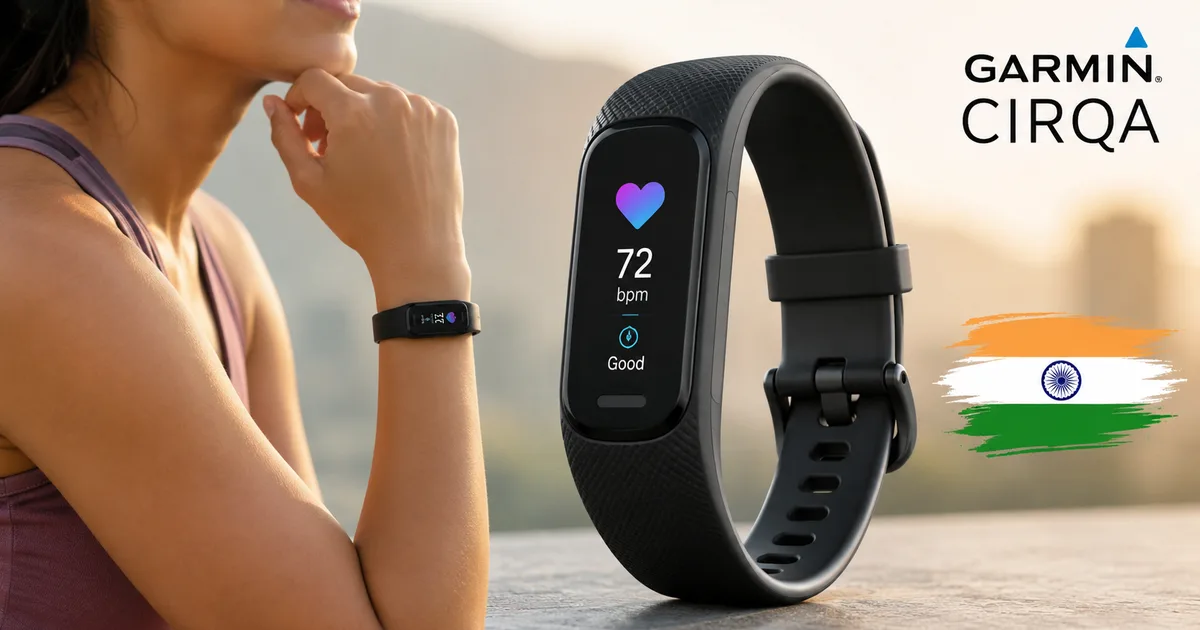
If you've been watching the fitness tracker space, you'll know it's been quietly getting interesting. Garmin just launched the Cirqa smart band, a screenless health tracker that takes direct aim at Whoop and Google's Fitbit Air. No display. No subscription fees. Just a band on your wrist doing its job around the clock. So what exactly is this thing, how does it work, and should Indian buyers care about it?
What is the Garmin Cirqa, and why does "no screen" matter?
The Cirqa is Garmin's take on a health band designed purely for data collection. There's no watch face to tap. You don't have notifications buzzing your wrist. The idea is that removing the screen makes the device lighter and way more comfortable to sleep with. And practically speaking, it has much better battery life.
Garmin says the Cirqa lasts 10 days on a single charge. That is genuinely useful. Most smartwatches are dead in a day or two. I think even serious fitness watches hover around 5-7 days. Ten days means you can just forget it's even charging most of the time.
All your data goes straight to the Garmin Connect app on your phone. You check it there. That is the trade-off. You get longer battery and a slimmer form factor, but you'll need your phone nearby to see anything.
What does it actually track?
Quite a bit, honestly. The Cirqa does 24/7 health monitoring including:
- Heart rate and heart rate variability (HRV)
- Blood oxygen levels (SpO2)
- Sleep tracking with sleep stages
- Stress monitoring
- Body battery — Garmin's own energy level score
- Step count and calorie burn
- Women's health tracking
The sleep tracking is one of the stronger features. Garmin has been doing sleep analysis for years across its fitness watches, and that experience is right here. If you're someone who genuinely wants to understand your sleep, this is the kind of data the Cirqa is built to give you. It isn't just a basic "you slept 7 hours" summary. You get actual sleep stages and recovery quality.
HRV is worth paying attention to. Heart rate variability is one of the better indicators of recovery and overall health stress. Most budget fitness bands don't track it well. Some don't track it at all. But the Cirqa has it as a central metric.
The subscription question — and why it matters for Indian buyers
Here's the thing that's actually differentiated in this market. There is no subscription required. Whoop is probably the most well-known screenless band globally. But Whoop charges a monthly fee just to use the device. You basically rent the hardware. For Indian users, that kind of model is frustrating. You pay in dollars and the conversion hurts. You just feel locked in.
Garmin's approach is buy-once, use forever. The Garmin Connect app is free. That's a meaningful difference. Look, for someone spending Rs 16,000+ on a band, paying Rs 800-1,200 a month on top just for app access is a tough sell.
This is why Garmin's positioning against Google's Fitbit Air makes sense. Fitbit's ecosystem has historically come with premium feature paywalls (annoying, I know). Garmin Connect gives you the full data picture. And they don't charge you monthly.
Garmin Cirqa India price — what to expect
The Cirqa is officially priced at $199.99 in the US. That converts to roughly Rs 16,700 at current exchange rates. But actual India retail pricing tends to add import duties and margins. So expect something closer to Rs 17,500-19,000.
As of July 2026, Garmin has listed the Cirqa on Amazon India in Black and French Gray color options in S-M sizing. I'm not sure exactly if it has officially landed in Indian stores or is still in soft availability. That is something worth confirming before you order. International listings sometimes show up before actual stock arrives.
For context, that price puts it in the same bracket as the Samsung Galaxy Watch FE and well above most Mi Band or boAt band territory. But it isn't trying to be a budget product. It's targeting the serious health-tracker user who wants long battery and clean data. They just don't want screen distractions.
How the AI health features work
"AI health features" gets thrown around a lot. So let me be specific about what's actually here.
Garmin Connect uses its algorithms to generate readiness scores and body battery levels based on your tracked data over time. The more you wear it, the better it understands your personal baseline. That isn't magic. It's pattern recognition across your sleep quality and HRV trends. But it does get more useful over weeks and months.
The Body Battery feature is one I'd particularly point to. It is Garmin's proprietary score that tells you how recovered you are at any point in the day. It factors in your sleep quality and stress to give a number from 0-100. In my experience, athletes and gym-goers find this genuinely actionable. It tells you whether today's a day to push hard or take it easy. I've seen people who were skeptical about this become borderline obsessed with it after a few weeks.
Sleep coaching is another area where the AI angle shows up concretely. Based on your patterns, the app can give you personalized suggestions on sleep timing and recovery. It is not a doctor. But for the average person trying to manage energy levels across a busy schedule, it's actually useful guidance. It helps when dealing with office deadlines and irregular hours.
Who is this for in India?
Genuinely, it is not for everyone. If you want to see notifications or check the time, the Cirqa isn't that device. A Garmin Forerunner or even a basic Apple Watch does more on the visible output side.
Basically, the Cirqa is for a specific person. It's for someone who has already accepted that their health data lives on their phone. They just want a 10-day battery without thinking about it. Athletes in recovery-focused training like this. People with sleep disorders trying to understand patterns use it too. It's also for office professionals who want passive health monitoring without a gadget demanding attention.
In India specifically, the no-subscription model helps a lot. Paying a monthly fee in dollars for a fitness tracker subscription is not something most Indian consumers want to sign up for. Garmin sidesteps that entirely.
If you've been following our explainers on wearable health tech, you'll know this screenless category has been growing. Whoop got it started. And now Garmin and Google are taking it seriously.
How it compares to the competition
The two direct competitors worth comparing:
- Whoop 5.0: Subscription-based (you don't even buy the hardware outright in most plans). Great data, huge community, but the ongoing cost adds up fast — especially for Indian buyers converting to INR monthly.
- Google Fitbit Air: Google's answer to this category. Subscription for premium features, tighter integration with Android. But Google's track record with hardware products makes some buyers nervous about long-term support.
- boAt and Noise bands: Far cheaper (Rs 1,500-4,000), but the health data quality and tracking accuracy don't compare. These are step counters with sleep estimates. The Cirqa is a different category entirely.
Garmin's advantage is the ecosystem. Garmin Connect has years of health data infrastructure behind it and a massive user community. It has the kind of data depth that casual fitness apps don't touch. If you're already a Garmin user with a watch, adding a Cirqa to your rotation for sleep tracking makes particular sense. All your data stays in one place.
A few things worth noting before buying
Thing is, the Cirqa does not have GPS. For outdoor runs or cycling with route tracking, you'd need your phone with you or a separate GPS device. This isn't a running watch. It is a health band.
There's no NFC, so no tap-to-pay from your wrist. The numbers here are a bit fuzzy on how many people actually use this. For Indian users, UPI tap payments from wearables are still fairly niche anyway. But it's worth mentioning if that's something you'd want.
Water resistance is rated to 5 ATM, so swimming is fine. Showers and rain are no problem.
And the sizing of S-M covers most wrists. But if you have a particularly large wrist, confirm the fit before buying. Comfort matters enormously with a device you're supposed to wear 24/7. That includes while sleeping.
The Garmin Cirqa is priced at $199.99 internationally and positions itself as a subscription-free alternative to Whoop and Fitbit Air, offering 10-day battery life, 24/7 health tracking, and full data access through the free Garmin Connect app.
If you want a serious health tracker that does passive, continuous monitoring without a screen demanding your attention, the Cirqa is a solid choice. Especially if you don't want to pay a subscription every month. It's one of the more coherent products in this space right now. At around Rs 17,000-19,000 for India buyers, it's not cheap. But for what it does, it's priced fairly against the alternatives.
Keep an eye on our news section for confirmed India pricing and availability updates as they come in.