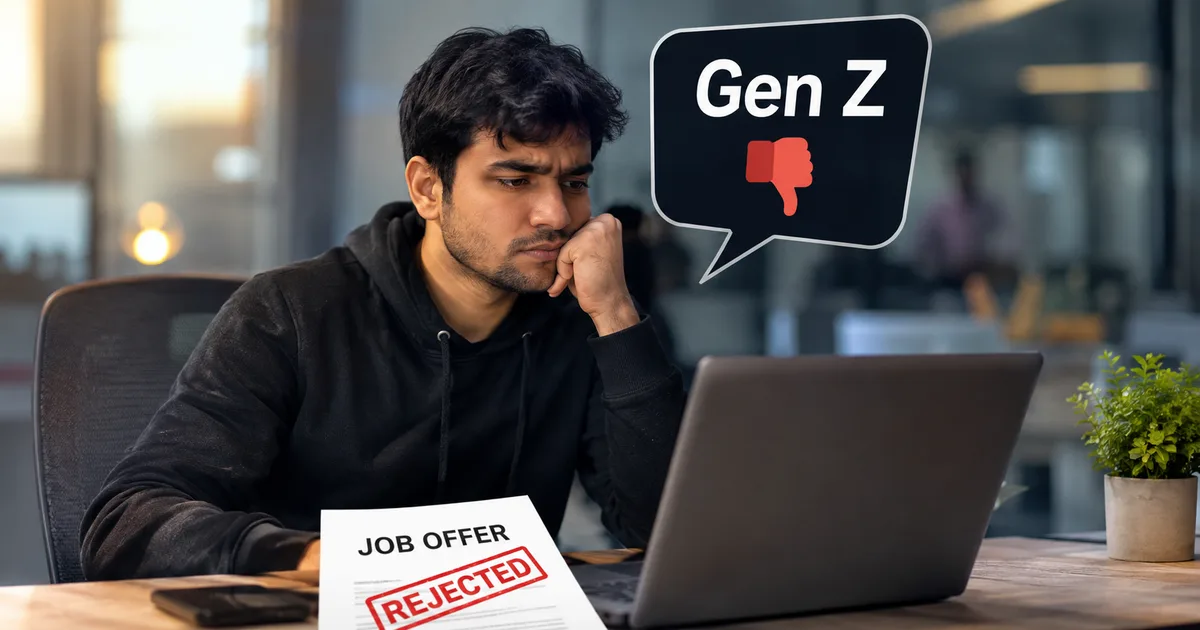
I read something this morning that genuinely surprised me. A guy just rejected a Rs 2 crore job offer right here in India. He took a $160,000 role in the US instead. If you do the math, taking purchasing power parity and taxes into account, he effectively took a massive pay cut. Why? Because he wanted work-life balance. And this isn't an isolated incident. The Gen Z Job Offer Rejection Trend 2026 is completely changing how Indian tech companies hire.
Think about that for a second. Ten years ago, an Indian engineer would have done absolutely anything for a Rs 2 crore package in Bengaluru or Gurgaon. They would've worked nights and weekends without complaining. Missed their kids growing up. Now? They're walking away. Young Indian techies look at these massive offer letters from top IT firms, see the 70-hour work week expectations, and just say no. They hand the offer back. Close their laptops. Move on to the next interview.
So what exactly is happening here? Are young people just allergic to work like some frustrated founders claim? Or is something else going on? I think it's a permanent shift in how India's youth views employment.
The "effort recession" in Indian IT
We're seeing what HR departments call an "effort recession". Honestly, the numbers back it up.
A recent report highlighted by India Today and The Indian Express shows that 63% of Indian organisations are observing a significant drop in employees putting in extra effort. Six in ten Indian firms are dealing with this exact problem right now. People come in. They do the job they're paid for, and log off. No more weekend calls. No more checking emails at 11 PM. No more sacrificing family time for a project deadline that someone else completely mismanaged.
Older managers don't know how to handle this. For decades, the Indian IT services model relied heavily on cheap labour willing to hustle endlessly. You joined a big service company like TCS or Infosys. You grinded for a promotion. You proved your loyalty by burning out. Gen Z watched their millennial older siblings go through that exact cycle. They watched them burn out, lose their hair, and get laid off the second the global market dipped.
Now, Gen Z is reacting to that trauma. They aren't lazy. They just don't believe the hustle culture promises anymore. When a manager says work hard now and you'll be rewarded later, these 23-year-olds just laugh. They know later usually means a 3% increment or a layoff notice when the stock price takes a hit.
Work-life balance over huge salaries
This is where the Naukri report on the Gen Z Work Code for 2026 gets really interesting. A full 50% of young professionals now prioritize work-life balance while evaluating job offers. Salary is important, obviously. But it's no longer the only thing that matters.
There was another viral story recently about a techie who turned down a Rs 65 lakh per annum job because the company wanted him in the office six days a week. Then there was the Gen Z candidate who said no to a Rs 1 crore offer. In the past, rejecting that kind of money would mean a serious scolding from your parents. Indian parents want stability and money for their kids. Today, the conversation at the dinner table has shifted. Parents are actually starting to understand that a high salary isn't worth a heart attack at age 35. If you ask me, that's a huge cultural shift.
Consider the reality of living in a major Indian tech hub right now. You make Rs 40 LPA in Bengaluru. You spend three hours a day stuck in traffic on the Outer Ring Road. Your rent for a basic 2BHK is astronomical. Sometimes it touches Rs 60,000 a month in a decent society (which makes sense, actually, given the demand). You have zero free time. Your physical health deteriorates because you only eat out and never exercise. What's the point of the money if you can't live a decent life? That's the exact calculation these young engineers are making.
They want flexibility. They want remote or hybrid options. They want a life outside the office. If a company can't offer that, they just reject the offer and look elsewhere. And because many of them have side hustles or freelance gigs, they aren't desperate. They have a safety net that previous generations never built.
There was a massive debate last year about moonlighting. IT giants fired thousands of employees for taking up second jobs. But here's the thing they completely misunderstood. Gen Z doesn't moonlight just to buy a nicer car. They do it to build a safety net so they don't have to tolerate a toxic boss. They are actively diversifying their income streams. When your primary employer doesn't own your entire financial future, you have the power to walk away from a bad job offer.
This generational shift is causing a mess during the interview process itself. Recruiters are shocked when 22-year-olds ask detailed questions about mental health leaves or remote work policies during the first screening call. Ten years ago, a candidate would never dare ask those questions. They would just nod, say yes to everything, and suffer in silence. Today, if a recruiter says we work hard and play hard, the candidate immediately translates that to we'll ruin your weekends. Then they drop out of the process.
The pushback: angry founders and ghosting
Obviously, the people running the companies aren't happy about this.
We see the LinkedIn posts every single week. Founders writing long essays complaining about how young people don't want to work anymore. The Economic Times ran a story about an entrepreneur who rejected a Gen Z candidate simply because the candidate ignored the job offer for two weeks. When the candidate finally returned, the founder essentially told him off publicly on social media.
I get the frustration. Ghosting a company after they offer you a job is rude. It wastes everyone's time. But it's also a two-way street. Companies have ghosted candidates for years. They string people along through six rounds of coding interviews. They make them complete a weekend assignment, and then disappear completely without even a rejection email. Now the power dynamic has shifted slightly, and employers are losing their minds.
But not all leaders agree with the complaining. Shark Tank India judge Anupam Mittal recently called the whole Gen Z is allergic to work perception Bakwas, which translates to rubbish. He gets it. Young people will work hard, but they demand respect and clear boundaries. They won't work hard for a vague promise of a bonus next year. They want clear terms. If you breach those terms, they quit. They're treating employment like a transaction, which is exactly what it is.
The mental health factor
We also have to talk about mental health. This is a massive driver behind the rejections. I'm not sure exactly why it took a pandemic to make us realize this, but here we are.
The Deloitte 2026 Gen Z and Millennial Survey shows that stress levels among young Indians remain incredibly high. The pandemic changed how people view their mortality and their time on earth. Working yourself to death for a software update just doesn't make sense to a 24-year-old anymore.
Companies that offer mental health days and strict rules about no weekend emails are winning the talent war. The startups that still expect 14-hour days are bleeding talent. They might attract desperate freshers for a year. But those freshers leave the second they get a better offer. You can't build a stable product with 60% annual attrition.
Online recruitment scams: the dark side of the hunt
Because so many young professionals are holding out for the perfect job with the perfect work-life balance, they spend a lot of time on job portals and LinkedIn. And unfortunately, scammers know this.
According to The Times of India, nearly half of young Indian professionals have nearly fallen for online recruitment scams recently. This is a massive issue right now, especially for fresh graduates who want remote work options.
How the job scam works
Here's what usually happens. You get a message on WhatsApp or Telegram. It looks like it's from a recruiter at a top firm like Google or Amazon. They offer you exactly what you want: remote work, flexible hours, and a salary of Rs 15-20 lakh for an entry-level position.
They might ask you to complete a small task to prove your skills. Usually it's liking YouTube videos or rating places on Google Maps. They even pay you Rs 150 or Rs 200 via UPI for the first task to build trust.
Then comes the catch. They ask you to upgrade your account or pay a security deposit for company equipment to continue working. They ask for money via UPI. You send Rs 5,000. Then they ask for Rs 20,000 for tax clearance. Before you know it, you've lost fifty thousand rupees. The recruiter has blocked your number. It's a sketchy setup, honestly.
How to protect yourself
- Never pay money to get a job. Real companies pay you, you don't pay them. Period.
- Check the email address carefully. A real recruiter from Infosys will email you from @infosys.com, not infosys.hr.recruitment@gmail.com or infosys-careers.in.
- Don't trust WhatsApp job offers from unknown international numbers starting with country codes like +1, +44, or +62.
- Verify the job on the company's official career page before responding to any messages.
If you do get scammed, report it immediately to the national cybercrime reporting portal at cybercrime.gov.in or call the 1930 helpline. Don't feel embarrassed. These scammers are highly sophisticated. They target smart, educated people every single day.
What this means for the Indian IT sector
The job market in India is changing completely. We're moving away from the old model of endless hustle and cheap labor.
If you're reading this and you're currently in the middle of a job hunt, I have some advice. Use this trend to your advantage. Read up on our guides for negotiating salary. But more importantly, negotiate your lifestyle. Ask about working hours during the interview. Ask to speak to current employees about the actual work culture. Ask what time people normally log off. Read between the lines. Do they brag about having a family culture? That usually means they expect you to work on Sundays (annoying, I know).
If you're an employer reading our explainers on tech trends, you need to wake up. Throwing money at the problem won't fix it anymore. You have to actually treat your employees like humans who have lives outside of your product roadmap. Offer genuine flexibility. Respect their weekends. Don't call them at 9 PM on a Friday.
Gen Z isn't breaking the Indian IT sector. They're just forcing it to grow up. And honestly, it's about time someone did. The old way of doing things was completely unsustainable. The current effort recession is just the natural consequence of years of corporate greed. The companies that adapt will survive. The ones that keep demanding 70-hour weeks will eventually run out of talent to hire.