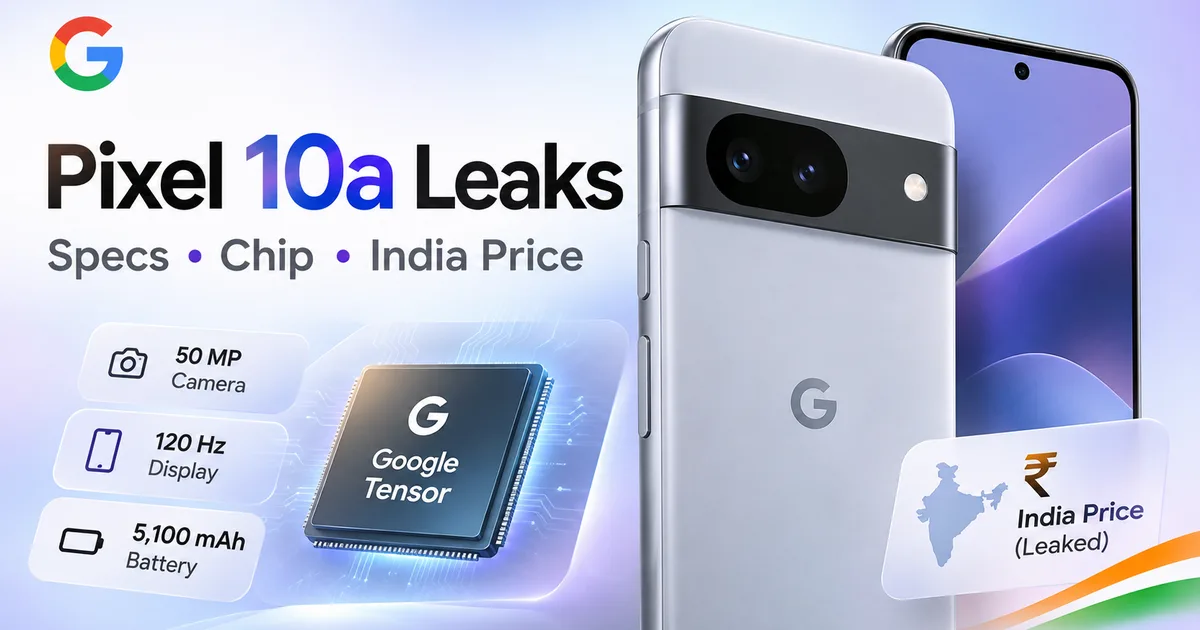
If you've followed Google's smartphone playbook in India, you know the routine by now. Every year around spring, leaks spill across European retail sites and certification databases, detailing what the next A-series phone will bring. This week, fresh regulatory filings and benchmark leaks revealed almost everything about the Google Pixel 10a. We now have a clear view of its hardware changes, screen upgrades, camera specifications, and what it might cost on Indian store shelves.
Google usually treats its A-series as a sensible compromise for people who want clean software and dependable cameras without spending eighty thousand rupees. But Indian buyers are notoriously demanding. We want fast charging, cool thermals during May heatwaves, solid battery life, and hardware that justifies every rupee. So, does the upcoming Pixel actually hit that sweet spot, or does it leave too much on the table? If you ask me, the answer isn't simple.
Expected Google Pixel 10a price in India and Flipkart offers
Let's talk money first, because that's where Google either wins or loses Indian buyers.
Retailer listings and certification filings reported by 91Mobiles and NDTV Profit suggest an expected India starting price of ₹49,999 for the base 128GB storage model. If history repeats itself, the 256GB model will land closer to ₹54,999. In India, Google sells its hardware primarily through Flipkart, alongside a gradual expansion into select offline retail partners in major metro cities like Bengaluru, Mumbai, Hyderabad, and Delhi.
Honestly, fifty thousand rupees is dangerous territory for any mid-range phone in our market. At that price point, Indian shoppers can easily pick up discounted older flagships or potent OnePlus mid-range alternatives that have faster charging bricks in the box and higher raw benchmarks. In my experience, buyers here rarely forgive slow charging at fifty grand.
Here's the deal: nobody should actually pay full sticker price on day one. Google almost always bundles launch deals to soften the initial blow (which makes sense, actually). Based on previous launches and early dealer checks, you can expect:
- Instant bank card discounts of ₹4,000 to ₹5,000 with major partners like HDFC, ICICI, and SBI cards.
- Exchange bonuses of ₹3,000 to ₹4,000 when trading in your old Android phone or iPhone.
- No-cost EMI plans stretching across six to nine months on credit cards.
With those launch offers applied, your effective checkout price drops to roughly ₹44,999. That makes the phone far more palatable for someone upgrading from an older device. But if you miss the launch window, paying full retail later feels steep.
Will the Tensor G5 chip power the Pixel 10a?
This is the biggest debate surrounding the new leaks.
Some early retailer sheets point to the Tensor G5. But the numbers here are a bit fuzzy, and supply chain reports from Taiwan suggest Google might stick with an optimized Tensor G4 to keep bill-of-materials costs under control.
Why does this matter so much to Indian users? Thermals and battery efficiency. Nothing ruins a commute like a hot phone in your pocket.
The standard Tensor G4 found in earlier phones relies on Samsung's foundry process, which historically ran warm when pushed hard under Indian conditions. Anyone who's navigated on Google Maps with mobile data active in 42-degree Delhi heat knows the dreaded dimming screen and sluggish frame drops (the Delhi heatwave experience is no joke). In contrast, the upcoming Tensor G5 transitions to TSMC's 3nm fabrication node, which brings cooler operation alongside better power draw. You can read our detailed processor explainers to understand how foundry nodes alter daily battery drain.
Retailer leaks and European certification entries indicate Google has tested prototypes with updated silicon, but whether the final retail model carries the full TSMC 3nm chip or an adjusted platform remains unconfirmed.
Look, if Google includes the TSMC-built Tensor G5, I think it'll be the single biggest reason to buy this phone. It'll mean fewer thermal throttles when you're running UPI apps or shooting 4K video during family functions. But if they ship an older Tensor G4, heavy mobile gamers should definitely look elsewhere. The Tensor line prioritizes on-device machine learning over raw graphical muscle, so hardcore BGMI players will still find competing Snapdragon chips faster.
Display and design upgrades for everyday use
Google has finally listened to one of the loudest complaints from Indian reviewers and users: screen refresh rates. About time.
The leaks reveal a 6.1-inch Actua OLED panel that has a 120Hz refresh rate. That finally replaces the sluggish 60Hz limits of older base units. Scrolling through WhatsApp chats and reading long PDFs feels noticeably smoother on a high-refresh panel. Peak brightness is reportedly rated around 2,000 nits, which should make reading text in direct afternoon sunshine far easier than on earlier generations.
Design-wise, leaked CAD renders published by Android Authority show Google is keeping its signature horizontal camera bar across the back, though with slightly flatter aluminum sides and rounded corners. The bezels look more uniform this time, so the front glass has a much cleaner look. The phone is expected to arrive in four shades: Obsidian black and Porcelain white, alongside two fresh pastel colorways.
Thing is, the in-display fingerprint sensor is once again an optical unit rather than an ultrasonic scanner (annoying, I know). In my experience, optical scanners can struggle if your thumb is sweaty during humid monsoon months or dusty after an evening commute on a two-wheeler. Face unlock will be available as a backup. It's supported by Google's Class 3 biometric security standard that allows banking authentication on Google Pay and BHIM UPI.
Camera sensors and real-world photography
Cameras are why people buy Pixels.
You don't buy a Pixel for benchmark bragging rights. You buy it because you want a dependable camera that captures clear photos of your kids or street scenes without fuss. Basically, I think Google still understands everyday photography better than most Android brands.
According to leaked hardware manifests cited by The Times of India, the Pixel 10a has a dual-camera array on the rear:
- A 64-megapixel primary sensor with optical image stabilization and an f/1.89 aperture.
- A 13-megapixel ultrawide sensor with a 120-degree field of view for landscape and group photos.
- A 13-megapixel front-facing selfie camera embedded inside a centered punch-hole cutout.
On paper, those numbers look identical to what we've seen recently, but Google relies on computational photography rather than chasing 200-megapixel sensors. Their Real Tone tuning remains exceptionally accurate for Indian skin tones. It stops the aggressive whitewashing and unnatural smoothing common on heavily skinned Android interfaces. Low-light Night Sight performance is also receiving updated algorithms to reduce noise when you're taking photos under dim Diwali string lights or indoor restaurant lamps (always a tricky lighting scenario).
Video recording caps out at 4K at 60 frames per second on the rear camera. While it won't replace a dedicated mirrorless camera, the optical and electronic stabilization makes walking vlogs or family vacation clips look steady without a gimbal.
Battery life, slow charging speeds, and Indian summer heat
Now for the uncomfortable part.
Google continues to lag behind Chinese rivals on charging convenience. Honestly, charging here is a bit of a mess.
The leak sheets point to a 4,500mAh to 4,800mAh battery pack. Paired with a more efficient display controller and Android 16 power optimizations, that capacity should comfortably last a full working day of web browsing, streaming music over Bluetooth, navigating city traffic, and scanning UPI QR codes at local stores. You won't need to hunt for a power bank by 4 PM under typical usage.
The frustration lies in charging speed. The phone reportedly tops out at roughly 20W to 27W wired charging, and it takes nearly eighty to ninety minutes for a complete zero-to-hundred fill. I'm not sure exactly why Google still caps speeds this low. Compare that to devices from Realme, OnePlus, Xiaomi, or iQOO in the same price range, which routinely charge fully in under thirty minutes with bundled 80W or 100W adapters.
To make matters worse, Google doesn't include a power adapter in the box. You get the handset, a USB Type-C to Type-C cable, safety paperwork, and a SIM tray pin. That means you'll need to spend an extra ₹1,500 to ₹2,000 on a quality USB Power Delivery wall charger if you don't already own one at home. And in my experience, that extra cost is something many first-time buyers forget to budget for.
Wireless charging is present, but it's stuck at a sluggish 7.5W to 10W rate. It's fine for an office desk or a bedside table overnight (good luck with that in peak summer heat, though), but useless if you need a quick boost before heading out to dinner.
Seven years of software updates and the final verdict
Where Google completely destroys the competition in this price segment is software support.
The company commits to seven years of software updates, including major Android operating system upgrades, security patches, system maintenance releases, and quarterly feature drops. That means a phone bought in early 2026 will receive official software updates until 2033. If you like keeping your phone for four or five years before handing it down to parents or a sibling, this alone makes it a compelling choice.
There's also zero third-party bloatware. You won't find pre-installed loan apps, sketchy games, clean-up tools, or spammy push notifications that clutter budget and mid-tier phones in India. Government digital platforms like DigiLocker and Umang run cleanly, and call screening features help block pesky telemarketing and loan spam calls that plague Indian phone numbers daily.
So, who should actually buy this phone when it arrives? If you want raw gaming performance or sixty-minute fast charging, look elsewhere. But if you value dependable point-and-shoot camera quality, long-term software security, clean daily performance, and reliable updates, the upcoming A-series looks solid. If you ask me, seven years of updates makes this the safest pick in the segment. Keep an eye on our latest mobile tech news section for the official launch date, and check our coverage of flagship Pixel 11 Pro leaks if you prefer top-tier specifications instead.