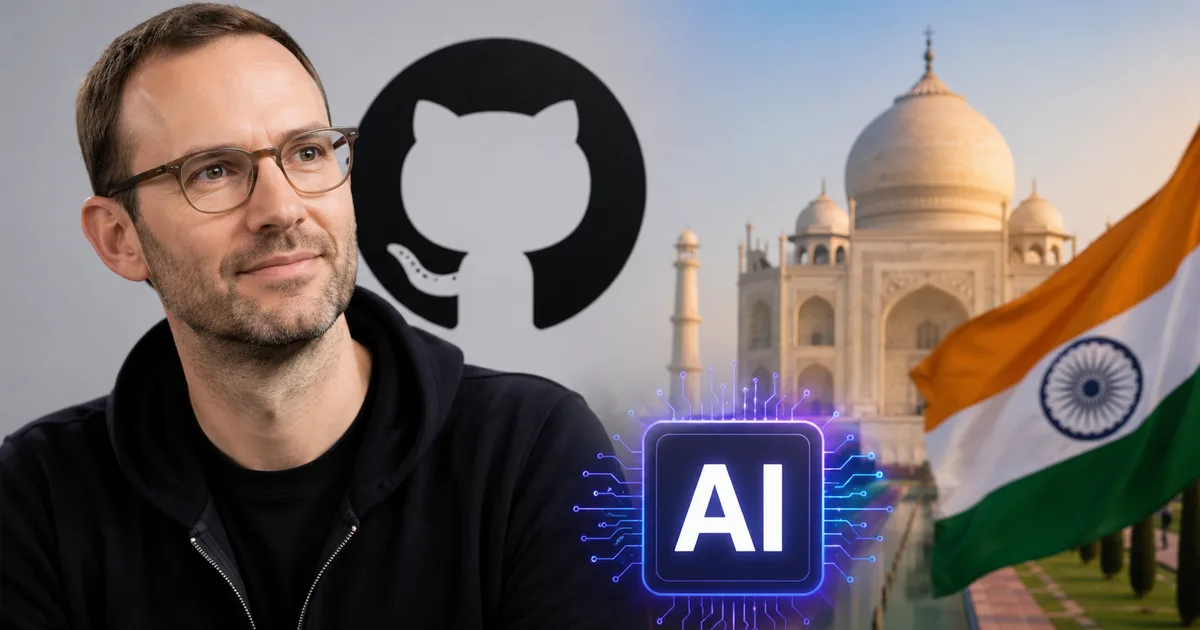
GitHub CEO Thomas Dohmke is stepping down by the end of 2026 after four years running the platform. But he isn't retiring to a beach somewhere. He's launching a $60 million startup called Entire. It's a new Git network built specifically for AI coding agents. And if you write code in India, this shift directly impacts your career trajectory.
India now has 27 million developers on GitHub. That's a huge number. We're officially the largest developer base outside the United States. So when the guy who ran the biggest code repository leaves to build something new, we should pay attention. I spent the morning reading the announcements. Here's the deal. Microsoft is folding GitHub deeper into its CoreAI division. And Dohmke saw a totally different problem to solve (which makes sense, actually). AI agents are getting smarter. They desperately need their own dedicated infrastructure.
The harsh reality of AI coding in India
You probably already use AI to write code. Maybe it's GitHub Copilot. Maybe it's Claude or ChatGPT. The exact numbers are a bit fuzzy. But almost every developer I talk to in Bengaluru or Hyderabad has an AI assistant open in their IDE all day.
Dohmke was blunt about this recently. He told software engineers to embrace AI or get out of their career.
Honestly, I agree with him. It sounds harsh. But it's the truth. Writing basic syntax isn't a premium skill companies want to pay top rupee for anymore. If you're just writing boilerplate code for a basic CRUD application or integrating Razorpay payment gateways, an AI can do that in seconds. You have to guide an AI agent to do the heavy lifting. That brings us to what Entire is trying to build.
Entire is creating a Git network that mirrors traditional GitHub repositories. But it's built from the ground up for AI coding agents. They're using something called regional cells. This is extremely interesting for Indian companies. They're stressed out about data residency and the new Digital Personal Data Protection (DPDP) Act. If your AI agents are running on a local Indian cell, your legal and compliance teams will be much happier. They won't worry about proprietary code leaving the country and sitting on a server in California.
Why Entire hired Karthik Rameshkumar
Dohmke knows India is the market he has to win. That's why Entire just appointed Karthik Rameshkumar as their Field CTO for India expansion. Rameshkumar was the former GitHub APAC Field CTO. He knows the Indian enterprise market inside out. He knows exactly how to sell developer tools to massive IT service companies like TCS and Infosys. He also knows how to sell to startups in Koramangala.
This move means Entire isn't just a Silicon Valley experiment. They're coming straight for Indian enterprise budgets. If you ask me, we'll see them pricing things aggressively in INR soon. If they want to compete with Microsoft's bundling power, they have to make it affordable for Indian tech companies to adopt at scale.
Microsoft's aggressive AI restructuring
While Dohmke is building Entire, Microsoft is making big moves of its own. They're integrating GitHub directly into their CoreAI division. This makes sense from a corporate perspective. The AI coding market is getting completely crowded. There are dozens of new developer tools launching every single week. And Microsoft wants to maintain its absolute dominance.
But this integration also means GitHub might start to feel less like an independent developer platform. It might feel more like just another Microsoft enterprise product. We already saw Julia Liuson step down after 34 years at Microsoft. The old guard is leaving. The AI restructuring is changing the DNA of the company.
This is exactly why Dohmke's move to start Entire is smart. He knows Microsoft will optimize GitHub for enterprise AI integration. But autonomous AI agents themselves need a completely new environment. They need a place to version control their work and test code safely. Entire wants to be that environment.
- Agents can pull code independently without waiting for human approval.
- They can run complex test suites and create pull requests completely autonomously.
- Governance layers are built directly into the network so the agents don't accidentally break production environments.
- Regional cells ensure data doesn't cross borders unnecessarily, keeping local regulators happy.
(I know, sounds complicated, but it's not. It just means the AI acts like an autonomous junior developer on your team. It needs its own specific workspace to do that without messing up your main codebase.)
Are junior developer jobs in India actually safe?
This is the big question everyone is asking. Every year, lakhs of engineering students graduate across India from tier-two and tier-three colleges. Most of them hope to join the big IT service companies as freshers. Dohmke argued in a recent interview that AI won't take the jobs of junior engineers as long as they adapt. He thinks new talent brings fresh perspective that AI lacks.
I'm not exactly sure about that optimistic view. Companies ultimately want efficiency and higher margins. If a cluster of AI agents running on Entire can do the routine QA testing and bug fixing work of three junior developers in a fraction of the time, why would a consulting firm hire five freshers? They'll likely hire just two who actually know how to manage the AI outputs effectively.
The job description for a fresher is changing right in front of us. It's shifting from "writing code based on specs" to "managing AI output and verifying logic."
"At GitHub, all employees have a specific non-negotiable, which is using AI."
That quote from Dohmke tells you everything you need to know about the future of work. If the biggest tech companies in the world are forcing their own employees to use AI tools, you have to do it too. If you're an engineering student right now, don't just memorize Python syntax or grind LeetCode. Learn how to prompt effectively. Learn how AI agents interact with large legacy codebases. Read our career advice guides if you need a solid starting point to reorient your learning.
Data governance is the real product here
Look, anyone can build a basic code generation tool these days using open-source models. The truly hard part is governance. Entire is explicitly focused on AI code governance. In my experience, this is a massive issue. Think about it. If an autonomous AI agent writes a subtle bug that causes a payment failure on a major UPI app like PhonePe, who is responsible? If an agent pushes code that accidentally leaks Aadhaar data to a public log file, who gets sued?
This is the exact problem Entire wants to solve with its $60 million funding. They want to give companies a safe, heavily monitored sandbox. A place where AI agents can work without causing a data breach.
This is a very big deal for Indian fintechs and healthtech startups. Indian regulations are getting stricter every year. The DPDP Act has real teeth and hefty fines. Companies will gladly pay a premium for a Git network service that promises to keep their AI agents compliant and prevents them from exposing sensitive user data. We have covered similar regulatory shifts in our detailed explainers before. And compliance is always the biggest headache for CTOs.
What this means for the open source community
There's also a question of what happens to open source. GitHub has been the undisputed home of open source for over a decade. With the platform being absorbed into Microsoft's CoreAI, some developers are naturally worried about the future. Indian developers are huge contributors to global open-source projects. Will those projects just become free training data for the next version of Copilot?
Entire isn't focusing on open source right now. They're clearly targeting enterprise AI agents. So GitHub isn't going to be replaced for your weekend side projects anytime soon. But the landscape is fracturing. We might see a future where humans write open-source code on GitHub. Meanwhile, enterprise AI agents talk to each other on networks like Entire. I think it changes the dynamic of how we share code.
What you should do next to prepare
You don't need to panic and change your entire career path today. The tech industry undergoes these massive shifts every five to seven years. This is just the latest cycle. But you absolutely do need to pay attention. You need to adjust your daily habits.
First, start using AI coding assistants immediately if you aren't already. Pay the subscription out of your own pocket if your company won't provide it. Think of it as a mandatory investment in your career survival. It costs less than a decent dinner out in Mumbai or Delhi each month (annoying, I know).
Second, keep a close eye on what Entire releases in the coming months. With their heavy focus on the Indian market and the hiring of Karthik Rameshkumar, they might offer early access or beta programs specifically for Indian developer communities. It's always a good idea to learn how to use a new platform early.
Third, stay updated on how the IT giants react to this. When TCS or Infosys announce partnerships with companies like Entire, that's your signal. The technology has hit the mainstream enterprise level. We track all these corporate shifts in our daily tech updates, so keep reading.
Basically, the era of manually typing every single line of code yourself is ending. Dohmke saw it coming. He stepped down from a massive CEO job. He left to build the next infrastructure layer. I think you should probably upgrade your skills to match that reality.