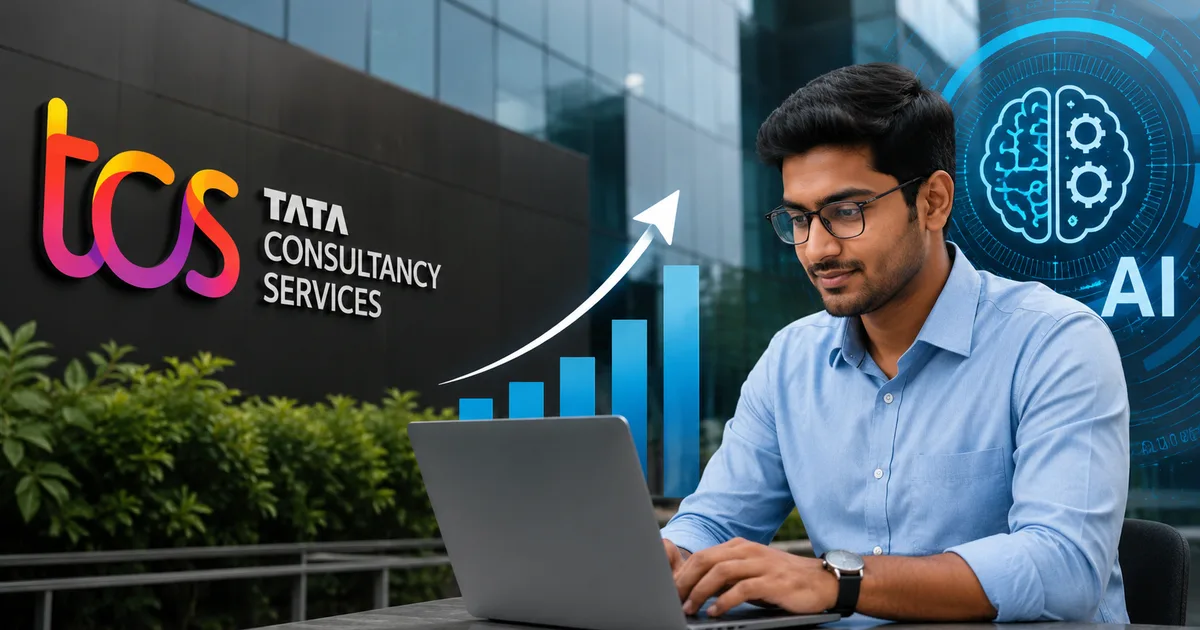
So the numbers are finally out. We've been waiting for the TCS Q1 2026 Results: GenAI Projects and Hiring Plans for Indian IT Professionals report to see exactly where the industry is heading. Honestly, if you work in the Indian IT sector right now, you need to pay attention to this.
Things are changing fast. Not in the slow, corporate way we usually see in massive service companies.
The stock fell 2% right before the results dropped, mostly because investors were getting nervous about demand recovery. But the actual financial figures are exactly what most people expected. We're looking at a 5% jump in net profit, hitting around INR 13,349 crore. Revenue is up. And they're tracking their 24% operating margin guidance perfectly. They also announced the dividend dates (annoying, I know, to wait this long). The numbers are stable on paper.
But the money isn't the real story here. The real story is what management said about the future of their workforce. I think we're seeing something completely unprecedented.
The AI Agent Revolution Inside TCS
TCS is basically setting a course to become the world's largest AI-led technology services company. They started FY27 with multiple massive AI transformation deals. They aren't testing the waters anymore. They're diving in completely.
You've probably heard about the recent layoffs. Around 20,000 jobs were cut, and that stings. But the follow-up announcement is what should really make you sit up and pay attention. TCS plans to have as many AI agents as human staff in the next three years.
Let that sink in.
They're replacing a massive chunk of manual capacity with software. This isn't some distant future scenario. It's happening today in offices across Bengaluru, Pune, Hyderabad, and Chennai. I'm not sure exactly why it's accelerating so fast, but it is.
Remember when digital transformation was the buzzword every project manager threw into presentations? That's entirely gone. Now, every client conversation starts and ends with Generative AI.
They build chat interfaces for customer support. But more importantly, they're integrating AI agents into core business processes. We're talking about supply chain optimization and HR onboarding. The scope is massive.
What This Means for Indian IT Hiring
If you're a fresher looking for a generic software engineering job, things are getting tough. The traditional model of hiring thousands of graduates and training them for six months is breaking down completely.
So who are they actually hiring right now?
- Engineers who can architect AI solutions from the ground up.
- Data specialists who understand how to clean and structure data for large language models.
- Security professionals who can audit AI outputs and ensure compliance.
- People who can manage the heavy cloud infrastructure for these massive AI deployments.
Basically, they want problem solvers. They want people who can look at a legacy business process and figure out how GenAI can make it 50% faster.
If you have these specific skills, your salary demands are probably being met. We're seeing premiums of 30% to 50% for engineers with proven, hands-on Generative AI experience. I know a developer with four years of experience who just jumped to a new role at INR 28 LPA simply because she had actual experience deploying RAG pipelines. If you ask me, that's just the beginning.
If you're stuck in legacy maintenance, you might be facing wage stagnation or worse. The gap between those who know AI and those who don't is widening every single month.
If you want to understand the broader context of this shift, you should check our latest tech news trends in India to see how other companies are reacting.
The Reality of Discretionary Spending
One interesting detail from the Q1 report is the state of discretionary technology spending. Clients in the US and Europe are still extremely cautious with their budgets. They're holding back on big, multi-year legacy modernization projects.
But they're finding budget for AI projects. Why is that?
Because AI is an immediate cost saver. If an international bank can automate 40% of its initial customer queries using a fine-tuned model, they'll find the money to fund that project. TCS is winning these deals because they can demonstrate actual return on investment.
They aren't selling futuristic promises anymore. They're selling efficiency.
Indian Regulations and Data Privacy
We have to talk about the local context here. Doing AI in India is about writing code. But it's also heavily tied to the new regulatory environment.
The DPDP Act is forcing companies to think very carefully about how they handle Indian citizens' data. When TCS builds an AI tool for a domestic bank, they can't just send all the customer data to a server in California to process a prompt. They have to keep it local.
This is creating a massive sub-industry of compliance tech. Engineers who understand how to deploy local, private LLMs on Indian servers are in incredibly high demand (which makes sense, actually). The government is pushing hard for data sovereignty. And the IT giants are having to adapt their AI strategies to fit these rules.
We're even seeing projects that integrate directly with the India Stack. Imagine an AI agent that can verify identities using Aadhaar APIs or fetch documents via DigiLocker automatically. That is the kind of stuff they're building right now. In my experience, compliance is becoming just as critical as the tech itself.
How You Need to Adapt Your Career
So what do you do with this information? Should you panic?
No. But you do need to wake up. Relying on the skills you learned five years ago is a guaranteed path to irrelevance in this market. The numbers here are a bit fuzzy, but the trend is absolute.
First, get familiar with the tools. Don't just read articles about them. Use them daily. Build something. Even a small side project using open-source models can teach you more than a dozen expensive certifications.
Second, understand the business context. AI is completely useless if it doesn't solve a real problem. The engineers who will thrive in this new environment are the ones who can speak both Python and profit margins.
You need to become someone who understands the business workflow. If you can explain to a client exactly how a specific AI implementation will save them ten hours a week, you'll never be out of a job.
If you're worried about getting caught in a sketchy fake job offer trap while looking for these new AI roles, read our detailed guide on how to spot employment scams. They're everywhere right now. And the scammers are using the AI hype to trick people.
The Bottom Line
The TCS Q1 2026 results are a clear signal. The transition period is over. We're now completely in the execution phase of the AI era in Indian IT.
The companies are ready. The clients are ready.
TCS is still investing heavily in internal training because they know they can't hire all the AI talent they need off the street. They have to build it internally. If you're already inside the company, jump on every training opportunity they offer. Take the courses. Pass the assessments.
If you're outside, you have to build your own curriculum. There are plenty of free resources out there, but you have to put in the actual time. Nobody is going to spoon-feed this to you.
And honestly, you shouldn't wait for them to try.
"The market commentary indicated a bottoming out of demand depression and gradual recovery moving ahead, with AI taking the center stage in new client conversations."
That quote from the analysts sums it up perfectly. The depression is ending, but the jobs coming back aren't the same ones that were lost.
If you want to dive deeper into how this affects specific tech stacks, you can explore our comprehensive programming guides to get started on upskilling.
The Indian IT sector has reinvented itself before. It moved from Y2K bug fixing to enterprise application development. And then to cloud computing. Now it is moving to AI agents. The industry will survive. I just wonder if your specific skill set will survive with it.