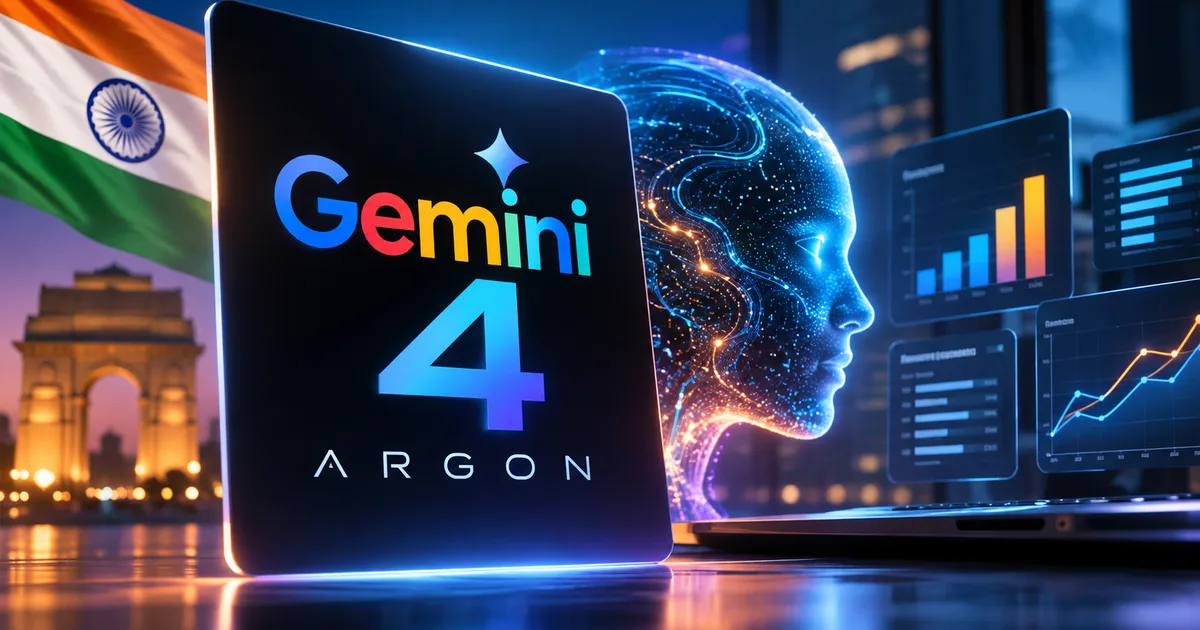
If you've been following the frontier model race this autumn, Google pulled a massive surprise on September 30 by dropping Google Gemini 4 Argon 2026 out of nowhere. Most of us in the Indian developer community expected a quiet Gemini 3.5 Pro refresh. Instead, Google scrapped that plan entirely. It skipped 3.5 and launched Argon to challenge Claude Opus 5.5 and GPT-6 Astra directly.
I spent three full evenings testing what I could get through developer channels. Honestly, if you ask me, it's one of the biggest reasoning jumps Google has pulled off since the first Gemini launched. Night and day. But it comes with caveats that matter for users here in India, especially around rollout speeds and local pricing.
If you remember our coverage of the earlier Gemini 4 release leaks, rumors suggested Google wanted a unified agent model. Well, Argon is exactly that attempt.
Under the hood: what makes Argon different from earlier models
Google calls this architecture Argon (to be fair, I'm not sure exactly why they picked noble gases this time). And no, the change isn't just cosmetic. Previous models like Gemini 1.5 Pro focused heavily on raw context window size. You could dump a million tokens of video or PDF documents into the prompt, and the model pulled out facts reliably.
Argon changes direction completely. It prioritizes autonomous problem-solving and self-reflection over raw ingestion.
When you feed Argon a challenging task, it doesn't just predict the next immediate token. It builds an internal reasoning chain, plans multiple steps, and catches mistakes before returning an answer. Google built this system specifically for tasks that take hours of human effort, like refactoring an entire repository or auditing smart contracts.
Thing is, building deep reasoning into the core architecture slows down response times. With Argon, the latency is very noticeable. If you ask a quick factual question, you'll wait several seconds while it thinks. For simple queries, that delay feels annoying (annoying, I know). But for complex system design, that extra reflection time saves hours of manual debugging.
You can find broader breakdowns of different model families in our detailed tech explainers hub. But in my experience, Argon is genuinely different because Google designed it to act like an autonomous agent instead of a passive chatbot.
Google unveiled Gemini 4 Argon as its frontier model engineered to handle long-running engineering and analytical workflows, reclaiming top benchmark positions while restricting initial availability to controlled testing tiers.
Benchmark scores: where Gemini 4 Argon pulls ahead
Tech companies love publishing benchmark charts, and Google is no exception. Still, looking past the marketing slides reveals numbers that genuinely surprise.
On SWE-bench Verified, which tests an AI model on solving real GitHub issues from popular open-source software, Gemini 4 Argon scored 58.4 percent in end-to-end task completion. For context, Claude Opus 5.5 scored near 54.8 percent on identical evaluations, while GPT-6 Astra landed at 56.1 percent. That gap might look small on paper. In practice, it means fewer broken dependencies and cleaner git commits when generating multi-file code solutions.
Autonomous software engineering and debugging
Look at coding. When I pasted a broken FastAPI project with circular dependencies and an out-of-sync Alembic migration script, previous models would fix the immediate syntax error and ignore the database constraint mismatch. Argon handled the mess properly. It traced the conflicting migration revision and rewrote the database relationships in one coordinated output. It took almost 42 seconds to finish thinking, but the code worked on the first attempt without manual patching.
Complex financial and quantitative modeling
On quantitative benchmarks, Argon solved 89.2 percent of advanced problems in the MATH-500 evaluation dataset. It also scored high on GPQA Diamond, a graduate-level scientific question benchmark designed to resist simple internet search retrieval.
Here's the deal: benchmark scores never tell the whole story. While Argon shines at rigid mathematical logic, it occasionally overcomplicates everyday writing requests. If you ask it to draft a short email to your landlord, it might produce three pages of structured legal clauses that nobody asked for. If you ask me, it's tuned for engineering rigor, not light banter.
How Gemini 4 Argon compares with Claude Opus 5.5 and GPT-6 Astra
The comparison table below outlines how these three models compare on cost and real-world capability:
| Feature | Google Gemini 4 Argon | Anthropic Claude Opus 5.5 | OpenAI GPT-6 Astra |
|---|---|---|---|
| Primary Focus | Multi-step coding and long reasoning chains | Nuanced technical writing and codebase analysis | General problem solving and multimodal voice tasks |
| SWE-bench Verified Score | 58.4% | 54.8% | 56.1% |
| API Input Cost (per 1M tokens) | Approx. $5.00 (₹420) | Approx. $11.00 (₹925) | Approx. $9.50 (₹800) |
| API Output Cost (per 1M tokens) | Approx. $18.00 (₹1,515) | Approx. $35.00 (₹2,945) | Approx. $28.00 (₹2,355) |
| India Consumer Access | Google One AI Premium rollout | Claude Pro subscription (card only) | ChatGPT Plus via international card or App Store |
| Main Limitation | Noticeable latency on short answers | Higher API pricing for startups | Occasional refusal triggers on system commands |
The pricing column in that table is where things get interesting for Indian developers. Google priced Argon API tokens at roughly half of what Anthropic charges for Claude Opus 5.5. That's a huge cut. When you run automated continuous integration pipelines with tens of thousands of tokens per run, that 50 percent savings adds up quickly.
India access and pricing for developers and consumers
Getting your hands on Argon in India depends entirely on whether you build software or subscribe as an everyday user.
For everyday users, Google plans to bundle Argon capabilities into the Google One AI Premium plan. In India, that plan officially costs ₹1,950 per month. But remember to factor in the 18 percent Goods and Services Tax, which pushes the final recurring bill to ₹2,301 per month. (I know, taxes hurt, but at least Google Play lets you pay through UPI AutoPay, Paytm wallets, local debit cards, or net banking without needing an international credit card).
If you already pay for Google One AI Premium, don't expect Argon to take over your Gemini app on Android overnight. It won't. Google is releasing it in stages. As of mid-October 2026, most Indian consumer accounts still connect to Gemini 1.5 Pro or Gemini 2.0 Flash for everyday mobile chats. Argon is appearing first in a dedicated testing toggle on the web client for select workspace users and subscribers enrolled in advanced developer previews.
For developers, the situation is much friendlier. You can access Argon through Google Cloud Vertex AI and Google AI Studio. You can see our step-by-step instructions in our Gemini 4 official release setup guide.
If you talk to founders in Bengaluru or Hyderabad, foreign card declines with overseas AI providers are a constant headache. In my experience, Google Cloud makes this way easier. Indian billing accounts accept domestic corporate credit cards and RuPay commercial cards without random declines. Plus, you get proper GST-compliant tax invoices, which saves small teams from endless accounting messes.
Step-by-step: testing the model in Google AI Studio
If you want to test Argon for your own coding or research projects right now, you can follow these straightforward steps in your browser:
- Navigate to Google AI Studio on your desktop browser and sign in using your standard Google account.
- Open the model selection drawer on the right side of the playground interface and choose Gemini 4 Argon Preview.
- Adjust the thinking budget slider based on how deeply the model should reason before answering.
- Paste your code or data prompt, then click Run to observe the step-by-step reasoning logs in the inspector pane.
Screenshot description: The Google AI Studio playground interface showing the model picker dropdown on the right panel, with Gemini 4 Argon selected alongside a custom thinking budget slider set to 16,384 tokens.
Screenshot description: The response window in Google AI Studio displaying an expandable internal reasoning trace box with timestamps, followed by generated Python code and dependency explanations.
If you want to discover alternative models or compare free options, check out our curated AI tools directory.
The practical verdict for Indian users
Should you rush out and spend ₹2,301 a month for Gemini 4 Argon right now? Honestly, no. Not if you just want an AI assistant to draft WhatsApp replies or translate text between Hindi and English. Cheaper or free models handle those everyday tasks quickly without making you wait through an extensive thinking cycle.
But if you're a freelance developer or an engineering student working on your final-year capstone, Argon is a genuine powerhouse. The SWE-bench scores are legit. And the API pricing makes it an easy recommendation over Claude Opus 5.5 for heavy technical workloads. Google took its time with this release, but it built something with real substance.