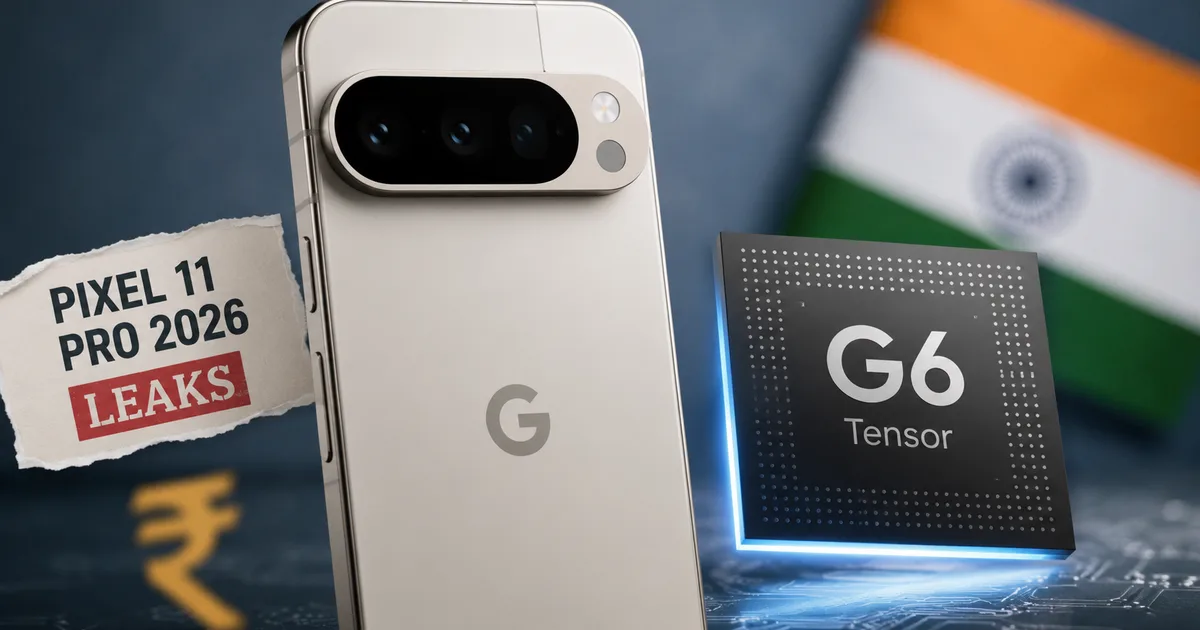
I've been tracking smartphone launches for years, and honestly, the hype cycle is getting predictable. But looking closely at the Google Pixel 11 Pro 2026 leaks, there's actually something worth talking about this time. We're just weeks away from Google's scheduled August 12 event. The leaks have basically spoiled the entire presentation. So I want to break down exactly what we know about the new Tensor G6 chip and the upcoming AI features. Oh, and most importantly, what this is gonna cost when it lands in India.
Google has a habit of failing to keep secrets. And this year is no different. The renders are out, and the specs are already floating around on Twitter and Reddit. Even the new colorways are practically public knowledge. In my experience, raw specs don't tell you if a phone is actually worth buying (annoying, I know). Especially when you're paying a massive premium in the Indian market. Buying a flagship in India is a major financial decision. You really need to know exactly what you're getting into before you buy.
The August 12 event and the Pixel 11 lineup
Google usually waits until October to drop new hardware. Moving the launch to August 12 is a deliberate choice. They clearly want to get ahead of the iPhone 16 announcement in September. It's a smart move. Because when Apple announces a phone, it sucks all the attention out of the room for a solid month. By going early, Google gets a clear runway to make their pitch.
Based on the latest leaks, we're looking at a full lineup. There's the standard Pixel 11 and the Pixel 11 Pro. We're also getting a Pixel 11 Pro Fold. I'm focusing mostly on the Pro model today. That's usually the sweet spot for people who actually care about smartphone cameras and long-term performance.
Thing is, the Pro model is where Google puts its best tech. The standard model often gets stripped-down hardware. Think slower charging or missing camera lenses. The Fold is still an experimental luxury item for most people. So if you're gonna drop a significant chunk of your salary on a phone, the Pro is generally the safest bet for longevity.
Breaking down the Tensor G6 chip
The processor is the brains of this whole operation. Historically, Google's Tensor chips have run really hot. They chew through battery life. And they struggle with thermal throttling when you push them hard. If you've ever tried recording a 4K video outdoors in Delhi during May, you know exactly what I'm talking about. The phone gets dangerously warm, and the camera app eventually just shuts down to protect the hardware.
But the leaks say something different this year. Google is apparently focusing entirely on efficiency rather than raw benchmark numbers. Honestly, I think that's the right call.
- It uses a newer, more efficient manufacturing process that should reduce heat output significantly during daily tasks.
- The modem is supposedly upgraded to a new MediaTek unit, which might finally fix the dropped signal issues people have complained about since the Pixel 6 days.
- The on-device AI processing unit is faster, handling more tasks locally rather than sending your data to a cloud server.
- Background battery drain, a notorious issue on older Pixels, is expected to see major improvements.
I really don't care if the Tensor G6 can beat a top-tier Snapdragon in a synthetic benchmark test. Most people don't care about Geekbench scores anyway. What actually matters is whether the phone survives a full day of scrolling Instagram and navigating through Bengaluru traffic on Google Maps. Throw in scanning QR codes at the local kirana store, too. If this chip runs cooler and holds a reliable 5G connection better on Jio and Airtel networks, it's a massive win for everyday users.
AI features: Gimmick or actually useful?
You can't buy a phone in 2026 without hearing about artificial intelligence. The Pixel 11 Pro is gonna be packed with Gemini integrations. Some of it will be useful. But a lot of it will be marketing fluff that you use once to show your friends and then never touch again (which makes sense, actually).
We know Google is pushing hard on photo and video editing. The Magic Eraser is getting an upgrade. It looks like it will move beyond just removing people in the background. It might completely alter the context of an image. There are rumors of a new feature that can completely reconstruct lighting in a badly lit photo. That sounds great for taking pictures at dimly lit weddings. Or those indoor family functions where the lighting is always terrible.
"The shift towards on-device AI processing is the only way these features become truly useful without eating up your monthly data allowance and draining your battery."
The India-specific reality check is important here. A lot of Google's best AI features rely on understanding context and local accents. If the new live translation or voice transcription features don't understand Indian English and Hindi accurately, they are effectively useless to us. The numbers here are a bit fuzzy, but recent updates to Gemini have been better at recognizing mixed language use like Hinglish. So I'm cautiously optimistic. We'll just have to test it in the real world.
One thing I'm really looking forward to is better automated call screening. Spam calls are an absolute nightmare right now. Every single day I get calls offering me a personal loan I didn't ask for. Or pitching real estate plots in cities I don't even live in. If the Pixel 11 Pro's AI can intercept those reliably and transcribe the caller's intent before I pick up the phone, that feature alone might justify buying the device.
Design choices and the rumored Pixel Glow
The leaked renders from 91mobiles and other outlets show a phone that looks distinctly like a Pixel. But it has some welcome refinement. The massive camera bar is still there, and it looks a bit more integrated into the metal frame. We're expecting some new colorways. They are dropping the pastels of previous years for more muted, professional tones.
The leaks mention a Pixel Glow feature. This sounds like some kind of notification light or ambient display element on the back of the phone. Honestly, a rear notification light is a throwback to the old Blackberry days. I kind of love the idea. When your phone is face down on a desk during a meeting, having a subtle, customizable light tell you if you just got a WhatsApp message from your boss is genuinely helpful. Or if it's just a useless promotional email.
The materials are likely sticking to the premium glass and metal sandwich we're used to. I just really hope they give it a matte frosted finish on the back glass. Because glossy phones in a hot, humid Indian summer are a nightmare to keep clean. They get covered in fingerprint smudges instantly. You end up putting a cheap TPU case on it immediately anyway. Which completely defeats the purpose of buying a premium-looking design.
The camera system upgrades
Pixels are known for their cameras. It's the main reason people buy them instead of a OnePlus or an iQOO. The leaks point to a triple camera setup on the Pro. That's pretty standard. We're expecting a 50MP main sensor and an upgraded ultrawide. Oh, and a periscope telephoto lens is in there too.
The hardware upgrades are nice. But Google's secret weapon has always been computational photography. The Tensor G6 will supposedly allow for better edge detection in portrait mode. It also means significantly faster processing times when shooting in low light. If you've ever taken a Night Sight photo and had to hold your hands perfectly still for three seconds while the phone processes the image, you'll appreciate a faster chip.
Video recording is where Google still lags behind Apple. The iPhone handles video stabilization and noise reduction far better than any Android phone on the market. It wins on dynamic range, too. The Pixel 11 Pro leaks suggest a major overhaul to the video processing pipeline. We'll see if it actually bridges the gap.
Expected India price: Brace your wallets
Pricing is always the hardest part to swallow. I'm not sure exactly why Google has never priced its phones aggressively in India, but the Pixel 11 Pro is gonna hurt your wallet. The exact pricing won't be announced until August 12. But we can make an educated guess based on current import duties and previous launch prices.
The Pixel 10 Pro launched at a massive premium over its US price tag. Even with some minor recent adjustments in electronics import taxes by the government, you should brace yourself. I expect the base model of the Pixel 11 Pro to easily cross the ₹1,00,000 mark. It could realistically launch around ₹1,05,000 to ₹1,15,000. That depends on the storage options you choose, of course.
That puts it in direct competition with the Apple iPhone 15 Pro and the Samsung Galaxy S25 series. This is a brutal segment of the market. For a lot of Indian buyers, spending that much money on a smartphone means they want the unquestioned social status of an iPhone. Or they want the perceived long-term reliability of a Samsung device. Google has to prove that the camera superiority and clean software experience are actually worth the premium.
You also have to consider resale value. Pixels drop in value on the secondhand market much faster than iPhones. If you buy a Pixel 11 Pro for over a lakh, you have to accept that you'll take a massive financial hit if you try to sell it on Cashify or OLX two years down the line. iPhones hold their value. Androids rarely do.
The after-sales service problem
Basically, we can't talk about buying a premium phone in India without mentioning after-sales service. If you drop your iPhone and crack the screen, you can find an authorized Apple service provider in almost any tier-1 or tier-2 city. Samsung's service network is legendary. They have a repair center in almost every major neighborhood.
Google's service network in India has historically been outsourced. And frankly, it's sketchy to deal with. If your Pixel has a hardware defect, getting it repaired often involves shipping the phone to a central facility. Then you wait weeks for it to return. When you're paying over a lakh for a device, being without a phone for two weeks is a mess. If Google wants to seriously compete in this price bracket, they need to fix their service infrastructure in India. You can check our guide on navigating warranty claims if you want to know what dealing with smartphone repairs is actually like.
Is the Pixel 11 Pro worth the upgrade?
If you're holding onto a Pixel 7 or an older OnePlus device, the jump to the Pixel 11 Pro will feel substantial. Same goes for any mid-range phone from three years ago. The display will be brighter in direct sunlight. The cameras will take noticeably better photos, and you'll get Google's promised seven years of software updates. That longevity really matters if you plan to keep the phone until 2033.
But what if you bought a flagship phone in the last two years? Honestly, you should probably just sit this one out. The improvements in smartphone technology are strictly incremental right now. A slightly better processor and a few new AI software tricks don't justify dropping a lakh on a brand new device.
We need to see how the Tensor G6 actually performs in daily use. We need to see if the battery can comfortably survive a heavy day of Google Maps navigation and Uber rides. Toss in continuous UPI payments, too. We also need to see if the historical thermal issues are finally fixed. I'll be watching the August 12 event closely. We'll have a full breakdown of the confirmed specs once Google makes it official. Until then, keep your credit card in your wallet and read up on how these tech companies collect your data.
There are also consistent rumors about a cheaper Pixel 11a coming early next year. For most of my friends who ask for phone recommendations, the A-series is usually what I suggest. It gives you around 90% of the flagship experience for roughly 60% of the price. If you're on a tight budget but really want that top-tier Pixel camera performance, waiting six months for the 11a might be the smartest financial decision you can make.
Watch out for the pre-order bundle offers. Brands always bundle expensive earbuds or a smartwatch to soften the blow of a high launch price. If Google throws in a pair of decent Pro earbuds, the math starts to look a little bit better.
Never buy a phone just for the freebies.
Look, the smartphone market is mostly stagnant. Companies are pushing AI software features hard because hardware innovation has basically slowed to a crawl. You don't need a new phone every year. You probably don't need one every two years. Make your current device last. Replace the battery for a few thousand rupees if it's degrading. Delete some old WhatsApp forwards to clear up your storage space. But if your phone is truly dying and you have the budget ready, the Pixel 11 Pro might just be the one to get.