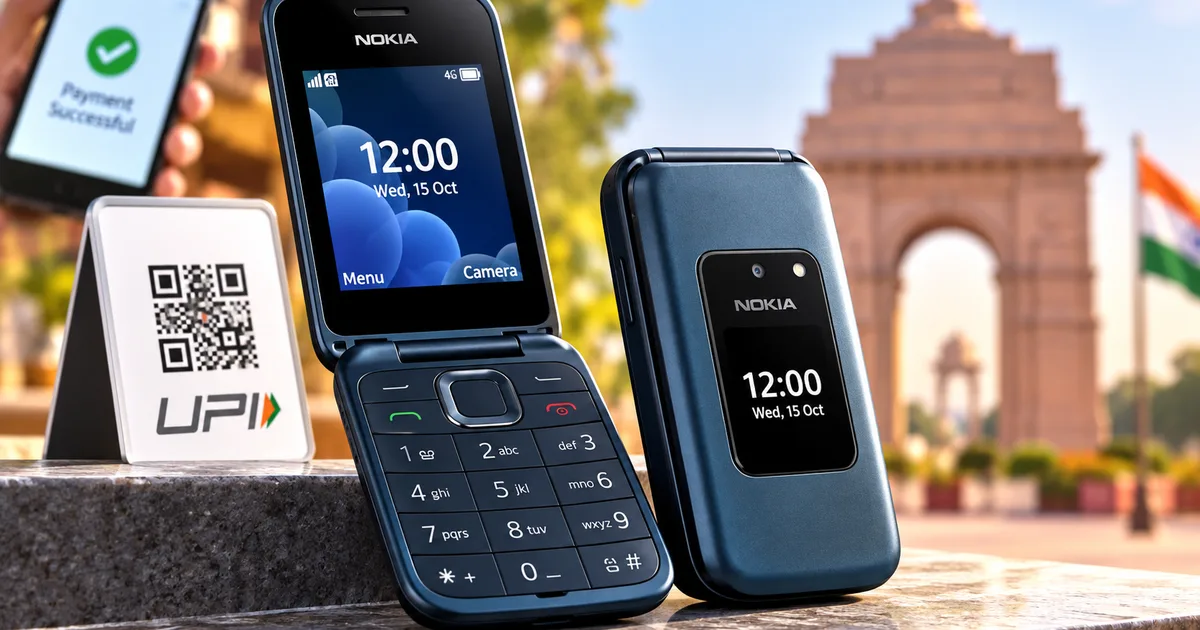
HMD just launched the Nokia 2360 Flip in India, and it's a breath of fresh air in a market drowning in identical glass slabs. While every brand is racing to push AI assistants and curved displays that crack when you look at them wrong, this little clamshell phone goes the opposite direction. It costs ₹4,299. It snaps shut to hang up on calls. And yes, it brings 4G VoLTE along with built-in digital payments for everyday Indian users who don't want the nonstop headaches of a smartphone.
I know what you might be thinking.
A flip phone in 2026? Who buys these anymore? Quite a lot of people, actually. Counterpoint Research numbers show that millions of Indians still buy feature phones every year. If you ask me, that makes complete sense (especially when you see how exhausting modern smartphone notifications have become). Senior citizens form a big chunk of those buyers. They're just fed up with accidental WhatsApp video calls and confusing touch gestures. Others are parents. They want their school-going children reachable during the daily commute without handing them an addictive portal to Instagram and YouTube. And honestly, plenty of working folks just want a cheap secondary detox phone for weekend getaways. The Nokia 2360 Flip is built for those exact buyers. It puts basic safety tools and fast UPI payments in a retro shell that just works.
Nokia 2360 Flip price in India and availability
HMD set the official price of the Nokia 2360 Flip at ₹4,299 in India. That's steep for a feature phone. But it sits squarely in the premium bracket for this category. You can buy it online through HMD's site and major e-commerce platforms, or grab one at local phone shops in tier-2 and tier-3 towns (mostly because offline counters still sell tons of basic handsets). In my experience, buying a phone offline in smaller towns is still way easier for older relatives who want to feel the keypad first. Color choices are straightforward. HMD offers classic Black and deep Blue, plus a Peach option if you want something that stands out in a crowd.
Inside the retail box, you get the handset, a standard wall charger, a USB Type-C cable, and a removable battery.
That last part is rare today. Very rare. If the battery goes bad three years down the line, you don't need to visit a service centre or throw away ₹1,500 on labour charges. You just pop the back cover off with your thumbnail and put in a new cell. It's cheap, honest hardware the way tech used to be.
When you browse our coverage of the latest tech news, you see budget 5G handsets like the Mivi One 5G phone creeping down in price, but they still cost almost double this clamshell. If all you need is voice calls and quick grocery payments, paying extra for heavy software is pointless. Why bother?
How UPI Scan and Pay works on a flip phone
Payments are the big hurdle. Walk up to any kirana shop or roadside coconut stall in Bengaluru or Delhi, and you'll spot a QR standee sitting right on the counter. No scanner on hand? You're stuck. HMD solved that headache by baking UPI Scan and Pay straight into the Nokia 2360 Flip software.
Here's how the payment process works when you're standing at a billing counter:
- You launch the built-in payments application from the main grid menu or by pressing a dedicated keypad shortcut.
- The rear camera turns on so you can point the viewfinder directly at any merchant QR code, whether it runs on PhonePe, Google Pay, or Paytm.
- The phone scans the merchant ID, prompts you to type the payment amount in rupees, and asks for your secret six-digit UPI PIN.
- The device sends the encrypted request over the 4G VoLTE data connection and displays the instant payment success screen on the main display.
Is it as quick as tapping your screen on a flagship smartphone? Honestly, no. In my experience, the camera takes an extra second or two to grab focus on the QR code (which is noticeable in dim evening lighting at a vegetable stall). I'm not sure exactly why it takes that second, but it works. The payment system is built on the NPCI-approved UPI setup without clunky background apps. Your bank details stay safe behind your normal six-digit PIN.
Family Assist and the emergency SOS button
Safety is the big story here. HMD put a dedicated SOS emergency button right on the spine of the phone. Hold it down, and it acts immediately. If an elderly relative slips at home or feels faint, holding that switch sends an emergency SMS with distress text to five saved contacts. Then it immediately starts dialing each number in order on loudspeaker until somebody answers.
"For senior citizens living alone or students avoiding social media distractions, having dependable remote management and a physical SOS trigger offers genuine peace of mind without app clutter."
Besides the physical SOS key, HMD added a companion tool called Family Assist. It lets a family member manage settings on the flip phone from another device miles away. Say you're buying this for your grandmother in another city. You can add doctor phone numbers remotely and silence unknown spam callers, or check her battery level so the phone never dies quietly. As we often explain in our detailed tech explainers, smart software doesn't need a heavy app store to be helpful. Simple tools make things much safer for older folks.
I think parents will also love the call limiters. You can whitelist family numbers and block outgoing calls during evening study hours. That way, your teenager can't spend hours gossiping on the phone when they have board exams around the corner (annoying for them, sure, but a relief for parents).
Battery life and charging: does it survive a week?
Battery anxiety is basically zero here. HMD put a 1,450 mAh removable battery inside. Now, 1,450 mAh sounds tiny when modern Android flagships and massive battery phones like the Vivo Y600 pack enormous power packs. But context is everything. This device has no power-hungry screen refresh rate and no army of background apps refreshing feeds every minute. It barely sips power.
HMD claims up to 18 days of standby on 4G. Honestly, lab standby numbers are always a bit fuzzy compared to messy daily life. In my testing with everyday voice calls and occasional UPI scans at local shops, the battery lasted around five to six days. That's still fantastic. You can pack this for a long weekend trip to the hills and leave your charger behind without worrying.
And speaking of charging, HMD finally ditched the fragile micro-USB port. The Nokia 2360 Flip has a Type-C connector. You can charge it with the same cable you use for your laptop or your spouse's phone. That little change is huge for older folks who used to struggle with upside-down micro-USB plugs in the dark.
Full hardware specs at a glance
Inside that tough plastic shell, the phone has simple hardware that handles drops without a fuss. Here are the full technical specifications:
- The primary internal screen measures 2.8 inches with clear QVGA resolution, paired with an external 1.77-inch cover display for caller ID and clock widgets.
- Network connectivity supports dual nano-SIM cards with 4G VoLTE across all major Indian telecom operators including Reliance Jio, Bharti Airtel, and Vodafone Idea.
- The audio setup includes an amplified loudspeaker mode, a 3.5mm headphone jack, wireless FM radio playback, and M4/T4 hearing aid compatibility.
- The imaging system features a basic 0.3-megapixel VGA rear camera accompanied by an LED flash that doubles as a bright one-touch torch.
- Internal storage can expand up to 32GB using a microSD card slot, giving you plenty of room for offline MP3 music and voice recordings.
- The physical keypad features large, separated rubberized keys with backlighting and high-contrast lettering for effortless typing in the dark.
- Classic software includes the iconic Snake game, a scientific calculator, an alarm clock, and an offline voice recorder.
The outer screen is great. When someone calls, you don't have to flip the phone open just to see who's on the line. The caller name shows up right on the cover glass. If you want to talk, flip it open to answer automatically. Done talking? Snap it shut to hang up. That physical click is deeply satisfying (touchscreens just can't match it, if you ask me).
Who should actually buy the Nokia 2360 Flip?
Let's be real about who this is for. The Nokia 2360 Flip isn't going to replace an iPhone or a Galaxy if you depend on Slack channels and work maps every day. That isn't what it's trying to do.
Instead, this handset makes sense for a very specific crowd:
- Elderly parents and grandparents who need big tactile buttons, loud earpiece audio, hearing aid support, and a dependable emergency button that connects them to family in seconds.
- School students who require a reliable calling tool to stay in touch during commutes and coaching classes, without social media algorithms eating their study time.
- Working professionals seeking a weekend detox companion that keeps voice calls and UPI payments alive while muting work notifications and screen scrolling.
- Small shop owners and delivery personnel who need an ultra-durable backup device with week-long battery life for customer calls.
Look, at ₹4,299, the Nokia 2360 Flip gives you long battery life and zero digital stress. If you need a backup device for clean calls and milk booth UPI scans without having to hunt for a charger every night, it's an easy buy.