So, we finally have the details. After months of rumors and leaked screenshots, Demis Hassabis just got on stage at the India AI Impact Summit 2026 and dropped the hammer. He gave us the complete rundown on the Google Project Astra AI Tool: 2026 India Launch and Features Explained straight from the source. And honestly, it's a lot to process.
I watched the entire presentation. I took notes. Then I just ignored my chai until it got cold while I tried to wrap my head around the announcement. Look, Google has promised a truly smart digital assistant for years. Assistant was okay. Gemini felt like a rushed response to OpenAI. But Astra? This actually feels different. It sees what you see. It also hears everything you hear. And it processes all of that locally and in the cloud at the exact same time.
I want to break down exactly what this means for you. Because whether you run a small business in Pune or you're a student trying to debug Python code in Chennai, this matters.
What exactly is Project Astra?
Let me explain this simply. You know how you currently use AI? You type a prompt and you wait. Then you get text back. Sometimes you might upload a photo and ask a complicated question to get some help, but it always comes back to the same thing. It is a very turn-based process.
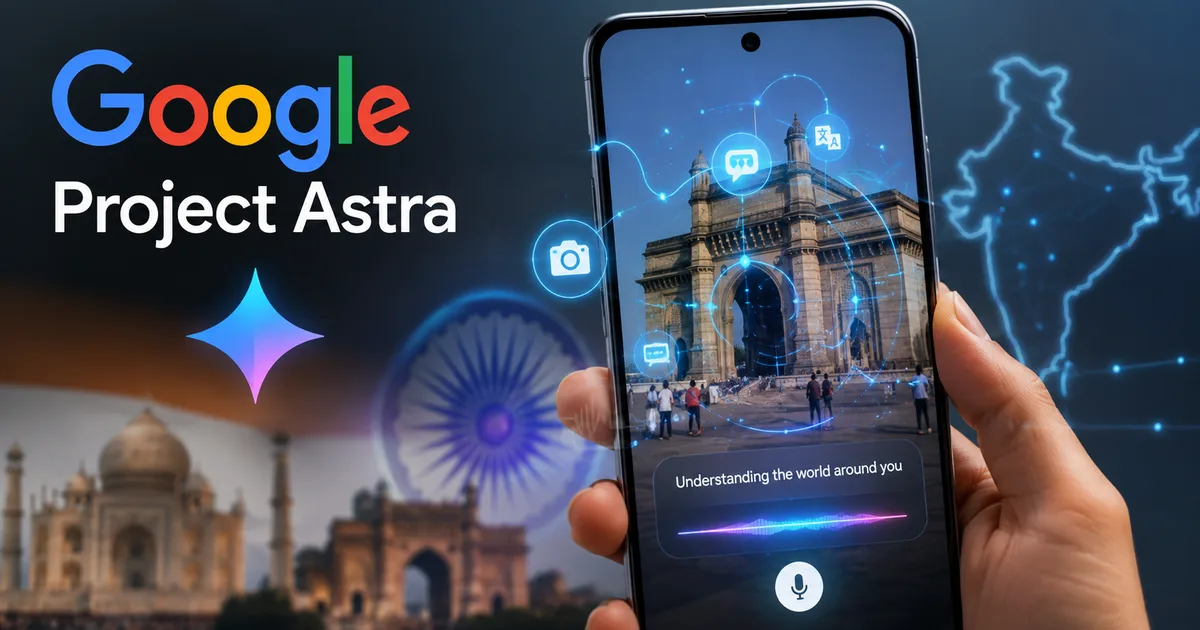
Project Astra kills the turn-based system. It's Google's direct multimodal answer to the new ChatGPT. It runs in real-time. You open your camera and point it at something. Then you just start talking.
"We are moving from chatbots that you type to, to digital agents that work alongside you in the real world," Hassabis said during his keynote. "And India is going to be the absolute powerhouse for this adoption."
He's right about the adoption part. We rely on our phones for everything. We use them for scanning UPI QR codes at the local kirana store and holding all our official documents in DigiLocker. If an AI can actually understand that context, it changes everything.
But how does it actually work? Basically, it keeps a rolling short-term memory of what it sees through your phone's camera and hears through your microphone. You can point it at a broken ceiling fan and ask "what's wrong with this?". Then you can pan away to look at your toolbox and ask "do I have the right tools to fix it?". And it actually remembers the fan. It's wildly impressive in demos (we'll have to see how it handles a patchy 4G connection on a moving train, though).
The Samsung Galaxy S25 monopoly
Here's the catch. You aren't getting this on your old Redmi phone anytime soon. The hardware requirements are massive. Processing live video and audio requires serious silicon. I think most people don't realize this yet.
Google confirmed that the upcoming Samsung Galaxy S25 series will be the first phones to have Google's Project Astra AI tech built natively into the operating system. If you read our news coverage of the recent smartphone leaks, you already know the S25 has a custom neural processing unit designed specifically for this.
If you have an older phone, you'll probably get a watered-down version inside the Google app. It'll have latency. It'll probably drain your battery in forty minutes (annoying, I know). If you want the real experience, you're going to pay flagship phone prices.
Top Astra features useful for Indian users
I hate it when tech companies announce features that only work in San Francisco. Thankfully, Google learned their lesson. Hassabis outlined several features coming in the 2026 India launch that actually make sense for our daily lives. In my experience, these localized tools are the only ones that actually matter.
Instant multilingual translation for documents
You get a property document in Marathi, but you only read English. Right now, you take a photo. You open Google Translate. You upload it and get a messy overlay. With Astra, you just point your phone camera at the paper. You ask, "Summarize the penalty clauses in this contract in English." It reads the regional text and speaks the summary back to you. They claim support for Hindi, Tamil, Telugu, and Marathi at launch.
The coding and freelancer assistant
If you're an independent developer or a freelancer, this might justify a phone upgrade. You can point your camera at two different screens showing your frontend and backend code. You can literally ask, "Why isn't this API call returning the user data?" Astra reads the code across both screens. It understands the architecture and highlights the exact line you missed. It's basically pair programming on steroids.
Homework and exam prep
I feel bad for the Indian EdTech companies right now. Students can point Astra at a complex physics diagram in their NCERT textbook and say, "I don't understand the friction calculation here." Astra doesn't just give the answer. It draws virtual overlays on your screen. It points to the diagram and explains the concept step-by-step using Indian curriculum standards. It's a private tutor in your pocket. The numbers here are a bit fuzzy, but they claim massive improvements in student comprehension.
The cost: free tier vs. paid subscription
Nobody gives away this much compute power for free. While the basic features will come bundled with new Android devices, the heavy lifting requires a subscription. I put together a quick comparison based on the leaked pricing tiers.
| Feature | Astra Basic (Free) | Google One AI Premium (₹1,950/month) |
|---|---|---|
| Real-time Video Processing | Limited to 5 minutes per session | Unlimited |
| Code Debugging | Basic syntax errors | Full repository context |
| DigiLocker Integration | View only | Auto-fill forms and applications |
| Cloud Storage | 15 GB standard | 2 TB included |
| Priority Server Access | No (High latency during peak hours) | Yes (Low latency) |
Is the premium tier worth nearly two thousand rupees a month? If you're a student, absolutely not. Stick to the free version. But if you're a freelancer charging hourly rates for coding or design, you'll easily make that money back in saved time. Check out our productivity guides if you want to see how to justify these costs for a small business.
How to setup Project Astra (when it arrives)
Google showed a brief preview of the onboarding process. It looks simple enough, but you need to be careful with permissions. You're giving an AI access to everything your phone sees.
- First, you download the update. You'll need Android 16 or the specific Astra system update if you're on a supported Samsung device.
- Second, you register your voice print. It needs to recognize your specific voice so someone else can't grab your phone and start giving it commands. You'll read a few sentences in English or Hindi to calibrate it.
- Third, you approve app integrations. This is the big one. It'll ask for access to your files and WhatsApp. I strongly recommend denying it access to your banking apps. It doesn't need to read your UPI transaction SMS alerts.
- Finally, you run the camera test. The app will ask you to pan around your room to build a local spatial map. This helps it understand depth and object permanence.
Impact on Indian startups
There's a massive elephant in the room that nobody talked about at the summit. What happens to the hundreds of Indian AI startups building wrapper apps on top of OpenAI or Claude? If Google builds native and fast AI directly into Android, why would anyone download a separate app for document scanning or homework help?
Companies that raised millions last year building basic chatbots are in serious trouble. Hassabis basically announced the extinction event for simple wrapper startups. Unless an Indian company builds deep AI tools for healthcare or legal tech, competing against a free tool inside a billion smartphones is impossible.
I spoke to a few founders after the presentation. They're terrified. Google is giving away their entire business model for free. But for developers, it's a goldmine. The new Astra APIs mean Indian developers can build custom plugins. Imagine integrating your local Swiggy orders or IRCTC train tracking directly into the Astra vision model. That's where the real money will be made in 2027.
The dark side: privacy, scams, and hallucinations
I have to be honest here. I'm worried. The potential for misuse is a complete mess. We already deal with enough digital fraud in India. So what happens when scammers get access to tools this powerful?
Imagine a scenario where a scammer uses a similar AI tool to analyze a video of your house or your documents. Then they generate a perfectly convincing deepfake audio call. We've already seen the fake Aadhaar APK scams. Now add real-time AI to the mix. It's a nightmare waiting to happen. You can read more about current threats in our scam alerts section.
Then there's the privacy aspect. Google promises that the video processing happens locally on the device and is immediately discarded. I want to believe them. But when you ask complex queries, that data definitely goes to their servers. If you're pointing your camera at sensitive financial documents, you're trusting Google with your livelihood.
And let's not forget hallucinations. The AI is confident, even when it's completely wrong. During one of the live demos, Astra misidentified a specific type of Indian street food. It called a vada pav a "spicy bread dumpling." It sounds funny. But if it misreads a medical report or gives you the wrong tax slab information, the consequences are real. You can't blindly trust the output. You still have to use your brain.
There's also the language barrier. Yes, they announced support for major Indian languages. But anyone who has used Google Translate knows that literal translation often misses cultural nuance. When I ask Astra a question in colloquial Mumbai Hindi mixed with English, will it actually understand the intent? Or will it just parse the syntax and give me a robotic answer? We'll find out soon enough (which is slightly terrifying, honestly).
The hardware problem: Android XR smart glasses
Hassabis briefly touched on something else that caught my eye. Google is reportedly unveiling Android XR smart glasses powered by Gemini AI. Astra on a phone is clunky. You have to hold your arm up. Astra in a pair of glasses? That's the end goal.
You wear the glasses. They see the world. You ask a question quietly. The answer is whispered into your ear or projected on the lens. It sounds like science fiction. But the supply chain leaks suggest we might see early prototypes by late 2026. Given the dust and heat of an Indian summer, I have serious doubts about the durability of first-generation smart glasses here (they'll probably melt in a week). But the ambition is huge.
Final thoughts
The Google Project Astra AI Tool: 2026 India Launch is a complete shift in how we interact with computers. The days of typing queries into a search box are ending. We're moving toward a world where you just talk to your surroundings.
I'm excited for the productivity gains. I can see this saving me hours of debugging code and reading dense PDF reports. But I'm also keeping my expectations in check. Google has a history of over-promising and under-delivering.
If you're planning to buy a new phone in late 2026, wait for the devices with built-in NPU hardware for Astra. Don't buy a phone right now if you care about AI. The landscape is shifting too fast. Save your money. Watch how the initial rollout performs. Then make a decision.
We'll be doing a full hands-on review the second we get access to the beta. Until then, keep an eye on your privacy settings and don't trust everything a chatbot tells you.