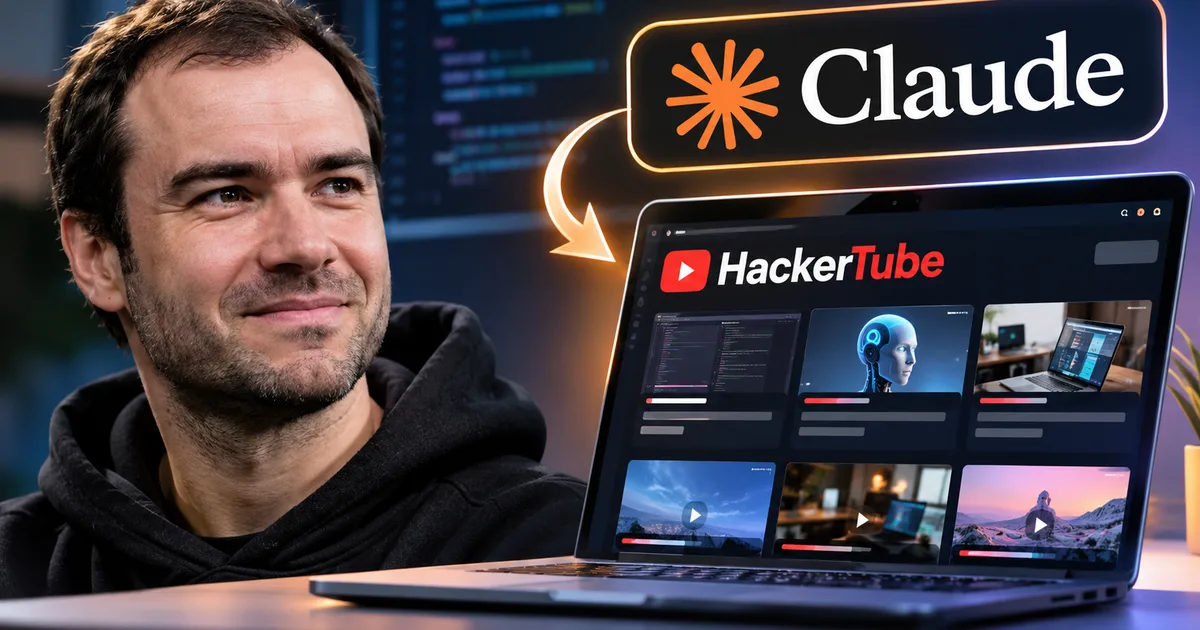
If you've ever sat down at your laptop late on a Friday night hoping to watch an interesting lecture or a deep documentary, only to get hit with screaming reaction faces and bright yellow arrows, you understand why Andrej Karpathy built HackerTube.
Karpathy, a co-founder of OpenAI and former head of AI at Tesla, hit that exact wall around 11 p.m. on October 31, 2026. He opened YouTube and looked at his home feed. Right away, he ran straight into a mess of recycled topics and algorithm junk. The platform was built for the median user, not someone hunting for real technical substance. In my experience, that feed gets worse every single year. So he stayed up and built his own solution right there on the spot.
By Saturday morning, hackertube.org was live.
He built the entire application in around two hours. He didn't write boilerplate code or fight with CSS syntax. Instead, he gave plain English instructions to Anthropic's Claude Code agent running locally on his Mac desktop. And it worked. The result is a clean catalog of 6,454 YouTube videos recommended inside Hacker News comments between 2007 and 2026, sorted across 150 topics. You don't need a login. There are no ads. And you won't see a single screaming thumbnail.
What is HackerTube and how does it work?
Basically, HackerTube is a community filter on top of YouTube's massive video catalog. It doesn't host any video files on its own servers. When you click a video, it plays directly from YouTube through an embedded player. That means streaming speed stays identical to YouTube, and availability follows YouTube's regional licensing rules (which makes sense, actually).
The difference is entirely in how you find things to watch.
Every single video in the catalog appeared because someone in the Hacker News community took the trouble to paste a link into a discussion thread and recommend it over the last nineteen years. It doesn't use an engagement algorithm built to keep your eyeballs glued to outrage clips. Instead, HackerTube relies on human judgment crowdsourced from software engineers and researchers.
The interface focuses on direct utility:
- A clean navigation bar with Home, Longs, Liked, History, Watch Later, Categories, and Playlists
- A specialized Longs tab that filters specifically for extended lectures, deep technical talks, and full-length documentaries
- Full keyboard shortcut navigation so you can browse without touching your mouse
- Topic directories grouping videos into 150 subject areas ranging from systems programming to mathematics and music
- A complete data export option that lets you download the full dataset to build your own personal video portal
[Screenshot: The HackerTube homepage displays a minimalist grid of video cards with neutral preview frames and direct links back to original Hacker News discussions.]
If you ask me, the smartest design choice on the site is how it handles previews. Standard YouTube creators spend hours optimizing custom thumbnails with high-contrast text and exaggerated expressions (which, for the record, gets exhausting after a long day at work). Karpathy skipped all of that. HackerTube generates a 50% thumbnail preview by grabbing a single frame exactly halfway through the video runtime. What you see is actual video content, not clickbait.
Another welcome touch is the lack of user sign-ups. You don't need to hand over an email address or link your Google profile. Your watch history and liked videos are saved directly in your browser session using local storage. Clear your browser cache, and that history disappears. But nobody tracks what you watch across the web.
How Karpathy used Claude AI to write the code
The development process is what caught everyone's attention across tech circles. Karpathy didn't spend his weekend writing React components or fighting with CSS flexbox bugs. He used Claude Code, Anthropic's agentic coding environment, configured with Claude Opus 5.5 set to medium effort as his default model. I'm not sure exactly why he chose medium effort over higher reasoning levels, but it clearly got the job done.
His development pipeline ran through five automated stages:
- Claude downloaded and parsed roughly 40,000 historical Hacker News comments that contained YouTube links
- The system ran Claude Sonnet over the raw text to filter out spam, promotional noise, and irrelevant links
- Claude extracted clean video identifiers and mapped them to metadata using the official YouTube API
- The agent classified the surviving 6,454 videos into 150 structured topic categories
- Claude generated the complete frontend and backend code, then packaged the project for deployment
Karpathy handled only three manual steps himself. He generated an API credential on Google Cloud for video metadata and provisioned a basic virtual private server. Next, he registered the hackertube.org domain name. Once the server was up, he just pasted the IP address into Claude Code. Then he told the agent to deploy and secure the application.
"I no longer write code, run terminal commands, or perform traditional engineering; I only talk to Claude and have it execute."
That quote from Karpathy's blog really shows where developer tooling has arrived. If you ask me, that shift from writing syntax to directing autonomous agents is already here. If you want to understand how these agentic environments operate on desktop setups, check out our guide on Claude AI desktop app setup and explore our detailed technology explainer guides for background on agent architecture.
[Screenshot: A terminal view of Claude Code running on macOS, executing bash commands and returning structured status logs without human intervention.]
The data behind the 6,454 video catalog
The two-hour build got all the headlines, but the underlying dataset is just as interesting. The team at Kingy AI ran an independent audit of the October 31 data export and found 39,834 comment-video mention pairs across those 6,454 distinct video IDs.
One detail caught my eye right away. Around 1,658 videos, or roughly 25.7% of the catalog, don't actually carry an explicit positive recommendation label in their retained mentions. The numbers here are a bit fuzzy, but Karpathy documented that limitation upfront. The scraper capped mentions at 20 per video, and some clips were linked just for context or technical counterarguments rather than glowing endorsements.
Thing is, that distinction matters. A video on HackerTube simply means it survived the filter and sparked discussion among technical folks. It doesn't guarantee that every claim in the video is factually correct. Also, the catalog naturally mirrors the demographic quirks of Hacker News. You'll find massive archives on Unix internals, distributed databases, compiler design, and machine learning history. But you won't find much on regional Indian agriculture or Hindi digital cinema, simply because that community rarely discussed those topics.
Comparing coding assistants for fullstack builds
Karpathy's project shows how fast agentic development is shifting away from basic autocomplete and toward autonomous execution. In my experience, the difference between an editor that autocompletes your functions and an agent that manages terminal tasks is night and day. If you're an Indian developer or a startup founder trying to decide where to invest your time, here is how the main tools stack up right now:
| Tool | Primary Focus | Typical Build Capability | Estimated Monthly Cost | Pros | Cons |
|---|---|---|---|---|---|
| Claude Code (Opus 5.5) | Autonomous terminal and repository workflows | End-to-end multi-file apps and server deployments | Around ₹1,800 ($20) per month | Executes terminal commands directly, handles file structures cleanly, strong multi-stage logic | Requires terminal comfort, consumption limits on heavy models can pause long tasks |
| Cursor Composer | In-editor fullstack code generation | Multi-file edits, interactive UI refactoring | Around ₹1,800 ($20) per month | Visual diff review, tight IDE integration, easy tab autocomplete | Does not configure remote server environments or run autonomous shell deployment pipelines |
| GitHub Copilot Workspace | Issue-to-pull-request automation | Feature implementation, bug patching, repo maintenance | Around ₹900 to ₹1,800 ($10-$20) per month | Direct GitHub repository integration, good team collaboration features | Slower on rapid greenfield prototyping, less flexible for arbitrary terminal automation |
If you're weighing different paid options, our curated AI tools directory breaks down real-world development benchmarks in greater detail.
How Indian developers can replicate this setup
You don't need a Silicon Valley budget or venture capital backing to build something like this. An Indian software engineer or a college student in Pune or Bengaluru can easily replicate Karpathy's setup on a tiny weekend budget.
Here is how the monthly expenses break down in Indian Rupees:
- A starter virtual private server on providers like Hetzner, DigitalOcean, or Hostinger costs between ₹400 and ₹800 per month, payable via Indian debit cards or UPI-enabled gateways
- The official YouTube Data API offers a free default quota of 10,000 units per day through Google Cloud Console, which costs ₹0 for a personal prototype
- A standard .org or .in domain name runs between ₹800 and ₹1,100 per year on registrars like Namecheap or Dynadot
- An Anthropic Claude subscription costs around ₹1,800 per month (plus 18% GST), which you can explore through our breakdown of Anthropic Claude subscription features
Look, the barrier to entry has basically collapsed. You set up a quick Python script or let Claude write a Node.js scraper to pull discussions from Reddit or Hacker News. From there, you clean the data and pull video metadata from YouTube. Then you let the model build an HTML5 frontend backed by a lightweight SQLite database. (I know, setting up cloud firewalls sounds intimidating if you haven't done it before, but Claude Code runs the server hardening commands for you once you give it root access). In my experience, the biggest bottleneck isn't writing the code; it's just picking a topic you actually want to browse.
[Screenshot: A step-by-step view of Google Cloud Console showing the YouTube Data API v3 credentials screen with free daily quota monitoring.]
What this means for the way we build software
Honestly, the most refreshing thing about HackerTube is that it solves an everyday annoyance without trying to become a venture-backed unicorn. Karpathy was sick of algorithm slop on a Friday night, so he spent two hours turning an old community archive into a useful daily tool. He shared the code concepts and published the data export, without even putting a donation button on the page.
We're entering a phase where small, bespoke software makes sense again. For years, building a custom video catalog with filtering, responsive design, keyboard shortcuts, and spam classification took weeks of sprint planning and a whole team of developers. Today, an experienced engineer acting as a director can guide an AI agent to build and ship the same project over a cup of chai.
And that changes who gets to build software. If you've got an idea for a clean curation site, whether that's Indian classical music archives or curated lectures for civil services prep, the tools are right there on your desk. You just have to know what prompts to feed them.