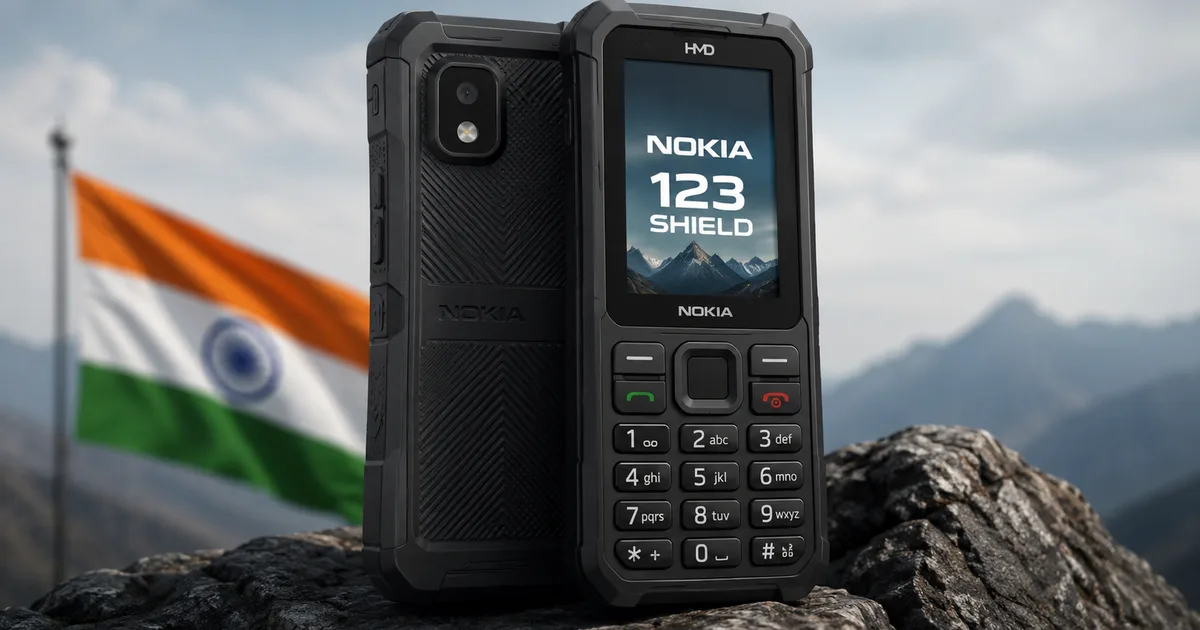
The HMD Nokia 123 Shield India launch has finally happened in 2026, and I know exactly what you're thinking right now. A 2G feature phone? In a market completely saturated with 5G smartphones? It sounds like a joke at first glance. But I spent the last few days looking into the specs and the reality of how people actually use phones in India today. And honestly, this device makes a lot of sense for a very specific type of user.
Look, we all have smartphones. We use them for everything from paying the local vegetable vendor via UPI to storing our Aadhaar cards on DigiLocker securely.
But we also have a constant, underlying fear. Battery anxiety.
You know the exact feeling. You're sitting on a train from Delhi to Lucknow, your battery hits 15%, and someone else is already using the charging socket in your compartment. Your ticket is on your phone. Your money is on your phone. If it dies, you're completely stranded.
So this is where the Nokia 123 Shield comes in.
HMD is pitching this as the ultimate backup phone. It refuses to die quickly. And it refuses to break easily.
Why HMD is launching a 2G phone in 2026
The most obvious question is the network choice. Launching a 2G device when companies are pushing satellite internet seems backwards. But India isn't a monolith. While tier-1 cities are running on fast 5G, there's a massive section of the population that still relies on older networks. Airtel and Vodafone Idea (Vi) continue to maintain their 2G infrastructure because millions of subscribers still use it daily.
Thing is, the Nokia 123 Shield isn't trying to replace your primary smartphone.
That'd be absurd. It is the phone you take on a long trek in Himachal Pradesh. It's the phone you give to a delivery executive who spends twelve hours a day on a bike in the blazing sun. It is the phone that sits in your car glovebox for absolute emergencies.
The 19-day battery claim
The battery is the main selling point. HMD claims a 19-day battery life for the Nokia 123 Shield. Now, I've tested enough electronics to know that lab numbers rarely match real-world usage. I'm not sure exactly why the numbers here are a bit fuzzy sometimes. You probably won't get exactly 19 days if you make hours of phone calls every single day.
But even if that number drops to 10 or 12 days in reality, that's still incredible by modern standards.
Think about the sheer convenience. You can charge it on a Sunday, throw it in your backpack, and not think about a charger again until the middle of the next week (which is wild, honestly). For people working in areas with frequent power cuts, or for those who travel long distances by road, this is a massive relief. It just works.
Rugged features and real-world durability
If you grew up in the early 2000s, you remember the legendary Nokia 3310.
We all dropped it down stairs and accidentally threw it across rooms. It just survived with a minor scratch. HMD is trying to bring back that 3310 toughness with the **Nokia 123 Shield**.
This is officially their most affordable water and dust-resistant feature phone to date. They've included proper IP protection. If you're caught in a sudden Mumbai monsoon downpour, your smartphone might get water damage if the seals are old. But this feature phone is built to handle it. The casing is thick. The buttons are sealed tightly against dust. If you work on a construction site where fine cement dust gets into every port of a normal phone, the Nokia 123 Shield is built to resist exactly that harsh environment. The plastic shell absorbs shocks that would shatter a modern glass phone in seconds.
USB-C charging is finally here
I'm so glad HMD finally did this. The Nokia 123 Shield has a modern USB-C port.
For years, companies dumped their cheap feature phones in India with outdated micro-USB ports. It was incredibly frustrating. You had a USB-C charger for your laptop and a USB-C charger for your smartphone. But you still had to hunt for an old micro-USB cable just to charge your cheap backup phone.
Not anymore. You can use your standard Android charger for this device. It seems like a small detail, but in everyday use, it makes a huge difference. You only need to carry one cable when you travel (which makes sense, actually, for reducing e-waste).
Pricing and alternatives in India
While the exact rupee pricing fluctuates slightly based on bank offers and offline retail margins, the Nokia 123 Shield is firmly in the affordable bracket. We expect it to land under INR 3,000. You can usually find these devices priced aggressively to compete with local Indian brands and cheap refurbished smartphones.
But you have to ask yourself what you're really paying for.
You aren't paying for apps. You aren't paying for a touchscreen. You're paying for peace of mind.
Compare it directly to a cheap Android phone. For around INR 4,000, you can buy a basic, low-end smartphone. But it'll be a mess. The battery will drain in less than a day. The screen will crack the first time you drop it on a concrete pavement. The Nokia 123 Shield costs less and lasts weeks. If you just need to make voice calls, the feature phone wins easily.
If you're looking at other options, check our guides on the best secondary phones. There are alternatives from brands like Itel and Lava. But in my experience, very few have this specific combination of IP-rated ruggedness and USB-C charging at this price point.
Living with a feature phone today
Using a feature phone in 2026 requires some serious adjustments. You have to remember how to type on a T9 numeric keypad. You don't have WhatsApp to send quick voice notes, and you definitely don't have YouTube for entertainment.
The UPI payment situation
The biggest daily hurdle is payments. India runs entirely on UPI now. From the local chai stall to large retail stores, we scan QR codes instinctively. You obviously can't scan a QR code with the tiny camera on the Nokia 123 Shield.
So what do you do if this is the only phone you have on you?
You can use the *99# USSD service for UPI. You can check your bank balance and transfer money using basic text menus. I won't lie to you. It's clunky. And it sometimes fails if the network is congested. But it works in a pinch. If your main phone is stolen or dies, you aren't completely cut off from your bank account. You can read more about alternative payment methods and secure banking in our detailed explainers section.
The digital detox angle
There's an interesting cultural trend happening right now. A lot of young professionals in cities like Bangalore and Delhi are buying phones like the Nokia 123 Shield on purpose. They call it a digital detox.
We spend hours staring at glowing screens. We're constantly bombarded by notifications and work emails. So some people are intentionally leaving their smartphones at home on Sundays. They pop their SIM card into a basic feature phone and go out.
If there's a genuine emergency, people can still call them. But they can't mindlessly scroll through Instagram while sitting at a cafe. (I tried this last week. It's much harder than it sounds, but weirdly peaceful). This phone makes you actually look at your surroundings instead of a screen.
What you need to know before buying
Before you hit the buy button online, there are a few highly practical things to consider.
First, check your telecom provider. If you're a Jio user, the Nokia 123 Shield is a mess for you as a primary device. Jio operates a 4G/5G only network in India. You'll need an active Airtel or Vi SIM card for the 2G network to work properly. If you put a Jio SIM in this phone, it simply won't connect to any network at all.
Second, the camera is genuinely terrible. Don't buy this thinking you can take decent photos for social media. It has a basic low-resolution camera. It might capture a blurry image of a printed document, but that's about it. It exists mostly just to say the phone has a camera.
Third, beware of electronics scams. Because Nokia has strong brand recognition in India, local markets are flooded with fake feature phones. They look visually identical. But they have sketchy, uncertified batteries that can swell or explode. They also don't have the water resistance of the real model. Make sure you're buying from an authorized retailer or trusted e-commerce platform. If you want to know how these counterfeit networks operate and target buyers, take a look at our latest scam alerts page.
Who is the Nokia 123 Shield really for?
If I had to break it down clearly, I see three distinct groups who should actually consider buying this phone today.
- The hardcore travelers and field workers. If you spend your days on a delivery bike or taking long train journeys across the country, you need a phone that can take a heavy beating and stay powered for weeks without a plug.
- The elderly population. Many older Indians still prefer the tactile feel of real physical buttons. They don't want to navigate complex Android menus just to call their grandchildren. This phone is simple and entirely familiar. The physical keypad is much easier for arthritic hands to manage than a flat glass screen.
- The backup seekers. If your job requires you to always be reachable, having a fully charged backup phone in your bag is just smart planning. It's cheap and is a huge safety net.
The final verdict
The Nokia 123 Shield isn't a revolutionary piece of technology. It's a very simple tool designed to do one job extremely well. It keeps you connected when modern fragile smartphones fail.
"The rugged Nokia 123 Shield brings back that 3310 toughness but updates it for modern users with USB-C and better durability."
It's rugged, and the massive battery life makes it genuinely convenient to live with. Yes, the 2G limitation is a drawback for some users depending on their network. But if you have an Airtel or Vi SIM and you need a device that can survive a drop in a puddle and still make a clear phone call two weeks later, this is exactly what you're looking for.
Honestly, in a tech world completely obsessed with complex software updates and folding screens, there's something incredibly refreshing about a phone that just focuses on basic, boring reliability.
Basically, it does exactly what it says on the box.