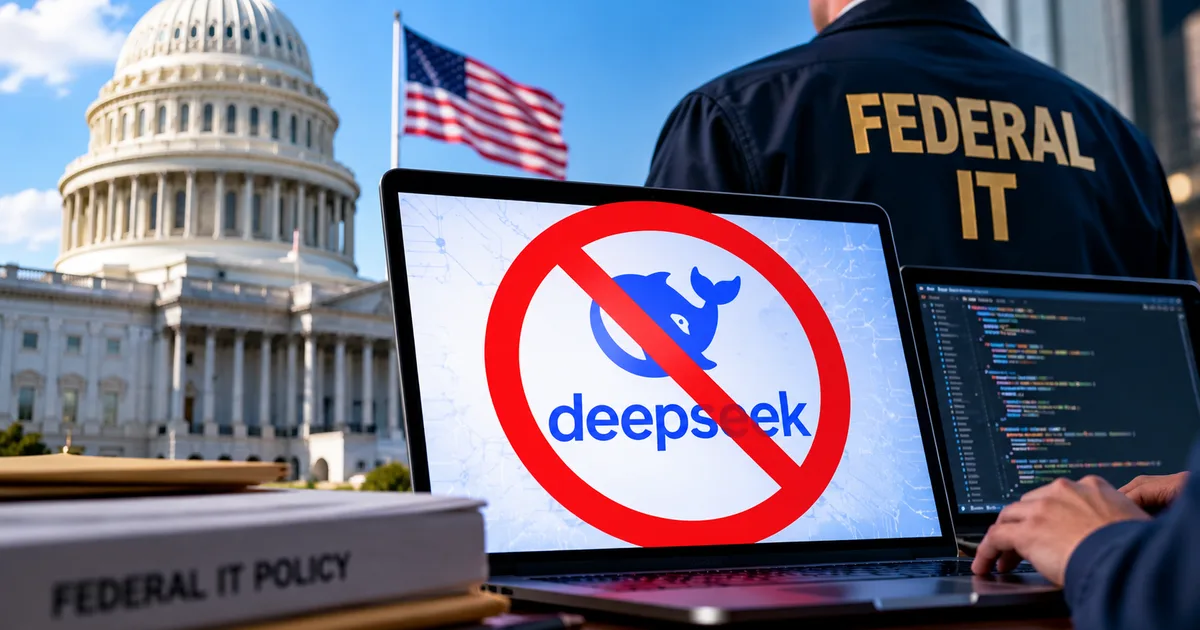
The United States government has officially barred Chinese artificial intelligence firm Hangzhou DeepSeek from all federal civilian agency networks. Under a binding directive from the Department of Homeland Security, departments like the Treasury, State, Commerce, and Justice have 60 days to purge every trace of the software. If you write code or run an engineering team in Bengaluru, you might wonder why this matters to your sprint board. It does. The DeepSeek AI federal IT ban reaches far beyond government desktops in Washington. It pulls the rug out from under third-party software integrations and forces every software vendor to inspect their codebase right now.
You can already see the ripples moving fast across the latest tech news developments while enterprise security leads scramble. It feels abrupt. But if you ask me, anyone tracking geopolitical tech friction saw this coming from miles away.
What the federal directive actually requires
The directive, published in the US Federal Register, is a strict procurement ban across civilian executive agencies. If an agency gets federal funds under that civilian umbrella, DeepSeek is out. Period.
There's a strict 60-day purge deadline on the calendar. In my experience with federal compliance deadlines, that doesn't leave much breathing room. Agency IT teams have to track down and delete all DeepSeek applications and framework installations (which makes sense, actually, given the political heat). If an agency faces serious operational disruption, it can file an exemption request with the Cybersecurity and Infrastructure Security Agency (CISA) within that 60-day window. Don't count on CISA handing out passes. The bar is brutal. You need documented proof that no alternative tool exists, and you must prove that temporary safeguards can stop leaks.
While the purge is underway, the order mandates immediate defenses. Network admins have to turn on enhanced logging and clamp down hard on outbound traffic. They're also monitoring connections around the clock for sketchy traffic patterns.
Look, the scope has boundaries. It only targets civilian agencies. It doesn't regulate personal laptops, consumer downloads, local state offices, or Department of Defense systems, which run under separate military rules. Regular users can still download and test the models whenever they want. But the commercial fallout is already huge.
Predictably, Beijing pushed back. Chinese Foreign Ministry spokesperson Mao Ning stated during a press briefing that Beijing opposes overstretching the concept of national security and politicizing technology. Mao Ning added that China will firmly safeguard the legitimate rights of its domestic enterprises. In Washington, though, policy momentum rarely reverses once national security alarms go off.
Cybersecurity concerns and the data sovereignty debate
Why did US security officials pull the trigger on DeepSeek now? Honestly, the official filings point to technical flaws and legal headaches that were brewing for months.
Homeland Security Department General Counsel James Percival put the government's stance plainly in the directive:
"DeepSeek's models present multiple threat vectors." - James Percival, General Counsel, US Department of Homeland Security
First, there's the legal reality of where data ends up. DeepSeek has its primary servers in the People's Republic of China. Under Chinese domestic laws, state intelligence agencies have sweeping legal authority to force private tech companies to turn over user data and infrastructure logs during security reviews. If an employee drops internal memos or code snippets into a hosted chat window, that data travels straight to servers in Hangzhou. Federal officials argue this is an unacceptable leak risk for government staff and public programs.
Second, independent technical audits cited by the Department of Homeland Security flagged troubling behavior in the mobile app. Researchers found invasive device fingerprinting alongside unpatched software vulnerabilities in DeepSeek's client code. When an app records device identifiers and network parameters, it builds a deep profile of the user. That goes way beyond what a simple coding assistant needs to answer a query.
Erik Avakian, technical counselor at Infotech, explained the structural risk facing organizations that connect to hosted models:
"When organizations use any type of hosted AI service, they're potentially sending intellectual property, confidential business information, or other sensitive data into an environment where they may have very little visibility or control over what happens to it." - Erik Avakian, Technical Counselor at Infotech
Washington isn't alone here. At least eight national governments, from Rome to Canberra, restricted DeepSeek on official devices over identical worries about Chinese data laws. I think the coordinated reaction says it all. When multiple international regulators raise the exact same red flag, enterprise risk officers have to pay attention.
The vendor clause and third-party software supply chains
Here's the deal: the ban doesn't stop at the DeepSeek website or its desktop app. It explicitly covers affiliated products and any third-party software built on DeepSeek implementations.
That single vendor clause changes everything for software companies. Over the past year, developers jumped on DeepSeek because the pricing was unbeatable. Proprietary US models cost real money per million tokens, while DeepSeek offered solid reasoning and quick code generation for pennies. Startups plugged the API into internal knowledge bases, support bots, document analyzers, and developer copilots. It was cheap and fast.
Now, if an enterprise vendor sells a SaaS platform to a US agency, that product has to be completely clean. If your background data pipeline calls a DeepSeek endpoint under the hood (and that happens a lot more than teams admit), your app suddenly violates federal procurement rules. It's a genuine software supply chain mess.
For years, corporate security focused on open-source libraries and CVE bugs. Now, procurement officers demand a Software Bill of Materials that accounts for model weights and backend API gateways. If an agency audit spots an undocumented DeepSeek call inside a vendor's tool, the contract is dead on the spot. If you ask me, half the engineering teams selling to enterprise clients don't even know every sub-processor their libraries call.
If you want to review compliant alternatives without breaking your budget, check our guide to popular developer AI tools for practical options.
Developer impact on Indian IT firms and global SaaS
Why should an engineering lead or founder in India care about US federal procurement rules? Because the Indian tech sector has direct, daily ties to American enterprise software.
Major Indian IT service giants like TCS, Infosys, Wipro, and HCLTech run multi-million-dollar modernization projects across North America. Many of those deals touch US public sector bodies and massive corporate contractors that service federal accounts. In my experience working with Indian delivery teams, client audits always trickle down faster than management expects. When Washington changes the rules, those enterprise clients pass the compliance headache straight down to offshore development centers in Bengaluru, Hyderabad, Chennai, and Noida. We saw the exact same pattern play out during earlier waves of enterprise generative AI deployments when client security teams blocked public APIs without warning.
SaaS founders have tough decisions to make too.
A lot of Indian startup builders swapped out expensive OpenAI or Anthropic endpoints for DeepSeek to keep burn rates under control. In Indian rupees, paying ₹15 per million tokens instead of ₹180 per million tokens is a massive win for a bootstrapped team. While the exact savings numbers across the sector are a bit fuzzy, the math makes total sense on paper. But if your SaaS product sells to enterprise buyers in the US, saving a few thousand rupees on API calls today can kill an enterprise deal tomorrow.
And then there's India's own regulatory pressure. CERT-In strictly enforces a six-hour cyber incident reporting window. Meanwhile, India's DPDP Act (Digital Personal Data Protection Act) sets heavy safeguards and threatens penalties up to ₹250 crore for unauthorized data exposures. If Indian user records or proprietary client code get routed through foreign servers with weak privacy protections, legal teams will have to answer for it.
Telecom infrastructure in India is under similar heat, as seen in telecom cybersecurity compliance mandates that demand deep audits of foreign network hardware and software components. Software provenance is just as critical as raw code quality now.
What engineering teams should audit today
If you manage a software product or write code for clients, waiting around for an angry compliance email is a bad strategy. You need an audit of your AI dependencies today.
Take these practical steps across your engineering stack:
- Search your repositories and environment configuration files for active endpoints pointing to api.deepseek.com or third-party proxy gateways routing to Chinese servers.
- Audit all sub-processors and commercial software libraries integrated into your production pipelines to identify any hidden model dependencies.
- Review your customer contracts and master service agreements to verify whether any enterprise clients operate under US federal procurement standards.
- Establish strict internal data governance rules that prohibit staff from pasting proprietary customer data or production code into unapproved public chat interfaces.
What about open-source weights? That's the question every developer keeps asking me. DeepSeek released open-weight versions of several models, so engineers can download weights and run them privately on their own cloud instances.
Technically, running open weights inside air-gapped deployments on local infrastructure (say, an AWS or Google Cloud cluster in Mumbai) prevents outbound leaks to foreign servers. No prompt ever leaves your virtual private cloud. Your traffic stays inside your own network.
Legal compliance is a completely different story. The federal order explicitly bars software built with DeepSeek implementations from civilian agency procurement. Government auditors don't care about the technical differences between an API call and a self-hosted weight. In my view, using even a self-hosted derivative model is an unnecessary gamble if you deliver software to regulated clients.
Self-hosting is still an option for teams with zero ties to US public contracts. But if you touch federal deals, switching to clean alternatives like Llama, Mistral, Gemma, or certified domestic cloud models is the smart move. It saves you from emergency refactoring at 2 AM.