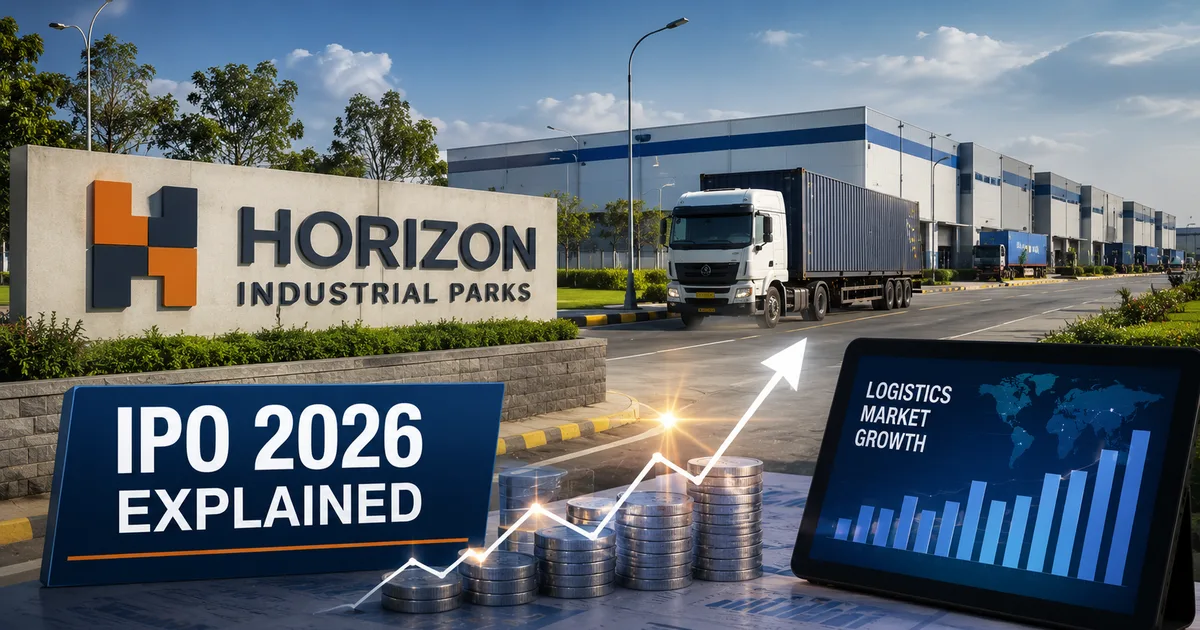
Look at your recent Amazon or Flipkart delivery. The box reached your door in a day. That speed doesn't just happen magically. It relies on massive warehouses sitting on the outskirts of cities like Delhi, Pune, and Bengaluru. And this is exactly the business we are talking about today.
The Horizon Industrial Parks IPO 2026 is making rounds in the grey market right now. And for good reason. It's a ₹2600 crore public issue backed by global investment giant Blackstone. But before you open your Zerodha or Groww app and hit subscribe, we really need to talk about what you're actually buying into. Honestly, logistics sounds completely boring until you realise how much money moves through those tin sheds.
Thing is, buying an IPO is tricky right now. The market is a mess. A lot of companies are rushing to list while retail investors are eager to buy. We're going to look at the expected valuation and the Grey Market Premium (GMP). Then we'll figure out what this means for the broader logistics sector in India (which is changing fast, actually).
What exactly is Horizon Industrial Parks?
Most people don't think about industrial real estate. You order a phone, it arrives. But someone has to own the physical land and buildings where that phone sat before it reached you. Horizon Industrial Parks builds and manages these massive logistics parks and warehouses. They rent them out to companies that need space to store goods or process orders.
I tried explaining this to a friend yesterday. Basically, they're landlords for big businesses. It's a steady business model. Companies sign long leases that often last five to ten years with built-in rent escalations. The rent just keeps coming in. That provides a really predictable cash flow.
They have properties spread across major industrial hubs in India. Think of the big logistics corridors near Mumbai, Pune, and the National Capital Region (NCR). With the boom in quick commerce apps like Blinkit and Zepto, the demand for warehousing is higher than ever. I think everyone needs space to store stuff closer to the customer.
It goes beyond just four walls and a roof. These are Grade-A warehouses. That means they have high ceilings for better stacking and strong floors that can handle heavy machinery. Multinational companies refuse to operate out of poorly constructed sheds. They want modern facilities. Horizon provides exactly that.
The IPO details you actually need
Here are the hard numbers. The Horizon Industrial Parks IPO is aiming to raise ₹2600 crore from the market. That's a decent chunk of money.
The price band is set between ₹57 and ₹60 per share. Bidding opened on August 17 and closes on August 19, 2026. If you get an allotment, the shares will list on the BSE and NSE on August 24.
The lot size is a big detail for retail investors. I'm not sure exactly why they structure it this way, but usually retail investors can jump in for around ₹14,000 to ₹15,000 per lot.
Demand on the first day was surprisingly modest. The Economic Times reported the issue was subscribed about 14% on Day 1. Retail investors usually jump at big names. But they seem to be taking their time with this one. Even the Qualified Institutional Buyers (QIBs) and Non-Institutional Investors (NIIs) were slow to place bids on the opening day.
This slow start comes down to the financials.
Looking at the financials and risks
You have to read the draft red herring prospectus (DRHP) carefully. I spent an hour looking at the numbers today. A few things stand out to me.
First, the debt. Building giant warehouses costs a lot of money upfront. You have to buy the land and get the environmental permits. Then you construct the buildings before you see a single rupee in rent. Horizon has accumulated significant debt to fund its expansion across multiple states. This is normal for real estate developers. But in an environment where interest rates set by the RBI are a constant concern, high debt means high interest payments. Those payments eat directly into profits. Every time the repo rate stays unchanged, companies with high debt loads feel the squeeze.
Second, the company has reported losses in recent periods. They're expanding fast. And expansion burns cash. The depreciation on their massive buildings also hits the profit and loss statement hard. The open question is whether their growth can outrun the costs of servicing that debt. You're betting that their rent income will eventually dwarf their loan repayments.
"The market is clearly weighing the solid backing of Blackstone against the immediate debt burden on the books. It is a classic growth versus profitability debate."
I'm not a SEBI-registered advisor. You have to decide your own risk appetite. But buying into a loss-making company with high debt is always a gamble. You have to read the fine print. And you need to understand that real estate returns are rarely instant.
The Blackstone factor
We can't ignore the elephant in the room. Blackstone is one of the largest private equity firms in the world. They know real estate better than almost anyone else. They have a massive portfolio of commercial properties globally. This includes their successful Nexus Select Trust and Embassy Office Parks REITs in India.
Their backing gives Horizon Industrial Parks a massive credibility boost. Blackstone brings access to cheaper capital and global tenant relationships. When an international logistics company wants to set up shop in India, Blackstone can connect them directly with Horizon's properties. It's a powerful network effect that local competitors just can't match.
But remember, private equity firms are in the business of making money for themselves. They're selling a portion of their stake through this IPO. They're cashing out on some of their early investments. That isn't necessarily a bad thing. But you should understand their motives. They build businesses to sell them or take them public. Once the lock-in periods expire for these anchor investors, you might see them slowly reduce their holdings. That can put downward pressure on the stock price in the long run (annoying, I know).
The Grey Market Premium story
Everyone wants to know the GMP. It's the unofficial indicator of listing day profits. For the Horizon Industrial Parks IPO, the GMP has been fluctuating quite a bit. It really shows the market's mixed feelings.
When the issue opened, the grey market premium was hovering around ₹4 per share. On a ₹60 upper price band, that signals a listing pop of about 6% to 7%. Not exactly the massive listing gains we see with some tech startups.
Then things cooled off. By the end of Day 1, the GMP dipped to around 2.8%. That means a gain of just ₹1 or ₹2 per share. The grey market is fickle. It changes based on the subscription numbers. Since the Day 1 subscription was only 14%, grey market traders lowered their expectations. If the QIBs don't step up in the final days of bidding, that premium could vanish entirely.
This is why tracking the grey market can be dangerous. It's completely unregulated. A few large traders can easily manipulate the perceived demand. You shouldn't base your investment decision purely on the GMP. Look at the fundamentals instead.
Impact on the Indian logistics market
This IPO is about more than just one company. It tells us something about the entire logistics and warehousing sector in India.
The government's push for infrastructure and initiatives like PM Gati Shakti are supposed to reduce costs. Right now, logistics costs in India are much higher compared to developed nations. It makes our exports less competitive and domestic goods more expensive. In my experience, a lot of this inefficiency comes from poor storage facilities where goods just get damaged.
Companies like Horizon are building the modern infrastructure needed to make supply chains efficient. They're moving away from the old godowns to professional warehousing parks. These have wide approach roads for heavy trucks and 24/7 power backup.
If this IPO succeeds and the stock performs well, it could encourage other logistics players to go public. We might see more real estate investment trusts (REITs) focused purely on industrial spaces. This would bring more transparency and capital into the sector. Historically, this space relied heavily on sketchy land deals.
But if it struggles, investors might start questioning the high valuations in the warehousing sector. The numbers here are a bit fuzzy, but land prices near major cities like Bengaluru and Mumbai are sky-high. Construction costs are rising due to inflation in raw materials like steel and cement. If warehouse operators can't pass these costs onto their tenants by raising rents, their profit margins will shrink. Tenants are also sensitive to costs. If rents go too high, they might look for cheaper alternatives.
Understanding the broader e-commerce connection
You can't talk about warehousing without talking about e-commerce. The rise of Amazon, Flipkart, Myntra, and now the quick commerce players has changed how goods are stored in India.
Ten years ago, a brand would ship products to a distributor. The distributor would send them to a wholesaler. Then they went to a local shop. The storage needs were fragmented. You just needed small godowns scattered across different districts.
Today, brands want massive central fulfillment centres. They need spaces that can handle automated sorting machines and massive conveyor belts. That's the kind of industrial space Horizon builds. The growth of Horizon is directly tied to the growth of online shopping in India. If you think Indians will buy more things online over the next five years, then the demand for these warehouses will remain strong.
We're also seeing a shift towards automated warehouses. Companies want robotics to sort packages faster. But you can't run robotics in a cheap tin shed. You need perfectly levelled floors and heavy-duty power supplies. Horizon specialises in this specific type of high-end infrastructure. This gives them an edge over unorganised local landlords.
How to decide if you should apply
I see people blindly applying for every IPO because they suffer from FOMO. Don't do that. You tie up your funds for weeks. And if the market turns, you end up holding a stock that lists at a discount.
Here's a simple way to look at it. If you're looking for a quick listing gain, the current GMP doesn't offer much of a buffer. A bad day in the broader stock market on August 24 could easily wipe out a ₹2 premium. Then you're listing in the red.
If you're looking at the long term, you have to believe in the India consumption story. You have to believe that manufacturing will pick up under schemes like PLI. And you have to believe that companies will keep needing massive sheds to store their goods.
Think about these factors before you invest:
- Blackstone backing provides strong institutional credibility and management expertise.
- The warehousing sector is seeing high demand from e-commerce and third-party logistics providers.
- The company's debt levels and recent losses present real risks to near-term profitability.
- The muted early subscription numbers suggest retail investors are cautious.
You can check out our other explainers on recent market movements to get a better sense of how similar issues have performed. We also have a solid guide on the tools you can use to track subscription statuses in real-time. And be aware of the scams floating around WhatsApp groups offering guaranteed IPO allotments. Those scams are always fake and will just drain your bank account. If you want to read more about the government's infrastructure plans, we cover that in our news section.
The choice is yours. Just don't expect it to double your money on listing day. It's an infrastructure play. Infrastructure takes a long time to deliver massive returns. You have to be patient.