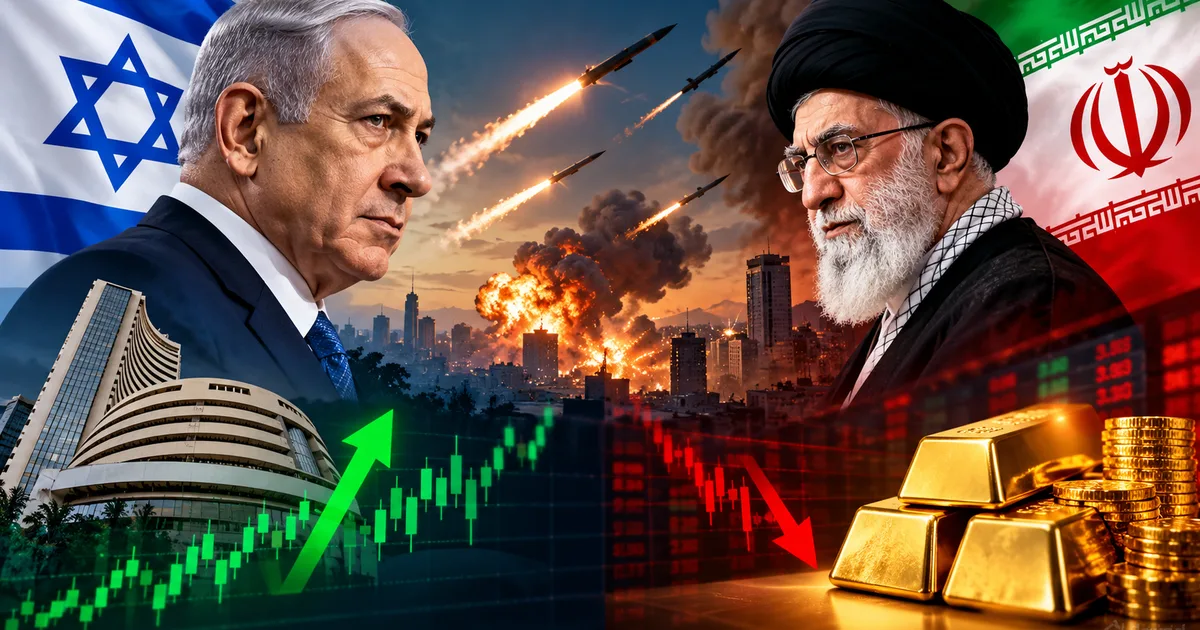
You open your Zerodha or Groww app and see a sea of red. The Sensex is tanking. Nifty has hit a massive slump, and you're probably wondering what just happened. The short answer is the Israel-Iran conflict 2026. Over the past week, we saw Dalal Street take a brutal beating. The markets wiped out over Rs 47 lakh crore in investor wealth. That's a staggering amount of money vanishing in just a few trading sessions.
And honestly, if you're a retail investor who just started SIPs a few months ago, panic is the natural response.
But here's the deal. Geopolitical tensions always shake up financial markets. When missiles fly in the Middle East, shockwaves hit Mumbai. If you ask me, we need to break down exactly how this conflict is driving the Sensex down and pushing gold prices up. Let's look at what it means for your hard-earned money.
How the Israel-Iran conflict 2026 crashed Sensex and Nifty
Let's look at the numbers. On Monday, the Nifty 50 corrected by nearly 9 percent from its recent peaks. The Sensex slid over 6.5 percent. We saw the Sensex sink by 1,280 points in a single intraday session. It dropped to levels we haven't seen in a while, and investors were caught completely off guard.
Why did this happen so fast? When news of Ali Khamenei's death in US missile strikes hit the wires, followed by Iran's warning to Israel, institutional investors hit the panic button. FIIs started pulling out money. They absolutely hate uncertainty.
When a war breaks out, the big money managers sitting in New York or London don't want to keep their dollars in emerging markets like India. They sell their Indian stocks and run to safer assets. This massive sell-off creates a domino effect. The more they sell, the more the index drops. If you look at the recent US Fed rate changes, you'll see that global money was already getting jittery. The war just gave them a reason to pull the trigger.
The crude oil connection
You can't talk about the Middle East without talking about oil. India imports over 80 percent of its crude oil. When Iran and Israel go to war, the immediate fear is that oil supply routes in the Persian Gulf will be blocked.
If crude oil prices shoot up, petrol and diesel get expensive in India. This drives up the cost of transporting everything from tomatoes to smartphones. Inflation spikes. The RBI then has to keep interest rates high to fight this inflation. High interest rates mean companies borrow less. Because they borrow less, they grow less. And then their stock prices fall.
It's a straight line from a missile in Tehran to higher vegetable prices in Delhi. The Nifty score goes down.
"The escalating US-Israel-Iran conflict has triggered a sharp global conflict impact on Indian stock market, with Nifty correcting nearly 9 percent and Sensex sliding 6.5 percent over recent weeks."
Which Indian sectors are taking the biggest hit?
When you look under the hood of the Sensex, not all companies are suffering equally. The conflict is hitting some specific sectors much harder than others. I spent some time looking at the sectoral indices. In my experience, the patterns are pretty clear.
Aviation is an obvious loser. IndiGo and Air India spend a massive chunk of their operating costs on Aviation Turbine Fuel (ATF). ATF is directly linked to crude oil. When oil prices jump, their profit margins shrink instantly. Their stock prices drop just as fast.
Paint companies and tyre manufacturers face the exact same problem. Companies like Asian Paints and MRF rely heavily on crude oil derivatives for their raw materials. High oil prices mean higher manufacturing costs. Investors know this. So they dump these stocks the moment oil prices start creeping up.
Then you have the IT sector. Companies like TCS and Infosys get a large chunk of their revenue from Western clients. If the global economy slows down because of war-induced inflation, American and European companies cut their IT budgets. Indian tech stocks take a massive beating as a result. We saw this exact thing during the recent tech layoffs, and the fear is definitely creeping back in.
Why gold prices always go up during a war
While your equity portfolio is bleeding, your mother's gold locker is suddenly worth a lot more. Gold is a safe haven asset.
Look at it this way. Stocks are risky because companies can fail. Currencies are risky because governments can print way too much money. Gold is physical. It has been valuable for thousands of years.
When institutional investors sell their shares in Reliance or HDFC, they need a safe place to park that cash. They buy gold. This massive global demand pushes the price of gold up. In India, local demand also spikes because people get scared about the economy and prefer buying physical assets. During the first few days of the Israel-Iran conflict 2026, we saw gold prices touch new highs across the whole country.
Digital gold and UPI
A lot of young Indians don't go to the jeweller anymore. They open PhonePe or Google Pay and buy digital gold for Rs 100. During this crisis, we saw a massive surge in UPI transactions for digital gold. People wanted the security of gold without the hassle of storing physical coins.
Historically, Indian households hold massive amounts of physical gold. It is embedded in our culture. But what is fascinating in 2026 is the shift towards financialising this gold. People are buying Gold ETFs on platforms like Zerodha and Groww. They bypass the making charges of traditional jewellery. When the war news broke, trading volumes for Gold ETFs spiked dramatically on the National Stock Exchange (NSE). People realised they can get exposure to rising gold prices, and they don't have to worry about locker fees.
I checked the local rates in Zaveri Bazaar yesterday. The premiums are crazy. So if you're holding Sovereign Gold Bonds (SGBs) or physical gold, you're probably the only one smiling right now (which makes sense, actually).
What happens to the Indian Rupee?
There's another angle to this whole mess. Currency. When global investors panic, they flock to the US Dollar. It is the ultimate safe haven currency. When everyone buys dollars, the value of the dollar goes up. By comparison, the Indian Rupee goes down.
A weaker Rupee is bad news for us. It makes our imports even more expensive. Remember how we talked about India importing 80 percent of its crude oil? We pay for that oil in dollars. The price of oil is going up because of the war. We also have to pay more Rupees to buy the dollars needed to get that expensive oil. It's a complete mess.
The RBI has massive foreign exchange reserves right now. They constantly intervene in the currency markets to prevent the Rupee from crashing too fast. But they can't fight a global trend forever. I'm not sure exactly why anyone thinks they can. If the Israel-Iran conflict 2026 drags on for months, you can expect the Rupee to hit new lows against the dollar. This makes foreign travel and studying abroad a lot more expensive for the average Indian.
The impact on Indian retail investors
So what does this mean for the average Indian investor? If you check the latest tech news and financial updates, you'll see a lot of panic. Market gurus will tell you to sell everything or buy the dip.
Here's my take.
If you're investing for the next 10 years through mutual fund SIPs, a war-driven market crash is usually a temporary roadblock. The Indian economy has a strong foundation. Domestic events, like the upcoming Tata Motors demerger or quarterly corporate earnings, eventually take back the steering wheel. That happens once the geopolitical dust settles.
An interesting trend this time around is how Domestic Institutional Investors (DIIs) are reacting. These are basically your mutual fund managers. While foreign funds are pulling out, Indian retail money is still flowing into the market through SIPs. This domestic support is actually preventing an even bigger crash. Without the constant inflow from everyday Indian investors, the Sensex would be in a much worse position right now.
But right now, the volatility is real. You'll see 1000-point swings on the Sensex based purely on a news headline or a statement from a world leader. Donald Trump recently mentioned that Iran and Israel are seeking an immediate ceasefire. The moment that news broke, the Indian stock market showed signs of rebounding. That's how sensitive the market is right now.
Should you stop your SIPs?
No. Honestly, stopping your SIPs when the market is down is the worst thing you can do. When the Nifty is down 9 percent, your monthly SIP amount actually buys you more units of the mutual fund. You're buying stocks on a discount.
(I know, sounds complicated, it's not. Think of it like buying your favourite smartphone during a Diwali sale instead of paying full price.)
We've seen this movie before. The Russia-Ukraine war caused a massive crash. The COVID-19 pandemic caused an even bigger one. Every single time, the market eventually recovered and hit new highs. Panic selling just locks in your losses.
What to watch out for this week
If you want to track where the market is going, keep an eye on these specific triggers.
- Crude oil prices are the first indicator. If Brent crude crosses $90 a barrel, expect more pain for Indian equities. The higher it goes, the more the Sensex will drop.
- The RBI MPC meeting outcomes will be heavily watched. The Reserve Bank of India will have to balance the inflation risks from expensive oil against the need to support economic growth.
- Foreign fund flows provide a daily pulse check. You can track this data daily on the NSE website to see if FIIs are continuing to sell or coming back.
- Geopolitical statements directly move the market. Any news about a ceasefire will cause a rapid market recovery, while news of retaliation will cause another crash.
For more breakdowns on how global events affect your money and tech, you can check out our other tech explainers.
The Israel-Iran conflict 2026 is a serious geopolitical crisis. Human lives are the biggest tragedy here. From a purely financial perspective, it's a reminder that Indian markets are deeply connected to global events. Keep your emergency fund in a fixed deposit. And don't panic sell your good stocks.