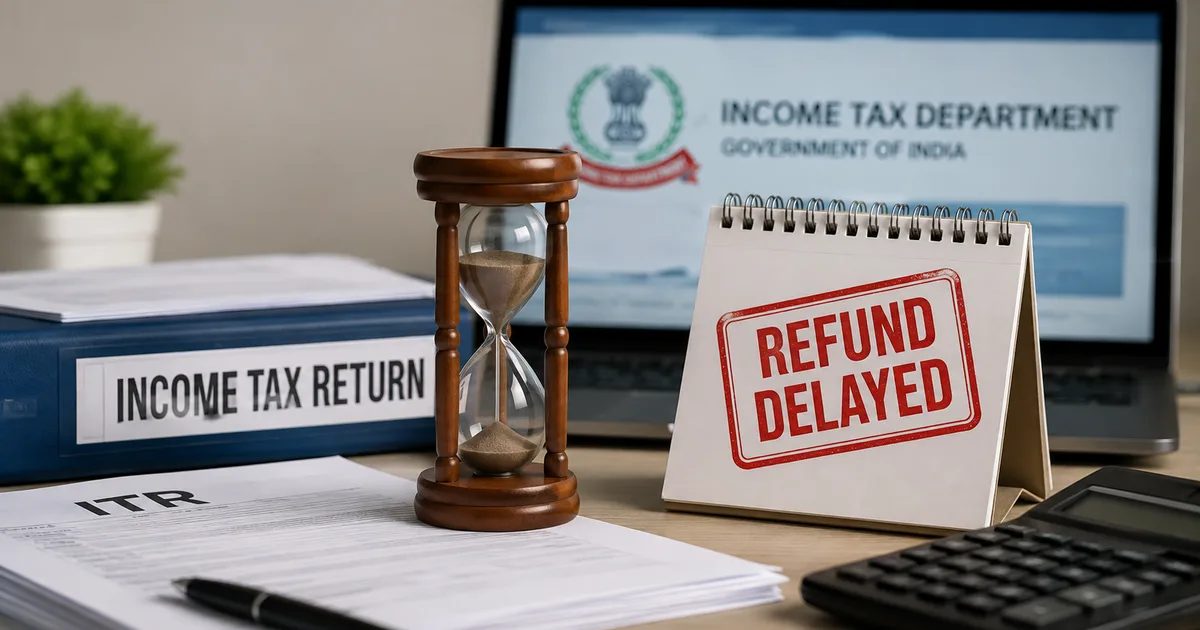
You filed your ITR well before the July 31 deadline. You got the e-verification done on the exact same day. And now you're checking your bank account every single morning, wondering where your money went. Trust me, you aren't the only one facing income tax refund delays 2026. Right now, nearly 27 lakh returns are still stuck in the processing pipeline.
Thing is, getting a refund used to take just a week or two for straightforward salaried filings. But this year for Assessment Year 2026-27, things are moving much slower. I've been talking to a few chartered accountants in Delhi and Mumbai. The consensus is pretty clear. The income tax department is doing way more background checking than they used to.
Why your income tax refund is delayed in 2026
There are actually a bunch of valid reasons your money hasn't hit your account yet. Honestly, some of these are just annoying technicalities. But others definitely need your immediate attention.
Mismatches with AIS and form 26AS
This is the big one. If there's even a tiny mismatch between what you declared in your return and what the Annual Information Statement (AIS) shows, your file gets flagged. The system cross-references everything now. Your mutual fund sales, or that small fixed deposit interest from SBI.
If you forgot to report a ₹5,000 capital gain from selling a few shares because you thought it didn't matter, the automated system will just pause your refund. In my experience, people underestimate this a lot. It's not a human sitting there reviewing it. It's an algorithm. And it wants exact matches.
Pending e-verification
I know this sounds silly. But a shocking number of people just forget this step. Filing your return on the portal isn't the end of the job (annoying, I know). You have 30 days to e-verify it using an Aadhaar OTP or net banking. If you haven't verified it, the tax department hasn't even started processing it. Your return is effectively sitting in a digital waiting room gathering dust.
Bank account validation failures
You can't just provide an IFSC code and account number anymore. Your bank account must be pre-validated on the e-filing portal. And the name on your PAN card has to exactly match the name on your bank account. If your bank account isn't linked to your PAN, the refund will fail. I saw a case last week where a guy's refund failed completely. His bank account was marked as dormant since he hadn't used it in six months.
Additional scrutiny and risk management
The tax department has significantly tightened its Risk Management System (RMS). This is basically an automated filter that looks for sketchy claims. I'm not sure exactly why they turned up the dial so high this year, but what exactly triggers it?
- Claiming sudden, unusually high deductions under Chapter VI-A that you never claimed in previous years.
- Filing for a massive refund that seems entirely out of proportion to your stated income.
- Showing a sudden drop in income while your TDS was very high.
- Claiming fake rent receipts for HRA. Seriously, don't do this. They are actively matching PANs of landlords now.
If the system flags your return, human officers have to step in. And that automatically pushes your processing time from a few weeks to potentially several months.
The confusion around the new tax regime default
Another major reason for the bottleneck this year is the default shift to the new tax regime. Many taxpayers simply didn't realise the new regime was set as the default option when they logged in. They went ahead and filed their returns expecting their usual old deductions to be considered automatically.
When the system processed these returns under the new regime, most of these standard deductions just didn't apply. It created massive confusion. Taxpayers ended up with a demand notice instead of a refund. Or they got a much smaller refund than expected. As a result, thousands of revised returns were filed at the last minute.
Processing revised returns naturally takes longer. If you filed a revised return because you messed up the regime selection the first time around, you're basically at the back of the queue again. The department has to re-evaluate your file from scratch.
How to check your exact refund status online
Stop checking your bank balance every three hours and check the actual source. Here's how you do it without pulling your hair out.
- Go straight to the official income tax e-filing portal. Log in using your PAN and password.
- Navigate to the 'e-File' menu, select 'Income Tax Returns', and then click on 'View Filed Returns'.
- Find your filing for Assessment Year 2026-27.
- Look at the status message. This is where you get the real story.
If it says "Under Processing", you just have to sit tight and wait. The department is working on it. But if you see something like "Pending for action" or "Defective return", you need to act immediately. They might be asking for more documentation or asking you to fix a glaring error. Also, make sure to check your email and the spam folder for any notices under section 143(1).
You can also check the status on the NSDL website using just your PAN and the assessment year, but the e-filing portal gives you much more detailed information about exactly why your file is stuck.
Dealing with a defective return notice
If your status says "Defective return", it usually means there's a fundamental error in how you filed. Maybe you didn't pay the self-assessment tax before filing. Or maybe there's a huge mismatch between your claimed TDS and what's actually in your Form 26AS (which happens a lot, actually). When this happens, you have 15 days to fix the defect from the date you receive the notice.
You have to log into the portal, go to 'e-File', click on 'e-Proceedings', and respond to the notice. If you agree with the defect, you usually have to file a revised return. If you ignore it, your original return is treated as invalid. That means legally, you haven't filed your taxes at all. And that comes with hefty penalties.
What if you missed the July 31 deadline entirely?
If you're reading this and suddenly realised you never actually submitted your return, you have a bigger problem than a delayed refund. Missing the July 31 deadline means you now have to file a belated return. This comes with some harsh consequences under section 234F of the Income Tax Act.
First, you'll be hit with a late fee. If your total income is below ₹5 lakh, the penalty is ₹1,000. If it's above ₹5 lakh, you're looking at a flat ₹5,000 penalty. That amount is deducted straight from any refund you were owed.
Also, filing a belated return means you lose the right to carry forward certain financial losses to offset against future income. And any refund you eventually get will likely be delayed even further. Belated returns are usually processed after all the on-time returns are cleared.
The new push for digital compliance
There's a reason everything is taking longer and getting stricter. The government is actively pushing to reduce the compliance burden by automating everything. They recently announced plans for an online application route for lower or nil TDS certificates. That's a great move for freelancers and consultants. But this automation also means the system has zero tolerance for manual errors.
Every piece of your financial life is slowly being integrated. Your Aadhaar and PAN, or your UPI transaction history. When you file a return, the system isn't just looking at the form you submitted. It's looking at your entire digital financial footprint.
What you should do right now
First off, don't panic. If the delay is from the income tax department's side, they actually pay you interest at 0.5% per month on the refund amount. That's calculated from April 1 of the assessment year. It isn't going to make you rich. But you aren't completely losing out on the time value of your money.
Second, log in and ensure your primary bank account is marked as "Validated" and "Nominated for Refund". You can find this in your profile settings. If it isn't validated, do it today. Usually, linking it through your Aadhaar or net banking solves the issue in a few days. The system uses NPCI's framework to validate accounts. So any name mismatch will cause an instant failure.
Third, educate yourself on the process. Read up on our explainers about handling basic tax notices. And please be careful. Scams are everywhere right now. Scammers know refunds are delayed. If you get a text message saying your income tax refund is approved and asking you to click a link to update your bank account, do not click it. Check our scam alerts immediately. They often send SMS messages with fake APK files designed to steal your banking credentials.
If you've been waiting for more than 45 days, you might want to raise a grievance. Assuming you've checked your portal and there are no pending actions or notices, and your bank account is perfectly validated. The e-filing portal has a dedicated grievance section. It actually works reasonably well. Sometimes a manual push is all a stuck file needs to clear the system.
Look, paying taxes in India is a mess already. Waiting for your own money to come back shouldn't be this stressful. Keep an eye on your portal dashboard. Make sure your bank details are rock solid. And if your return was complex, give the system the time it needs to verify everything. It just might require a bit more patience this year.