Every time you board a train for a long journey, you trust that the tracks ahead are clear. You sip your IRCTC tea and read a book. You try to ignore the swaying carriage. But recent accidents have left many of us with a lingering anxiety about train travel in India. You see the news reports of collisions and wonder why our trains don't have an automatic braking system. The answer to that question is complex. It revolves around one piece of technology. The Indian Railways Kavach 4.0 Rollout 2026 is finally pushing this much-needed safety net to more routes.
Just a few days ago, the railways commissioned Kavach version 4.0 for the first time on the South Central Railway. They covered 108 route kilometers on the Malkajgiri to Kamareddi section in Telangana. This is a solid start. Honestly, it's something the network needed a decade ago. I want to break down exactly how this technology functions. And we'll look at why it's taking so long to cover the entire country.
What exactly is this technology?
Kavach literally translates to armor in Hindi. It is the indigenously developed Automatic Train Protection system for Indian Railways. But unlike a physical bumper, this is a digital shield. The system takes control when the human loco pilot makes a mistake. Or maybe they just can't see the signal due to heavy rain or winter fog.
The Ministry of Railways started working on this concept years ago. Earlier versions were called the Train Collision Avoidance System. They tested it and eventually rebranded it as Kavach. Basically, the core idea is simple. If a train is going too fast, the onboard computer will automatically apply the brakes. If it crosses a red signal, it does the exact same thing.
It doesn't wait for the driver to react.
If you're interested in how other Indian systems are evolving, you might want to read our coverage on the BRICS currency payment system 2026 to see how financial networks are shifting. But back to trains. The shift from manual driving to automated safety is a big jump for our infrastructure.
How the anti-collision system works
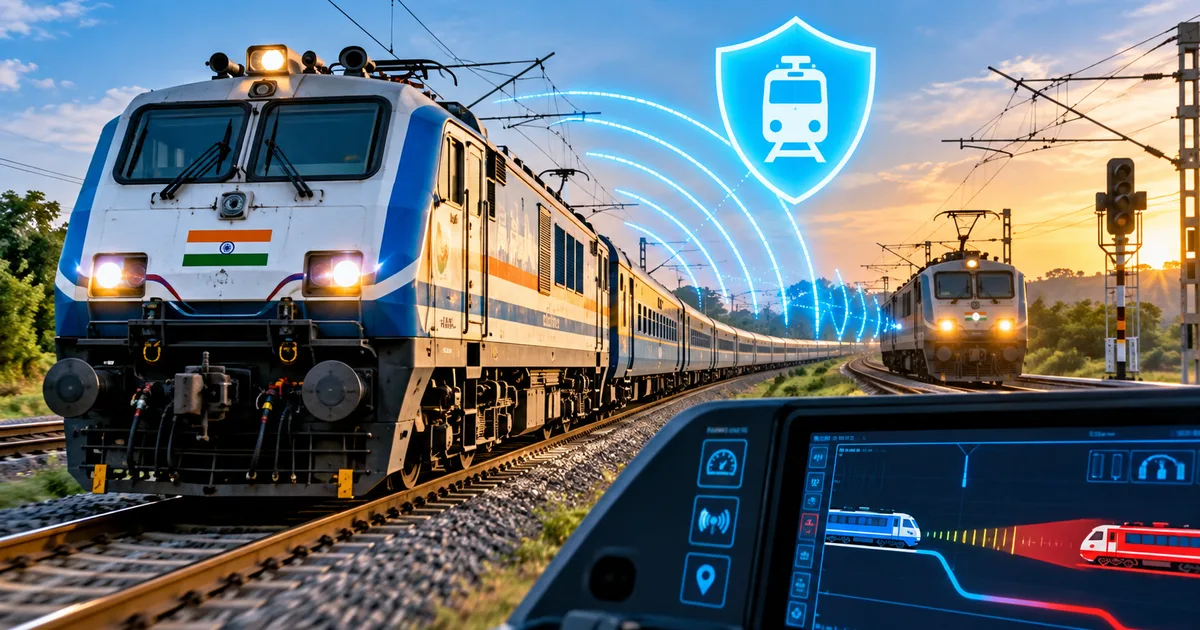
People often assume the trains use GPS to avoid each other. The reality is much more grounded. GPS can be completely unreliable in tunnels or thick forests (which makes sense, actually). Kavach relies on a localized radio network instead. There are four main components that make the whole thing work.
- Radio frequency identification tags on the tracks.
- An onboard computer inside the locomotive.
- Station master equipment at every railway station.
- Radio towers placed every few kilometers along the route.
Think of the track tags like the FASTag sticker on your car windshield. The railway engineers install these small tags on the sleepers between the rails. As the train passes over them, a reader underneath the engine scans the tag. This tells the train exactly where it is on the route. It knows its precise location down to the meter.
The onboard computer constantly calculates the train speed. It talks to the station master's equipment through the radio towers. The station master's system knows the status of all the signals in the area. It transmits this information directly to the display screen inside the driver cabin.
This changes everything, if you ask me. The driver doesn't have to lean out of the window to look for a red or green light in the pouring rain. The signal status is right there on the dashboard. If the signal is red and the driver doesn't slow down, Kavach sounds a loud alarm. If the driver ignores the alarm, the computer cuts off the engine power and slams on the brakes.
Handling a direct collision scenario
Imagine a worst-case scenario. Due to a manual signaling error, two trains end up on the same track heading straight for each other. This is exactly what happened in the tragic Odisha accident. That technology was absent there.
If both trains have Kavach installed, their computers constantly broadcast their location and speed to the local radio network. The system recognizes that two locomotives are occupying the same block of track. It triggers an immediate emergency stop for both trains. They come to a halt thousands of meters apart. No human intervention is required at all.
Thing is, the system handles speed limits automatically too. Say a train enters a loop line at a station where the speed limit is 30 kilometers per hour. But the train is doing 60. Kavach automatically brakes to bring the speed down. It protects against over-speeding just as much as it prevents collisions.
There is another brilliant feature called the SOS button. Let's say a train derails. A portion of it spills over onto the adjacent track. The driver can hit the SOS button on the console. This instantly sends a distress signal to all trains within a several-kilometer radius. Any train approaching that location on any track automatically stops. This prevents secondary collisions. Those secondary crashes are often more deadly than the initial derailment. This specific feature is designed exactly for the kind of multi-track chaos we see during major accidents.
Kavach 4.0 rollout and route updates in 2026
The 2026 updates are mostly about scaling up the deployment. Version 4.0 is a refined iteration. It incorporates all the lessons learned from the earlier pilot projects. The software handles the complex mix of slow passenger trains and fast express trains. It deals with heavy freight trains much better now too.
The commissioning of the 108 route kilometers on the Malkajgiri to Kamareddi section is the first step for this new version. But you have to look at the bigger picture. Right now, this technology protects only about 1,445 kilometers of track. India has over 68,000 route kilometers in total. That means we have covered barely two percent of the network.
The Railway Board has approved the installation of the system across thousands of kilometers. The physical work takes time though. They are prioritizing the high-density networks. The Delhi-Mumbai and Delhi-Howrah corridors are the absolute top priority. These routes carry the bulk of the country's rail traffic.
If you frequently travel on these major trunk routes, you will likely ride on a protected train within the next year or two. For branch lines and smaller regional routes, the wait is going to be much longer. I'm not exactly sure why the timeline is so delayed for the rural segments.
Why is the installation taking so long?
I get this question all the time from readers who follow our Latest Tech News section. If the tech works, why don't we just put it on every train tomorrow? The answer boils down to logistics and money.
Equipping a single kilometer of track with this system costs around 50 lakh rupees. You have to physically dig trenches to lay optical fiber cables. You have to erect radio towers on concrete foundations. And you have to screw thousands of RFID tags into the railway sleepers.
And that's just the track. You also have to modify the locomotives. Taking a train engine out of service to install screens and computers takes days. You have to fit the braking actuators too. The railways can't pull hundreds of engines out of service at the same time without causing massive train cancellations. The entire process is a mess.
Plus, there are only a handful of Indian vendors certified to manufacture this equipment. They have to scale up their factories to meet the massive demand from the railways. You can't just buy this stuff off the shelf from China or Europe. It has to be built here to meet Indian specifications.
Comparing our tech to global standards
European countries have used similar systems for decades. The European Train Control System is the gold standard globally. So why didn't India just buy the European system and install it here?
Cost is the biggest factor. The European system costs roughly two to three crore rupees per kilometer. The Indian version costs a fraction of that at 50 lakh rupees per kilometer. When you are dealing with a 68,000-kilometer network, that price difference is staggering.
The local system also handles Indian conditions better. Our trains run closer together. We have more level crossings. Our signaling logic is different. Building an indigenous system allowed engineers to tailor the software to our exact chaos. It has Safety Integrity Level 4 certification. That is the highest international standard for safety systems. It is just as reliable as the expensive foreign alternatives.
What commuters need to know
You won't notice Kavach working when you travel. There are no screens for passengers to look at. The only difference is that your train is far less likely to crash.
The government recently reported through the Press Information Bureau that there have only been two consequential train accidents so far in the 2026-27 financial year. That's a low number. But even one accident is too many. The focus on infrastructure upgrades is obvious. We have new Vande Bharat trains launching constantly. Speed means nothing without safety though.
If you're a tech enthusiast tracking software updates on your phone, like the Xiaomi HyperOS 2.0 India Rollout 2026, it's easy to forget that real-world hardware updates are much slower. You can't push an over-the-air update to a diesel locomotive.
The coming months will see more tenders awarded for track installation. The railways are targeting 5,000 to 6,000 kilometers of installation per year. At that pace, it will take over a decade to cover the entire country.
For those reading our Tech Explainers to understand the broader impact, this project is creating thousands of jobs. From the engineers writing the software in Hyderabad to the technicians laying cables in rural Maharashtra. It is a huge project. It builds local expertise in high-tech signaling. Indian companies can eventually export this to other developing nations.
Look, I think the railways need to find a way to speed this up. They need to approve more vendors and throw more budget at the problem. We have the technology to stop train collisions completely. We just need to find the political and administrative will to deploy it everywhere. Until that happens, we rely on the sharp eyes of the people driving the trains.