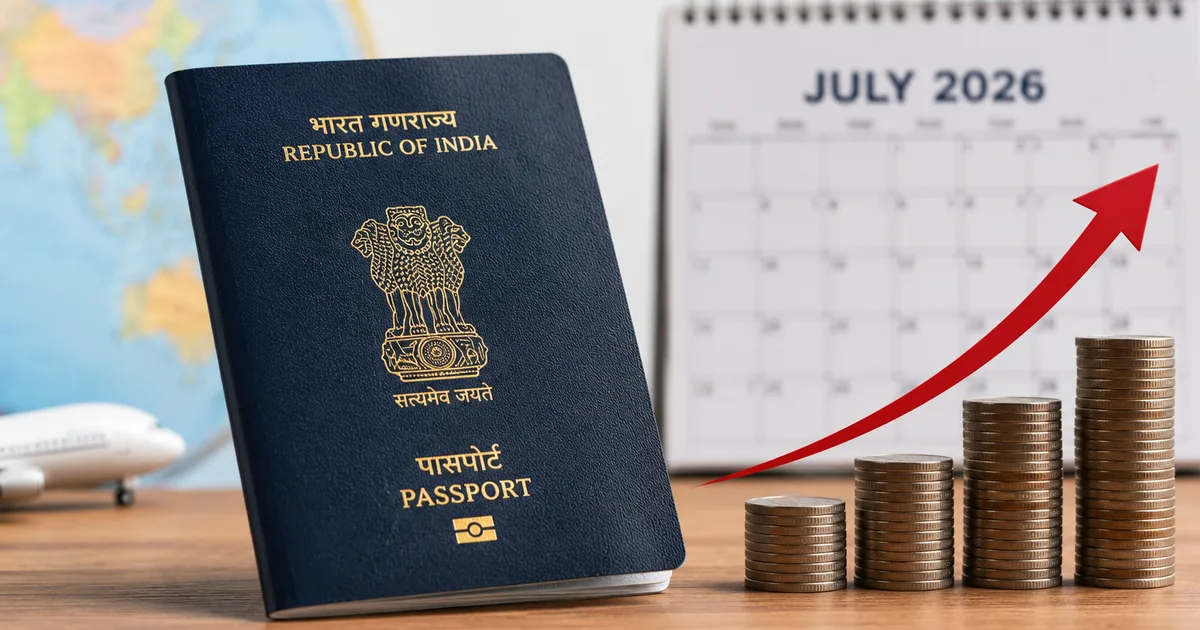
Imagine planning your dream vacation to Europe or booking tickets to visit family in Dubai, only to realize your passport's about to expire. You log onto the government portal, fill out the form, and get hit with a surprise at the payment page. The Indian passport fee hike July 2026 is officially here, and it makes getting or renewing your travel document more expensive. This is the first time the Ministry of External Affairs has revised the fee structure since 2012, ending a fourteen-year period of stable rates.
Why are passport fees increasing?
Look, nobody likes paying more for government services. But fourteen years is a long time. It's a huge gap to keep prices frozen. The Ministry of External Affairs released a notification on June 20, 2026, changing the fee system. Running the passport offices, security verification, printing high-quality booklets, and managing the online portal costs money. In my experience, these systems get expensive. So, the government says the increase is needed to cover rising administrative costs and help with new features like microchip-embedded e-passports.
Thing is, those old fees didn't reflect today's economic reality. Everything from paper to database management has grown more expensive since 2012. It's just facts. A thousand-rupee jump feels steep. But it's the price of keeping the passport system functional. If you want faster processing and better security, the funding has to come from somewhere.
The Ministry of External Affairs notified the Passports (Amendment) Rules, 2026, on June 20, 2026, revising the fee structure for the first time since 2012. The new rates take effect on July 1, 2026, and apply to all passport offices across India.
New passport rates for standard and tatkal services
Let's look at the actual numbers. That's what affects your wallet. The standard 36-page adult passport, which most people get, now costs 2,500 rupees for normal processing. If you want the larger 60-page jumbo booklet because you travel frequently, that'll cost you 3,500 rupees.
Tatkal services, which speed up things for urgent travel, also see a big jump. You'll have to pay 5,000 rupees for a standard 36-page Tatkal application. And the 60-page version is 6,000 rupees. Honestly, it's a lot of money.
This table shows the new fees.
| Service type | Booklet size | New normal fee (INR) | New Tatkal fee (INR) |
|---|---|---|---|
| Fresh or Reissue (Adult) | 36 pages | 2,500 | 5,000 |
| Fresh or Reissue (Adult) | 60 pages | 3,500 | 6,000 |
| Fresh or Reissue (Minor under 18) | 36 pages | 1,750 | 4,250 |
| Lost or Damaged Replacement | 36 pages | 5,000 | 7,500 |
| Lost or Damaged Replacement | 60 pages | 6,000 | 8,500 |
| Police Clearance Certificate (PCC) | N/A | 750 | N/A |
These rates apply directly to online applications.
For kids under 18, the fees are a bit lower. A normal 36-page child passport is now 1,750 rupees. But the Tatkal version is 4,250 rupees (which is quite a leap, actually). If you lose your passport or damage it, the replacement cost is 5,000 rupees for the standard booklet and 6,000 rupees for the jumbo one. These replacement charges double under Tatkal, reaching up to 8,500 rupees for a jumbo booklet. I think that's a bit steep. Also, even simple documents like the Police Clearance Certificate, commonly needed for work visas, now cost 750 rupees.
Who gets the 10% fee concession?
The Ministry of External Affairs has kept a small relief measure for specific groups. Under the Passports (Amendment) Rules, 2026, a 10% concession is available to two groups of applicants. I think that's nice.
First, senior citizens above 60 qualify. Second, kids up to eight years old also get the discount. It's a great move. Families traveling with toddlers will love it.
But there's a catch. You can only get this discount if you're applying for a fresh passport. If you're renewing an expired passport or replacing a lost one, you've got to pay the full fee. Also, the concession's only valid for applications submitted within India.
If you qualify, the standard normal fee drops to 2,250 rupees for a senior citizen, and a minor's normal fee becomes 1,575 rupees. Honestly, it's a decent gesture. Even if it's only for fresh applications. Every rupee saved helps when planning international travel.
Understanding validity and renewal rules
A standard adult passport is valid for ten years from the date of issue. Once those ten years are up, you can't use the passport. You have to apply for a reissue.
Many countries require your passport to have at least six months of validity left before they grant you a visa. You won't even be allowed to board your flight otherwise. So, even if your passport hasn't expired yet, you might need to apply for a reissue if you're planning a trip. I think it's always safer to do it early.
Minors get a passport valid for only five years or until they turn 18, whichever comes first. This is because kids' appearances change quickly. The passport photo needs to be updated. The government wants the biometrics and photo to stay accurate (which makes sense, actually).
When you apply for a reissue, the government charges the same rate as a fresh passport. Under the new rates, that's 2,500 rupees for a standard 36-page booklet. Remember, the 10% concession only applies to fresh applications, so seniors and minors will pay the full rate for renewals. In my experience, people always forget this.
You can apply for a renewal up to one year before the expiry date, or at any time after it has expired. If you change details like your name, address, signature, or spouse's name, you must also apply for a reissue and pay the new fee.
Normal versus Tatkal: which option should you choose?
With Tatkal rates rising to 5,000 rupees, you might wonder if it's worth paying double. The main difference is speed. If you aren't in a rush, normal is the way to go.
A normal application takes anywhere from seven to fifteen working days to process. This timeline depends heavily on how fast your local police department conducts the physical verification. I'm not sure exactly why it takes so long in some areas.
Tatkal applications are processed on a priority basis. The passport is usually printed and dispatched within one to three working days. You get it fast. But you pay a premium.
The catch is that police verification for Tatkal is done after the passport is issued, not before. This requires you to submit additional documents, like three specific identity proofs, to verify your identity. It's a bit more paperwork upfront. So, make sure you have all your files ready.
If you have an urgent flight or a sudden business trip, Tatkal is a lifesaver. But if you're planning a trip months in advance, normal processing is perfectly fine. It saves you 2,500 rupees. Honestly, spending extra money just to get the booklet a few days early isn't necessary for most people.
How to apply online using DigiLocker and UPI
The process of applying for a passport has become increasingly digital. I think it's generally a good thing. You don't need to visit a travel agent or pay extra fees to sketchy middle agents anymore.
To start, you need to do these steps:
- Create an account on the official portal.
- Fill out the personal details form carefully.
- Upload required documents from your digital wallet.
- Pay the revised application fee online.
The system is now integrated with DigiLocker. It lets you share documents like your Aadhaar card, PAN card, school certificates, or driving license directly. So you don't have to carry piles of paper. Using digital verification also speeds up the entire process.
Once the form's filled, you have to pay the fee online to book your appointment slot. You can pay using netbanking, debit cards, credit cards, or UPI.
If you get stuck, look at our online payment explainers for help.
After paying, you've got to visit the PSK on your scheduled date for fingerprinting and document verification. A police verification's then done at your address. Once that's cleared, your passport's printed and sent via Speed Post. It's a pretty smooth system, but you've got to be careful with the details. For example, your name on the application must match your Aadhaar card exactly, or the system'll reject it. If you want to avoid common mistakes, check our digital passport application guides.
With the fee hike making news, sketchy websites have popped up pretending to be the official portal. They charge extra fees under the guise of the new rates. It's a mess. We've documented these tricks in our report on passport portal scams to keep you safe. Always double-check that the URL ends in gov.in before entering details or making payments.