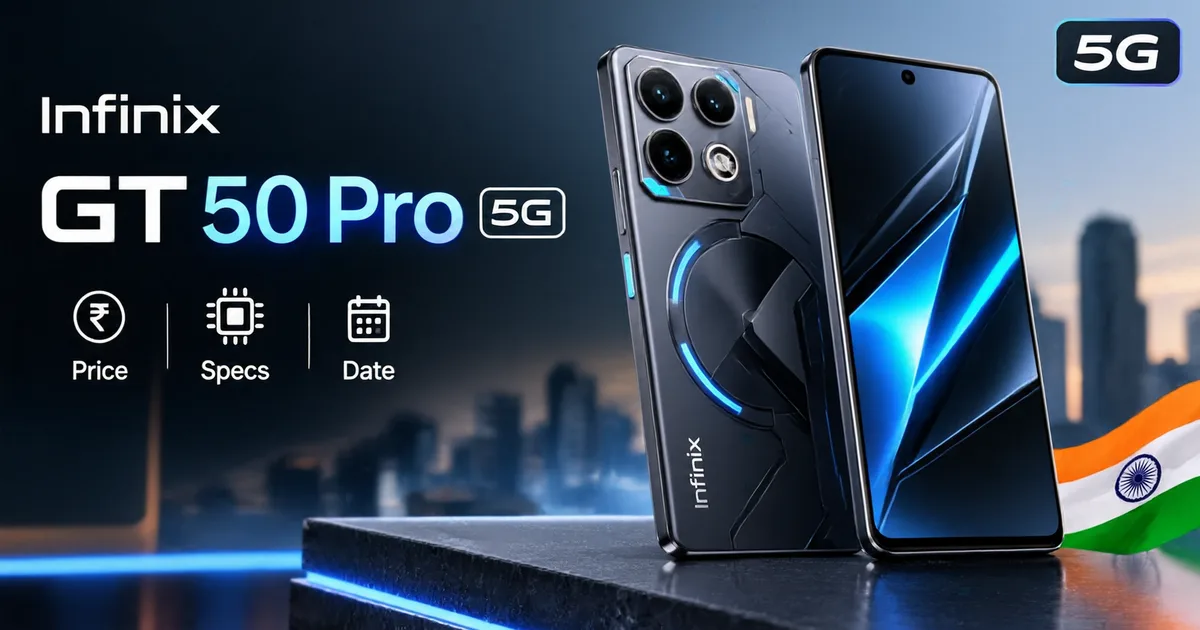
If you've been keeping an eye on aggressive gaming phones lately, you know Infinix loves doing things that look slightly unhinged. The upcoming Infinix GT 50 Pro 5G is no exception. After weeks of teasers and a community click-meter campaign on its website, Infinix confirmed that the phone will officially land in India on October 27, 2026. It'll sell exclusively through Flipkart. And it's aimed straight at competitive BGMI players who want dedicated physical triggers without taping cheap plastic attachments onto their screens.
I tracked the global rollout back in April when this phone first surfaced in Indonesia. The rear panel looks like something pulled straight out of a cyberpunk anime, complete with a tiny glass window showing actual liquid coolant moving through miniature tubes. It sounds wild. But in my experience, six months is an eternity in the Indian smartphone market. By the time a phone takes half a year to cross the Indian Ocean, rivals have already launched newer processors and slashed their prices. So is this new GT model still worth your cash?
Infinix GT 50 Pro 5G launch date and Flipkart availability
The official date is locked. Infinix set the Indian launch for October 27, 2026, through an exclusive deal with Flipkart. If you follow our latest smartphone news, you might remember that Infinix ran a community voting counter called Game Together to tease this exact date. Once fans clicked the counter enough times, the launch poster dropped.
Here's the catch with timing.
The global version debuted on April 24, 2026. That means Indian buyers get hardware engineered in early 2026 while walking into the festive shopping rush late in the year. Honestly, I'm not sure exactly why Infinix waited half a year (customs clearance always feels messy), but usually the gap is just a few weeks. If you ask me, that delay hurts. A six-month gap means the phone has to compete against newer silicon that launched while this device sat in testing labs and warehouses. Still, Flipkart will likely push early-bird bank discounts and no-cost EMI options right from day one.
Expected price in India and the competition
Infinix has kept the official price under wraps, but local retail leaks point to a window between ₹30,000 and ₹35,000. That's a noticeable jump. For comparison, the older GT 20 and GT 30 Pro series sat comfortably in the ₹23,000 to ₹26,000 range. Stepping past ₹30,000 puts Infinix into an entirely different ring.
Look, I think ₹30,000 is where Indian phone buyers stop forgiving small software bugs or average cameras. At ₹24,000, you tolerate quirky software because the gaming hardware punches above its weight. Above ₹32,000, you're competing directly with heavyweights. You can check the iQOO 16 5G gaming performance numbers to see just how fierce this territory gets when newer silicon enters the picture.
Here's how the pricing math looks for different buyers:
- Base variant with 12GB RAM and 256GB storage expected around ₹30,999 before card discounts
- Top configuration with 512GB fast storage likely pushing ₹33,999 to ₹34,999
- Introductory bank offers with SBI or HDFC credit cards could knock roughly ₹2,000 off the sticker price during launch week
If Infinix manages to price the base model at ₹28,999 with bank offers, it'll grab serious attention. But if it creeps past ₹33,000 on Flipkart, it's a much tougher sell for casual gamers who just want reliable daily performance.
Hardware specs and gaming performance
Under the hood, the GT 50 Pro runs on the MediaTek Dimensity 8400 Ultimate chip paired with Mali-G720 MC7 graphics. It's built on a 4nm process. So you get snappy CPU clock speeds and solid power efficiency when gaming hard. Memory is just as generous. The phone has 12GB of fast LPDDR5X RAM and up to 512GB of UFS 4.1 storage.
What does this mean for BGMI and Call of Duty Mobile?
Basically, you get smooth 90fps gameplay without frame drops during chaotic firefights. In my experience, the Dimensity 8400 handles long gaming sessions without choking. You can compare it directly with the Redmi Note 17 Pro 5G specifications to see how mid-range chips stack up against each other right now. Normal tasks like juggling WhatsApp and downloading files on Jio 5G run without a single hiccup.
Display quality and high touch sampling
The screen is easily one of the best parts of this phone. You get a 6.78-inch LTPS AMOLED display with a crisp 1.5K resolution (1208x2644 pixels). It has a dynamic refresh rate between 30Hz and 144Hz. So it shifts automatically whether you're reading an article or sprinting across Erangel in BGMI.
Peak brightness hits 4,500 nits. That sounds like marketing exaggeration (marketing numbers are always a bit crazy, I know), but in daily use, high brightness is a blessing. If you ask me, outdoor visibility matters way more than synthetic benchmarks. Whether you're trying to read Google Maps under the scorching May afternoon sun in Delhi or checking train schedules on an open railway platform, the panel stays clear. And Corning Gorilla Glass 7i protects the front glass against pocket scratches from loose coins and keys.
The HydroFlow liquid cooling system explained
Now for the headline party trick: the HydroFlow Liquid Cooling setup. Most gaming phones only mention vapor chambers. Infinix went a step further by packing an actual micro-pump network into the chassis. Two tiny pumps circulate liquid coolant through miniature channels across the motherboard. Even wilder, the back panel has an Explicit Viewport Design. That's a transparent window where you can watch the liquid coolant move while you play.
Right next to the cooling window is a set of Mechanical Lighting Waves. These are four RGB light strips arranged in a crosshair layout. You get 14 distinct lighting effects and eight customizable colors that flash for incoming phone calls, WhatsApp pings, music playback, or gaming kills. You can pick between two body finishes: Black Abyss with neon green cooling accents, and Red Blaze with crimson trim. Both have a textured Kevlar-style back built on a lightweight composite sheet.
Active liquid cooling sounds impressive on paper, but running mechanical micro-pumps inside a tight chassis drains battery noticeably faster during long gaming sessions.
Thing is, there's a real trade-off here. Running active pumps takes battery power. In my view, watching coolant circulate is a neat gimmick, but it definitely costs you battery life. Testing from global units shows that keeping the micro-pumps buzzing during marathon gaming sessions eats roughly an extra hour of total screen time compared to passive cooling designs. It keeps processor throttling at bay, but your battery percentage drops faster. That's just physics.
GT Trigger shoulder buttons and physical controls
If you play competitive shooters, the GT Trigger 2.0 system is the feature you'll care about most. Built right into the top edge are two pressure-sensitive capacitive shoulder buttons. When you hold the phone horizontally, your index fingers rest naturally over them.
You can map each trigger to any on-screen button inside your game. That means you can aim down sights and fire weapons using your index fingers while your thumbs stay glued to the movement stick and camera view. It gives you an instant four-finger claw layout without giving yourself nasty thumb cramps. In my experience, once you get used to shoulder buttons in BGMI, going back to glass controls feels clunky. Beyond gaming, you can also set the triggers to zoom the camera or launch specific apps like UPI payment scanners. Check our mobile gaming guides for setup tips on dialing in your sensitivity.
Battery capacity, charging speed, and daily use
To feed the power-hungry 144Hz screen and active cooling pumps, Infinix packed a hefty 6,500mAh battery into the phone. That's substantially bigger than the standard 5,000mAh packs found in most mid-rangers. Even with the liquid cooling pumps running during an evening gaming session, you easily get a full day of heavy use before hunting for a wall plug.
Charging speeds are a bit of a mixed bag:
- 45W wired charging fills the 6,500mAh cell from empty to full in approximately 65 to 75 minutes
- 30W wireless charging gives convenient cord-free power on compatible desk pads
- 10W reverse wired charging lets you use the phone as a power bank to top up your earbuds or a friend's phone in a pinch
While 45W is decent, rivals in India offer 80W or 100W charging at this price point. A 6,500mAh cell takes real patience to fill at 45W. Honestly, in my experience, waiting over an hour feels slow once you're used to rapid top-ups. On the camera front, you get a 50MP primary shooter with optical image stabilization and an 8MP ultrawide lens. It snaps clean daytime photos for Instagram. But low-light shots are pretty average compared to camera-first phones.
Should you wait for the Infinix GT 50 Pro 5G?
The answer comes down to what you actually care about in a phone. If you're an avid BGMI or Free Fire player who wants physical shoulder buttons and a liquid-cooled chassis, the GT 50 Pro has hardware that almost nobody else builds in the sub-₹35,000 range. You get real gaming ergonomics. And in my experience, those physical triggers genuinely help your reaction times in clutch matches.
On the flip side, that six-month delay from its April global release means you're buying earlier 2026 silicon just as newer chips hit Indian shelves. If Infinix prices the base model around ₹29,999 on Flipkart with bank discounts, it's a solid gaming package. But if the price climbs closer to ₹35,000, rival brands are going to give you faster raw chips and far longer software support.