Look, I get it. Every time you open Twitter or read the morning paper, there's some new update about the ISRO Gaganyaan Mission 2026 project. One day it's launching tomorrow. The next day they're testing a parachute. And the day after that, people are arguing in the comments about whether it's happening in 2026 or sometime in the next decade. It's confusing.
Sending humans to space is ridiculously hard. You're putting actual Indian citizens on top of a controlled explosion. Then you send them 400 kilometres straight up, keep them alive for a few days in a vacuum, and drop them back into the Bay of Bengal safely. And ISRO is trying to do it on a budget that makes NASA look like they're burning cash for fun. The stakes couldn't be higher. One mistake, and it's a national tragedy.
Basically, we need to look at the actual status right now. When are we actually launching people? Who are the guys strapping themselves into this rocket? I've been digging through the recent ISRO updates, including the ones from just this July, to make sense of the timeline and the tech.
What actually is the Gaganyaan mission?
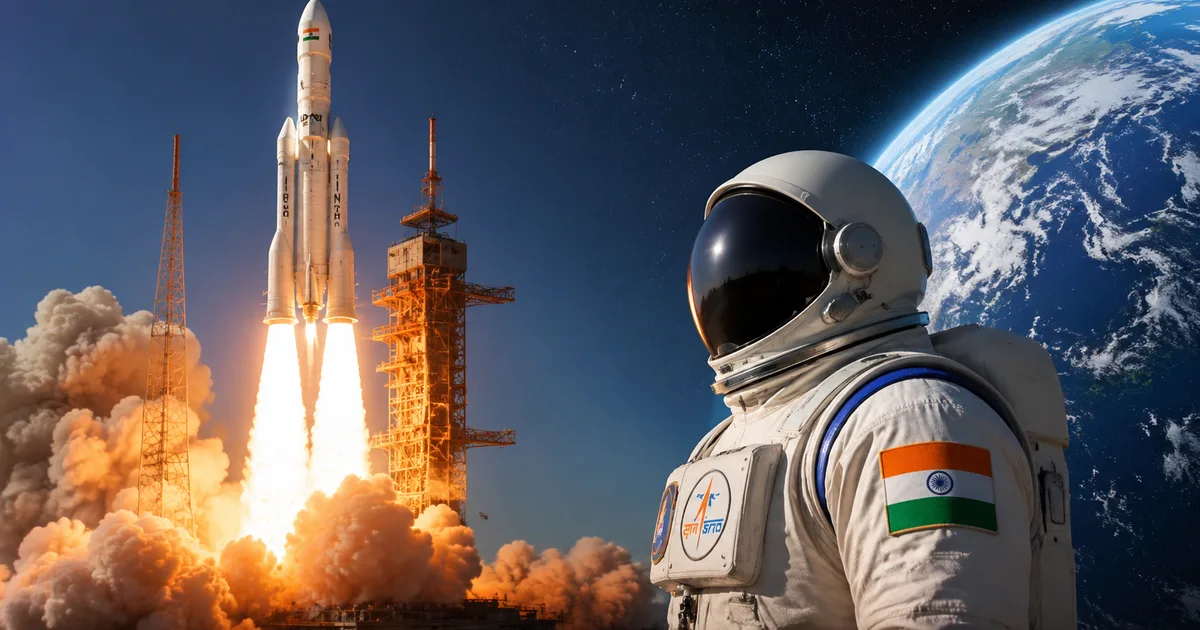
Gaganyaan is a massive human spaceflight program. The end goal is to send a crew of three Indian astronauts into an orbit of 400 km for a 3-day mission and bring them back safely to Earth. If we pull this off, India will be only the fourth country in the world to do human spaceflight independently. We join Russia and the US. We also join China. We stop being just a country that launches satellites. We become a country that explores space.
You can't put people in a rocket on day one and hit launch (obviously). That's a recipe for disaster. So ISRO has to run a whole series of uncrewed missions first. They call these the G-1, G-2, and so on.
These test flights are exactly what they sound like: sending up the rocket and the crew module entirely empty, or maybe with a humanoid robot named Vyommitra. This is how they make sure the tech won't fail when real lives are on the line.
Getting the tech right means upgrading almost everything ISRO usually uses. We're talking about "human-rating" the LVM3 rocket. The LVM3 is our heaviest lifter, the beast that launched Chandrayaan. Human-rating means taking their biggest launch vehicle and upgrading its safety margins to be absolutely bulletproof for human beings. They've added something called a Crew Escape System. This is basically a giant eject button. It rockets the crew module away if the main rocket fails on the launchpad or during the flight.
The launch date confusion: Will it happen in 2026 or 2027?
When are we actually going to see Indians in space on an Indian rocket? I wish I had a simple, clean answer. I don't. The official timeline has shifted a few times because ISRO refuses to rush this. Honestly, I think this is actually a good thing. Space is unforgiving. Rushing gets people killed.
"The launch date of the first uncrewed mission of Gaganyaan will be announced soon, as we are completing the final safety assessments."
Recently, there was a lot of buzz about the G-1 mission. The ISRO Chairperson mentioned they'd be announcing the launch date for the first uncrewed mission soon. According to The New Indian Express, G-1 could happen in three to four months, which puts it right at the end of 2026. But other statements from officials reported by The Hindu point to a first launch in the third quarter of 2027.
I'm not sure exactly why the dates are so scattered, but safety assessments are definitely causing delays. A report from TheWire.in pointed out that the Gaganyaan mission could face delays because ISRO is doing intense, ongoing safety checks. Just this July, ISRO announced they successfully completed three major qualification tests on the Gaganyaan crew module. They also tested the SOLVE motor at Sriharikota to check the parachute safety.
These are massive milestones. They prove the hardware can actually survive the trip.
Expect the uncrewed test flights (G-1 and maybe G-2) to happen between late 2026 and 2027. The actual crewed flight, the one with the astronauts, is probably pushed beyond that. Maybe late 2027. Maybe 2028. Better safe than sorry. I'd rather they delay it by two years than take a 1% risk with our astronauts' lives.
Who are the astronauts?
You've probably seen their faces by now. They were introduced to the public earlier this year, and they instantly became national heroes. Test pilots are a different breed. They're used to flying experimental aircraft where things go wrong. And they know how to stay calm when alarms start blaring.
The four Indian Air Force test pilots selected for the mission are:
- Group Captain Prasanth Balakrishnan Nair
- Group Captain Ajit Krishnan
- Group Captain Angad Pratap
- Wing Commander Shubhanshu Shukla
They've been training for years. They did a long stint in Russia at the Yuri Gagarin Cosmonaut Training Center to learn the ropes of spaceflight and survival techniques. They also learned how to handle a Soyuz capsule. Now, they're doing their specific mission training right here in India, at the Astronaut Training Facility in Bengaluru. They spend hours in simulators, learning every single button and switch inside the Gaganyaan module.
Only three of them will fly on the actual mission. But all of them need to be completely ready (which makes sense, actually). Watching them get introduced to the country made the whole Gaganyaan project feel incredibly real. It's not just an abstract engineering challenge anymore.
What happens during the actual flight?
Let's map out exactly what will happen when the final crewed mission actually launches. The LVM3 rocket will blast off from the Satish Dhawan Space Centre in Sriharikota. Within just 16 minutes, the rocket pushes the crew module into a Low Earth Orbit of 400 kilometres. At that point, the astronauts experience zero gravity.
For three days, they'll circle the Earth. They're going to conduct microgravity experiments and test all the indigenous systems on board. It's not just a sightseeing trip. They have a strict schedule of tasks to complete while floating in space. Every second of those three days is planned out by the mission control team back in Bengaluru.
The return trip is the scariest part. The module has to orient itself perfectly to re-enter the atmosphere. The heat shield will glow red hot as the capsule slows down from orbital velocity. Then, at around 5 kilometres above the ocean, the massive main parachutes will deploy. Finally, the capsule splashes down in the Bay of Bengal, where Indian Navy ships will be waiting to pull the astronauts out. This whole recovery operation is a massive logistical challenge that the military has been practicing for months.
The space tech upgrades keeping them alive
The hardware is completely new. Sending humans up means building an Environmental Control and Life Support System (ECLSS). This system provides oxygen and removes carbon dioxide. It also keeps the temperature and pressure normal inside the capsule while outside it's a freezing, airless vacuum. You need a system that works perfectly for days without failing.
ISRO built this entirely from scratch. You can't buy this stuff off the shelf. They also designed special space food, engineered by the Defence Food Research Laboratory (DFRL) in Mysuru. They have space idlis and chicken curry. There is also space moong dal halwa. Because even in space, you need proper Indian food to keep morale up.
The crew module itself is a double-walled structure. The inner pressurized structure keeps the astronauts alive, and the outer unpressurized structure handles the extreme heat of re-entering the Earth's atmosphere. Plunging through the air so fast heats the outside of the ship to thousands of degrees. You need serious thermal protection tiles for that. Once you survive the heat, you need massive parachutes to slow the capsule down before it hits the water. They ran the SOLVE motor test at Sriharikota to make sure the parachutes deploy perfectly every single time.
Behind the scenes challenges at ISRO
Thing is, it's not all smooth sailing at ISRO headquarters. There's been some worrying news lately. WION reported on an internal government memo directing ISRO to closely scrutinise scientist resignations. There's a talent exodus, and they face staff shortages.
Private space companies in India and abroad pay massive salaries. It's hard to keep top engineers on government pay scales. A senior engineer at a private space startup can make multiples of what a senior scientist at ISRO makes. This is a real problem. Gaganyaan needs the brightest minds staying focused on the mission. The government putting curbs on resignations is a bit of a mess, but it shows how desperately they need to keep the engineering team together to hit these launch dates.
Why are we spending money on this?
People ask why India is spending over ₹9000 crores on this space mission when we have problems like poverty and infrastructure issues here on Earth. Why look up when we have problems down here?
The tech developed for Gaganyaan will be useful on Earth too. The materials developed to withstand re-entry heat and the advanced life support systems will make it to the public. They eventually find their way into everyday technology and advanced medical equipment. They'll even be used in new software tools right here in India.
It sets India up for the next 50 years of space exploration. ISRO is talking about building a Bharatiya Antariksha Station by 2035 and sending an Indian astronaut to the Moon by 2040. You can't do any of that without Gaganyaan. It's the foundational step. If we want a seat at the table in the future space economy, we have to invest now.
How to avoid Gaganyaan related scams
Whenever a huge national project like this is in the news, scammers start working overtime (annoying, I know). Be extremely careful if you see WhatsApp messages claiming you can "invest in Gaganyaan" or "buy ISRO shares" for guaranteed returns. There are fake job offers circulating, claiming to be from ISRO for the Gaganyaan project, asking for a "processing fee" or security deposit to secure an interview.
ISRO is a government body. They don't ask for investment money on WhatsApp. They don't charge processing fees for job applications through random UPI links. If you see something sketchy, don't pay. Report it immediately on the official cybercrime.gov.in portal or call the 1930 national cyber helpline. Stick to verified news sources for any information.
The bottom line
The ISRO Gaganyaan Mission 2026 timeline is fluid. They're doing exactly what they should be doing: prioritising safety over political deadlines. The uncrewed flights are getting much closer. The crew capsule tests are passing with flying colours, and the astronauts are ready. We're realistically looking at late 2026 or 2027 for the uncrewed action to begin, and a bit later for the human flight.
It's a long wait. But when that massive LVM3 rocket finally lifts off from Sriharikota with our astronauts inside, it's going to be a huge deal for the country. I'll be watching it live.