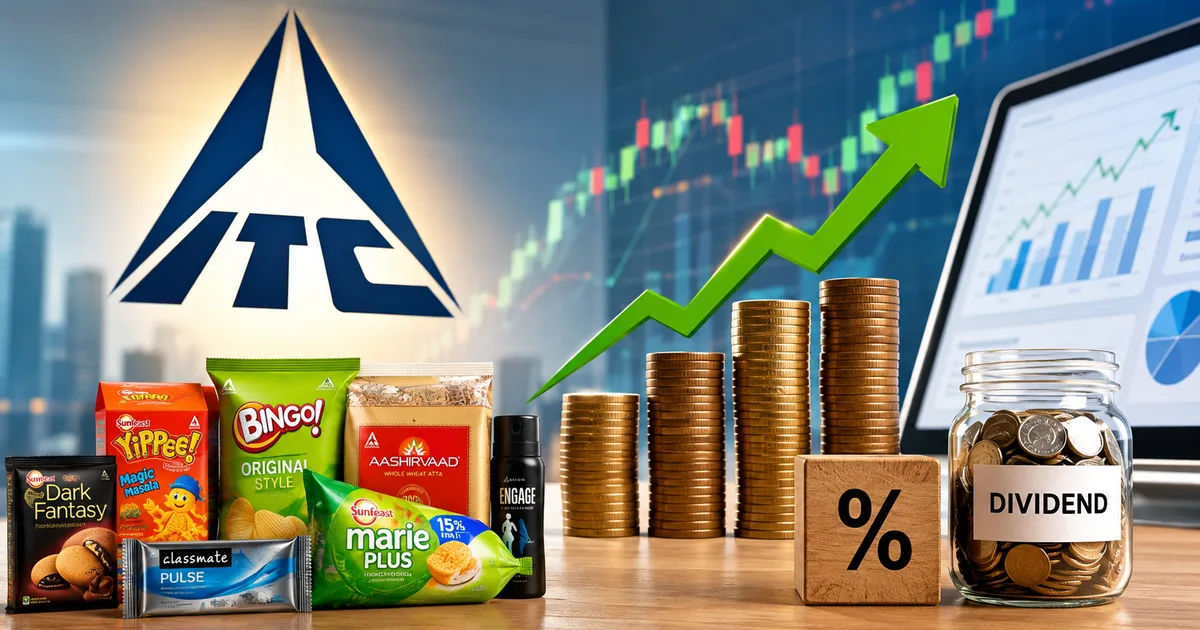
If you track Indian stocks, you probably saw the numbers flash across your screen this morning. The ITC Q1 2026 results are finally out, and honestly, they are a mixed bag. You have massive sales growth on one hand. But a profit drop caught a lot of retail investors totally off guard.
I get it. Looking at quarterly earnings reports can feel like reading a foreign language. You see terms like EBITDA margins and PAT thrown around on business channels, and it just sounds like noise. But if you hold ITC shares in your Zerodha or Upstox account, or even if you just buy Aashirvaad atta and Sunfeast biscuits every month, this stuff actually affects you.
This is exactly what happened with ITC between April and June 2026. No finance jargon. Just plain English.
The big picture: high sales, low profit
ITC reported a net profit of ₹3,579 crore for the quarter ended June 30, 2026. That sounds like a lot of money. But it's actually a 27% drop compared to the same period last year. In my experience, analysts expected better numbers. And missing those estimates is why the stock price reacted early in the trading session.
But the revenue from operations actually jumped by 28%. Yes, you read that right. They sold way more stuff, but made way less profit doing it. Basically, they generated huge top-line revenue, but the money left over after paying all the bills shrunk significantly.
How does a massive company sell 28% more goods and somehow make 27% less money? (I know, sounds complicated, but it isn't really). It usually comes down to margins and taxes.
The cigarette tax problem
We need to look at cigarettes. ITC still makes a huge chunk of its money from selling cigarettes like Classic and Gold Flake. The recent cigarette tax hikes have seriously squeezed their profits. Look, when the government raises taxes on tobacco, companies like ITC have two choices. They can absorb the cost, which hurts their profit margin. Or they can pass the cost on to the consumer by raising prices.
ITC chose to hike prices across its cigarette portfolio. But there's a limit to how much you can charge before people just buy fewer cigarettes or switch to cheaper illicit alternatives. You can't just price a pack of Gold Flake at ₹500 and expect sales to stay flat. Business Today reported that cigarette volumes might fall sharply because of these price hikes. That volume drop hits the bottom line hard. People are either smoking less, or they're buying sketchy smuggled brands that don't pay Indian taxes.
The maker of Sunfeast biscuits and Aashirvaad atta undertook price hikes across its cigarettes, FMCG, and paper businesses to mitigate the impact of the ongoing West Asia crisis.
This quote from Moneycontrol perfectly captures the situation. The company is trying to manage rising costs, but it's an uphill battle right now. You fix one problem by raising prices. Then you create another problem by losing sales volume. I think it's a tough spot to be in.
Beyond smokes: FMCG and paperboards
ITC isn't just a tobacco company anymore. They make everything from notebooks to instant noodles. I think this non-cigarette FMCG segment is super important for their long-term survival, especially since the government will never stop taxing tobacco.
The FMCG segment did okay on the sales front, but the profit margins are under pressure here too. Why? Raw material costs are up. The ongoing crisis in West Asia messed up global supply chains. So it's more expensive to manufacture and ship goods. ITC had to raise prices on its FMCG products as well to protect their margins.
Think about your own grocery bills. When the price of Aashirvaad atta goes up by a few rupees, you notice. If prices go up too much, Indian consumers will just switch to a local brand or buy loose atta from the neighborhood kirana store. The FMCG market in India is incredibly price-sensitive. Maintaining margins while pushing for volume growth is basically a tightrope walk for ITC management. They're competing with giants like Hindustan Unilever, but also with regional brands that operate on wafer-thin margins.
The paperboards and packaging business didn't do them any favors this quarter either. That segment has been struggling with weak demand and cheap imports, mostly from China. This drags down the overall company profit. When Chinese paper floods the Indian market at rock-bottom prices, Indian manufacturers like ITC simply can't compete on price without destroying their own profitability. (Which makes sense, actually, given the cost differences).
What this means for your dividend payout
This is probably the part most retail investors care about. ITC is famous for its dividends. Many older Indian investors literally treat ITC stock like a fixed deposit. They rely on those regular dividend payouts for income.
So, does a 27% profit drop mean your dividend is in trouble?
Probably not. ITC has a massive cash reserve and a long history of rewarding shareholders. In my experience, even with a bad quarter, they usually maintain their dividend payout ratio. You'll still likely see that money hit your bank account linked to your demat account. Just keep an eye on the official BSE or NSE filings for the exact record date. Companies hate cutting dividends because it signals weakness to the market. And ITC takes its reputation as a dividend aristocrat very seriously.
If you need a refresher on how dividends are taxed in India under the latest rules, we have a few basic finance explainers you can check out. Remember that dividends are now added to your total income and taxed at your applicable slab rate. This changes the math for high earners.
The impact on the share price
Stock markets hate surprises. And they really hate it when a major blue-chip company misses earnings estimates. The news of the 27% profit drop naturally put pressure on the ITC share price. When you log into your brokerage app, you might see some red in your portfolio.
But you have to remember that ITC is a heavyweight on the Nifty 50. It doesn't usually crash 20% in a single day like some small-cap tech stock. Institutional investors like LIC and big mutual funds hold massive chunks of ITC. They don't panic-sell over one weak quarter. They look at the next five years, not the last three months. They know that FMCG is a cyclical business. A bad quarter doesn't mean a bad company.
Analysts are definitely revising their target prices downward, though. Business Standard noted that analysts foresaw a weak quarter. They expected a 10-13% dip in revenue and PAT. The actual 27% profit drop was a mess, worse than many expected. Even if the revenue numbers surprised on the upside by jumping 28%. That disconnect between revenue growth and profit decline is what makes this specific earnings report so weird to read.
Broader economic context in India
You can't look at ITC's results in isolation. The Indian economy is going through a weird phase right now. We see strong GDP growth numbers from the government, but rural consumption has been patchy at best. Companies rely heavily on rural India buying their soaps and biscuits. If rural wages aren't growing fast enough, FMCG companies feel the pain instantly.
Plus, inflation is still annoying (I know, tell me about it). Food inflation changes how much disposable income a middle-class Indian family has. If tomatoes and onions cost a fortune, people aren't going to buy premium cookies or expensive body wash. They stick to the basics. This directly impacts the product mix ITC sells. It forces them to sell more low-margin items instead of their high-margin premium stuff.
And let's not forget the regulatory environment. The GST council and the central government frequently tweak tax rates. Tobacco is an easy target for tax hikes because it's a sin good. The government needs revenue, and raising taxes on cigarettes rarely faces much political backlash. If you ask me, ITC just has to live with this constant regulatory risk as a core part of their business model.
Digital payments and the rural supply chain
One interesting aspect is how ITC manages its massive rural distribution network. They rely heavily on the e-Choupal network to get agricultural goods directly from farmers. This system is heavily integrated with digital payments now. Farmers get paid via UPI and direct bank transfers linked to their Aadhaar cards. That cuts out middlemen and improves efficiency.
But even with these tech upgrades in the supply chain, if the end consumer in a village doesn't have the cash to buy a packet of Bingo chips, all that efficiency doesn't translate into profit. The numbers here are a bit fuzzy, honestly. But the rural slowdown is real. And it's showing up in the balance sheets of every major consumer goods company in India this quarter.
What should retail investors do?
I'm not a SEBI-registered investment advisor, so this isn't financial advice. Always do your own research. But generally speaking, there are three ways people look at ITC right now.
- If you bought ITC purely for the dividend yield, a single bad quarter probably doesn't change your thesis. You hold, collect your dividends, and ignore the daily stock price fluctuations. You treat it like a bond that occasionally grows in value.
- If you bought ITC hoping the stock price would double in two years, you might be disappointed. The cigarette business is a cash cow, but it isn't a high-growth engine anymore. And the FMCG business faces brutal competition from Hindustan Unilever, Britannia, and even regional players.
- Some people are holding out for the hotel business demerger. ITC is spinning off its hotel business into a separate listed entity. If you hold ITC shares, you will get shares in the new hotel company. Some investors believe this will unlock hidden value.
If you're confused about how to analyze stock fundamentals, there are plenty of free screener tools available online that can help you track ITC's historical performance and compare it to its peers in the FMCG sector.
Looking ahead to the next quarter
The next few months will be interesting for ITC. The festive season starts kicking in around September with Ganesh Chaturthi, leading up to Diwali. This is traditionally the strongest period for FMCG companies in India. People buy gifts and stock up on snacks. A good monsoon season could also put more money in the hands of rural consumers. That would be a massive relief for ITC's volume growth.
ITC's management will be hoping that the upcoming festive demand can offset some of the margin pressures they faced in Q1. They're also investing heavily in their agri-business and IT services segments. They want to diversify their revenue streams even further away from tobacco.
The hotel business is another bright spot. Domestic tourism in India is booming. People are traveling more than ever, and ITC's luxury hotels are seeing strong occupancy rates and higher room tariffs. It's a smaller part of their overall revenue. But every bit helps when the core cigarette business is struggling with taxes.
I'm not sure exactly how long it will take, but we'll have to wait until October or November to see if they can bounce back in Q2. Until then, the stock might just remain range-bound. That will test the patience of retail investors who are hoping for a quick breakout.
Keeping track of corporate earnings can feel like a full-time job. But understanding how a giant like ITC navigates taxes and inflation actually shows you a lot about how the Indian economy works. If you want to get deeper into how other major Indian companies are performing this quarter, keep an eye on our market guides for more simple breakdowns. Honestly, it's better to understand the numbers than to just blindly follow stock tips on WhatsApp.