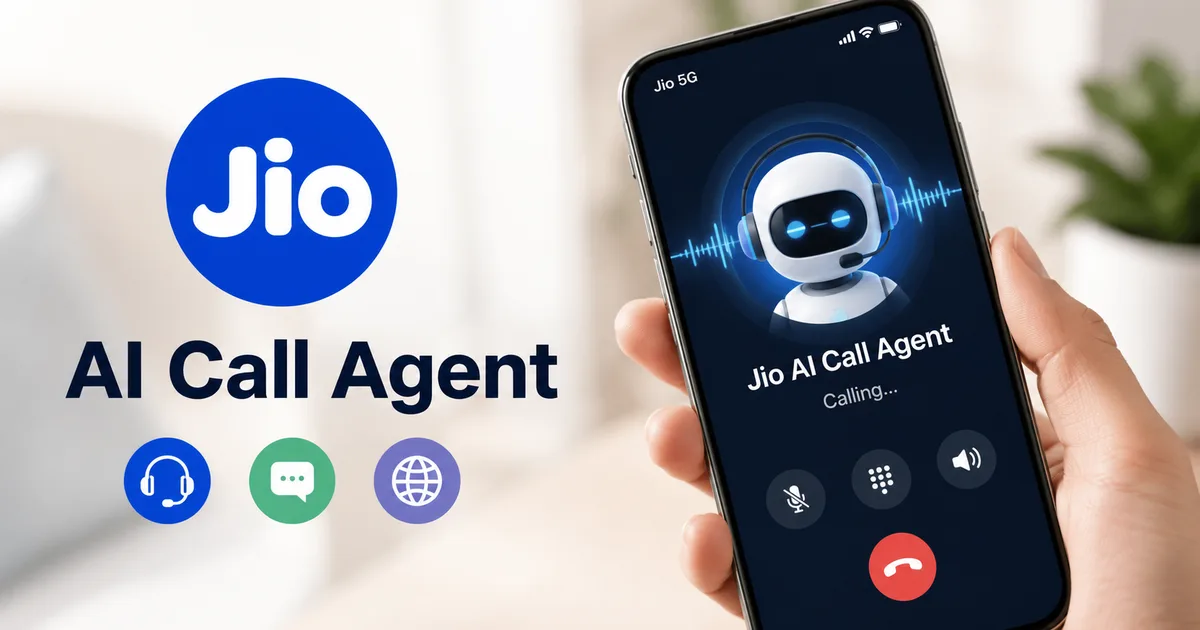
Reliance just finished its 49th Annual General Meeting on June 19, 2026, and they made a massive announcement. Instead of launching another app that you'll probably download and forget, they're putting AI right into your phone calls. It's called the Jio AI Call Agent. The company wants this to act as a free voice assistant for its 500 million subscribers. (I know, it sounds like sci-fi, but it's actually happening). You don't need to install anything from the Google Play Store or buy a premium subscription. If you have a Jio SIM, it works directly over the carrier network.
This new development changes how we handle daily phone calls. Honestly, standard calls haven't changed in ages, but this is different.
What is the Jio AI call agent?
The assistant lives right inside Jio's telecom network. And during the AGM, Mukesh Ambani explained how the company wants to put AI into calls, homes, devices, and applications. (Which makes sense, actually, given their scale). When you're on a phone call, this agent can just join in. If you ask me, that's pretty wild. It listens to you, takes notes, translates the speech, and writes a quick summary at the end.
Every day, you get spam calls. At least three of them. Sometimes it's a robotic voice warning that your power is getting cut, and other times it's a real agent pushing a card you don't even want. If you're busy at work, it's a total pain. Jio's AI Call Agent wants to fix this whole mess. So when a call comes in, you just route it to the assistant. It answers the call, asks what they want, transcribes the audio, and shows it on screen. You'll see the live text pop up. If it's a real caller, you pick up. If it's spam, you block them. The system is more than a basic blocker. It is a live filter.
Jio users get this for free, at least during the initial rollout. Reliance wants to make AI accessible to everyone. Even people who can't afford high-priced subscriptions get to use it, which is a great move in my book.
How the network-native assistant actually works
Most AI apps like ChatGPT or Gemini make you open an app or type things out. This is different. It's network-native. Basically, the AI runs on servers owned by Jio and Meta in Jamnagar. When you're on a call, you just press a button or say a command to bring the assistant in. I think this makes the whole setup extremely smooth.
Jio built this infrastructure with Meta. They recently set up a massive AI-ready data center in Jamnagar, Gujarat. The facility has thousands of GPUs to process the voice data. When you speak, the audio goes straight to Jamnagar. The AI converts the audio, processes the text, translates everything, and sends it back as voice or text. And since this happens in India, the latency is low. You won't get a five-second delay between sentences. But there's a catch. If you're in a basement or a remote village with sketchy network coverage, the system'll lag. (Which makes sense, honestly). The AI needs a stable connection to process the voice data.
So how does it handle the heavy lifting? Jio runs the models on their cloud. You don't need a fancy phone with a powerful NPU. Even a basic JioBharat phone under Rs 1,500 works. If you ask me, this is smart. It brings tech to rural users who don't have expensive flagships.
Language support and the JioBharatIQ push
India has hundreds of languages and dialects. An English-only tool is useless for most people here. So Jio launched JioBharatIQ to solve this. The system supports 22 local Indian languages, including Hindi, Bengali, Tamil, Telugu, Marathi, and Gujarati.
The tool translates colloquial phrases instead of doing literal translations. It gets local contexts and slang. For example, if someone says "paisa transfer kar do" or talks about UPI, the assistant gets the point. I'm not sure exactly why others struggle here, but Jio figured it out.
According to the official announcement at the Reliance AGM, JioBharatIQ aims to democratise AI access by breaking down linguistic barriers for small business owners and students across India.
This language integration is the backbone of the whole system. Imagine a shop owner in Bihar talking to a distributor in Chennai. One speaks Hindi, and the other speaks Tamil. The assistant sits in the middle to translate the talk. Honestly, it removes the barrier completely.
Step-by-step guide to using Jio AI call agent
Using the service doesn't require any complex technical expertise. Jio has designed the setup process to be accessible for every user. Here's how you can set it up and configure it on your mobile device:
- Open the MyJio application on your smartphone. You'll see a banner for the call assistant service on the homepage.
- Tap on the banner and choose your preferred primary language. This is the language the assistant uses to talk to you.
- Grant the necessary call permissions. The app asks for permission to access your microphone and call log. Make sure you read the terms.
- During any active call, press the speaker button and select the assistant option from the dialer screen.
- To record or translate, speak a command like 'start translation' or 'transcribe this call'. The assistant confirms and starts working.
- Once the call ends, check the MyJio app to view the written transcript and summary. You can copy the text or share it.
Look, the process is simple. But you've got to make sure your phone has a stable 4G or 5G connection. If your network drops, the translation'll lag or just stop.
So if you're talking to family, you can tell the assistant to turn on the AC or set a reminder. It links everything.
The privacy catch with the new voice assistant
The privacy side of this is huge. Honestly, it's creepy to have an AI listen to your calls. Everything goes to Jio's servers.
Consent issues under the DPDP Act
In India, we recently got the DPDP Act of 2023. This law makes it clear that you can't collect personal data without consent. If you turn the assistant on, you're consenting. But what about the other person? They didn't click a button. They're just talking.
Data storage in Jamnagar
Is it legal to record and store their voice on a server? Jio says the assistant'll play a warning when it starts. They'll play a prompt: 'This call is being transcribed by Jio AI'. It's like the support call warnings. But on a personal call, it'll feel awkward. Imagine calling your friend to gossip, and a robot interrupts to say it's recording. It completely ruins the flow.
We always recommend reading our digital safety practices before sharing personal info with AI. If you're talking about bank passwords, Aadhaar numbers, card details, or OTPs, turn the assistant off. Don't take risks.
Also, Indian cybersecurity watchdog CERT-In warns about data leaks from cloud transcription tools. (Which makes sense, honestly, given how often breaches happen). While Reliance claims their Jamnagar data center is secure, storing voice logs of millions of users is a massive target. A single breach could leak call recordings of government officials, business owners, students, and regular citizens. That's a risk we can't ignore.
Is this actually useful?
Honestly, it's a mixed bag. On one hand, real-time translation across 22 Indian languages is huge. It helps rural merchants, delivery agents, students, and workers. But the privacy concerns are real.
And then there's accuracy. AI translation is notorious for making mistakes with complex Indian names and addresses. One wrong address and it's a mess. At AGMs, voice tools look perfect. But real-world tests in noisy conditions show high error rates. A noisy bus in Mumbai'll break it.
Jio is also launching Jio TeleFrame, a smart home platform that integrates these AI agents. So the call agent is just the start. Reliance wants to run your smart home devices, manage family schedules, control entertainment, and link everything. We'll see how it works in daily life later this year. For now, it's an experiment. You've got to keep an eye on your privacy settings. If you ask me, just skip the AI features entirely and stick to normal calls. The choice is yours.