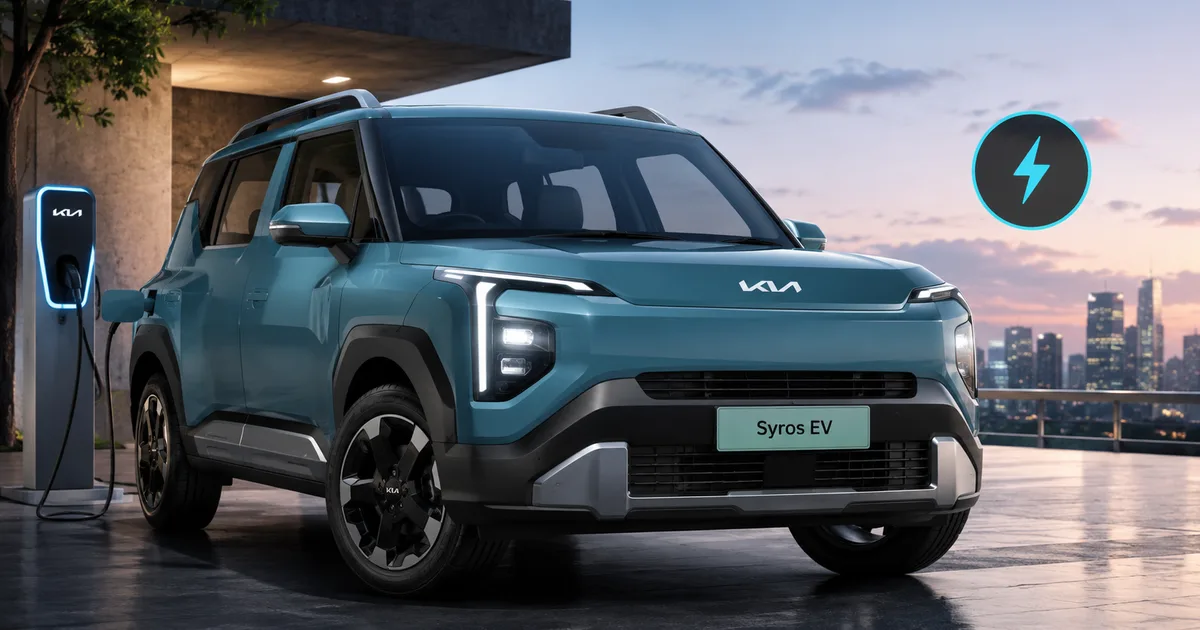
Look, buying an electric car in India right now is a bit of a headache. You want something small enough for city traffic. But you also need it to be big enough for weekend trips, with enough range that you don't panic on the highway when the AC is running full blast. We've got a few decent options today. But the upcoming Kia Syros EV India launch on July 23, 2026, is going to shake things up completely. Honestly, I've been watching this space closely. Kia's entry-level electric SUV might just be the sweet spot a lot of us have been waiting for.
Fuel prices aren't dropping anytime soon. That's just reality. A regular petrol car costs around Rs 7 or Rs 8 per kilometre in stop-and-go city traffic. It adds up fast. Especially if you commute from Noida to Gurugram every day. The whole promise of an electric vehicle is that it drops your running cost to about Re 1 per kilometre. You plug it in at night. You wake up. You drive. I want to explain exactly what the Kia Syros EV is and how the technology actually works for an everyday Indian driver.
What exactly is the Kia Syros EV?
Basically, the Kia Syros EV is the company's smallest electric crossover so far. Car nerds call it an ICE-to-EV converted model. What does that mean? ICE stands for Internal Combustion Engine (your standard petrol or diesel car). Instead of designing a brand new car from scratch, engineers take the regular petrol Syros platform and change it. They just rip out the engine and the fuel tank. Then they pull out the exhaust system. In their place, they put a big battery pack under the floor and an electric motor on the axles.
Some purists absolutely hate this approach. They want purpose-built EV platforms from the ground up. Those usually have a flat floor inside the cabin and a frunk (a trunk in the front). I get that. But we're talking about a sub-compact SUV meant for dodging auto-rickshaws in Bangalore or Delhi. For that, this conversion strategy works perfectly fine. It keeps development costs down. That ideally means a lower price tag for you at the dealership. Heavily camouflaged test mules were actually spotted at a public DC fast charging station in Bangalore just a few days ago. The car is clearly ready for Indian roads.
Understanding the battery options and range
This is the big one. It's where most Indian buyers get nervous. Range anxiety is entirely real. You don't want to end up stranded on the Mumbai-Pune expressway with a dead battery. The Kia Syros EV has two different battery pack options across its five variants. In my experience, giving buyers that choice is a really smart move.
Not everyone needs a massive battery. If you just drive 20 kilometres a day to the office, a smaller battery is enough. It is cheaper. It is lighter. That makes the car more efficient for city traffic. But if you take weekend road trips, the larger battery option is what you want. Official figures say this larger battery gets 526 km of range on a single charge.
We need to talk about how these numbers work in the real world. That 526 km is an ARAI certified number. ARAI tests cars in highly controlled labs. They don't test them in 45-degree Delhi heat. They don't put four people inside with the AC running on max. Out on real Indian roads, that 526 km is going to drop. You should expect a more realistic 350 km or maybe 400 km. The numbers here are a bit fuzzy, honestly. But 350 kilometres is still a massive distance for one day of driving. It's more than enough for most inter-city runs without needing to stop.
How charging works in the real world
So, how do you actually charge this thing? Electric car charging has two main flavors. You have slow home charging. And you have fast public charging.
When you buy the Syros EV, Kia will likely install a standard wall charger at your home or apartment parking spot. This uses regular AC power from your house. It is definitely slow. It'll probably take 7 to 9 hours to charge the car from zero to full. But you just plug it in overnight. You sleep. By morning, the car is ready to go.
For highway trips, you rely on public fast chargers. These use DC power to push energy into the battery fast. You pull up to a station. You plug the heavy cable into the car. Then you just use a smartphone app to start the session. You can easily find these stations using any good charging network map on your phone. You scan the QR code on the machine and pay via UPI. The charger tops up the battery from 10% to 80% in about 40 minutes. You grab a coffee and some idlis. By the time you finish eating, the car is ready to hit the road again.
Unpacking the 171 PS motor performance
We should look at the motor next. Leaked specs show the top variants of the Kia Syros EV will have 171 PS of power. Are you used to driving a standard petrol hatchback that makes maybe 80 or 90 PS? If so, 171 PS in a small crossover is going to feel like an absolute rocket.
Electric motors deliver power very differently than petrol engines. In a petrol car, you step on the accelerator. The engine revs up. The gearbox shifts. Then the car finally speeds up (annoying, I know). It takes a second or two. But an electric motor has instant torque. The second you press the pedal, all the power goes straight to the wheels. There is no gearbox. There is no lag. There is zero noise. You just get a smooth, aggressive push forward. It makes overtaking long trucks on single-lane state highways incredibly easy. You just point the steering wheel and go.
Expected price and pre-booking details
Pricing usually makes or breaks a car in India. Dealerships have unofficially opened pre-bookings for the Kia Syros EV right now. The token amount is Rs 25,000. You can put this money down today to get ahead in the queue.
Official pricing is under wraps until the launch event. But we can make an educated guess. The Syros EV sits below the premium EV6. It is a high-volume, entry-level option. The base variant might start around Rs 15 lakh. It could go up to maybe Rs 19 lakh or Rs 20 lakh ex-showroom for the top model. That top model has the bigger battery and all the extra features.
That price puts the Syros EV in direct competition with the Tata Nexon EV and the Mahindra XUV400. Tata dominates the electric market in India right now. Kia has to price this aggressively. The upfront cost of an EV is high. But the running cost is tiny. Plus, many Indian states discount or completely waive road tax for electric vehicles. That saves you lakhs of rupees right at the time of purchase. You can read our buying advice articles for a breakdown of state-level EV subsidies. And keep your Aadhaar and PAN handy in DigiLocker. It makes the registration process a breeze.
If you commute more than 40 kilometres a day, the higher upfront cost of an electric vehicle usually pays for itself in fuel savings within three to four years.
Interior features and technology
Kia usually wins over Indian buyers with cabin quality. They load their cars with features. The petrol version of the Syros is already packed with screens and gadgets. The EV version will definitely push that even further.
Here is what you can expect on the top variants:
- A large dual-screen setup for instruments and infotainment
- Ventilated front seats for the harsh Indian summer
- Connected car technology to cool the cabin remotely
- Basic ADAS features like blind-spot monitoring
Full self-driving doesn't work on chaotic Indian city streets. That's a fact. But features like rear cross-traffic alert are incredibly useful. They help a lot when you are reversing out of a tight parking spot in a crowded market.
Safety and warranty expectations
Indian buyers are finally taking car safety seriously. A few years ago, nobody cared about crash ratings at all. Now? It's one of the first questions people ask in the showroom. Kia absolutely knows this. The Syros EV will likely have six airbags as standard across all variants. It will have ABS and ESC. It will also have disc brakes on all four wheels to handle the heavy battery pack.
The battery itself is the biggest concern for new buyers. What happens if it breaks? How much does it cost to replace? The industry standard in India right now is an 8-year or 160,000-kilometre warranty on the battery pack and the motor. Kia will almost certainly match this. That covers the entire realistic lifespan of the car for most first owners. You don't need to stress about the battery dying in a couple of years. The technology is way past that point now.
What about the competition?
You can't talk about a new electric SUV in India without mentioning Tata Motors. They basically built this segment from scratch with the Nexon EV and Punch EV. The Tata Punch EV sits slightly below the expected price of the Syros. The Nexon EV sits right next to it.
Tata's cars are proven. Thousands of them are already on the roads. But they have their software glitches. And they have occasional service center headaches. Kia has a strong reputation in India for reliable electronics. They also have a premium service experience. If Kia prices the Syros EV aggressively, they could easily steal buyers who worry about Tata's after-sales service.
There's also the MG ZS EV. But that car is in a slightly higher price bracket. For the average buyer upgrading from a petrol hatchback to their first electric vehicle, the choice is clear. The real battle is strictly between Kia and Tata.
The verdict on the Syros EV
If you ask me, the Kia Syros EV brings a very strong package to the market. It has the badge value of Kia. The electronics are reliable. It has solid range numbers with that 526 km claimed figure. It also has a highly practical design for Indian families.
It isn't perfect. The ICE-derived platform means the floor is a bit higher in the back seat compared to a born-EV. Your knees might sit slightly elevated. I'm mostly curious to see if they can undercut their rivals on price. I guess we'll find out very soon.
Keep an eye on the official July 23 launch. And please, if you get a sketchy WhatsApp message or a Facebook ad offering a guaranteed early delivery slot for a huge discount, ignore it. Scammers are trying to cash in on the hype. Always book directly through the official website. Or just go to verified physical dealerships. That is the best way to avoid falling for common auto frauds. You can always check our latest updates for the official links and pricing once they launch the car.