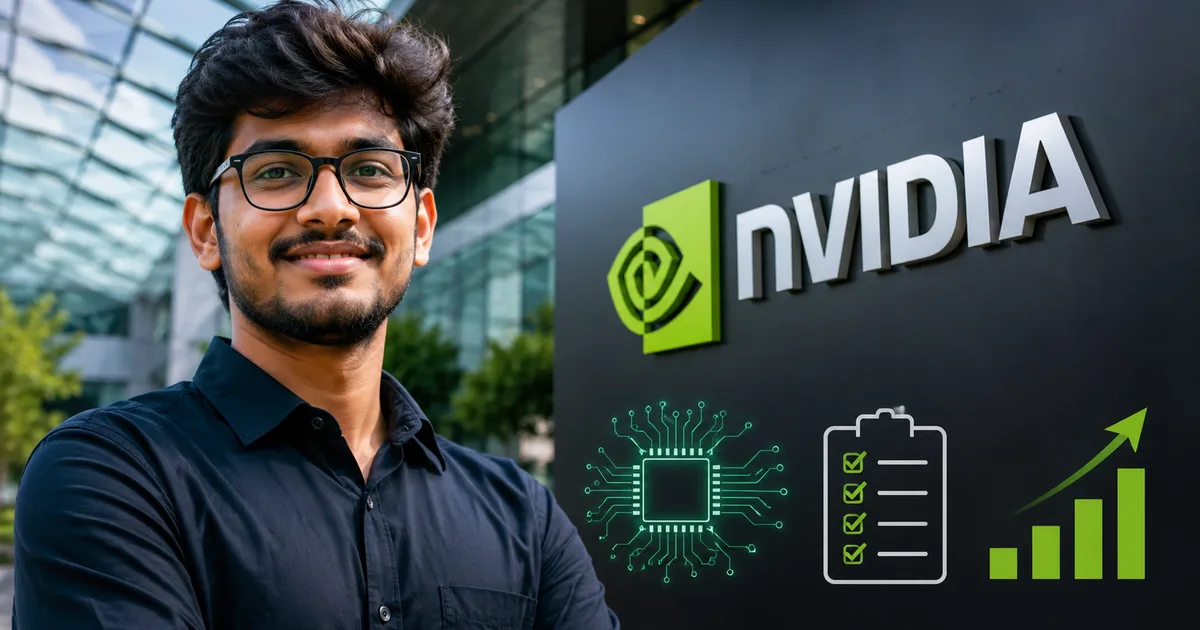
Look, if you've ever scrolled through LinkedIn and felt a massive wave of inadequacy, I get it. Every second post seems to be a 21-year-old IIT graduate announcing their placement at some tech giant. But the Prithviraj Nvidia success story that's blowing up everywhere right now? This one is entirely different. Honestly, it's the exact reality check the Indian engineering ecosystem desperately needs right now.
Here's the deal. Prithviraj P is a young guy from a small village near Chitradurga in Karnataka. He just landed a job at Nvidia in California.
The compensation is a casual ₹2.6 crore. And the best part is that he didn't go to an IIT or an NIT. He didn't go to BITS Pilani either. He didn't spend three years locked in a coaching center in Kota destroying his mental health (which makes sense, actually).
He graduated with a degree in Electronics Engineering from PES University in Bengaluru. So how exactly does someone from a standard private engineering college in India end up at the most valuable tech company on the planet?
The death of the college brand obsession
I talk to a lot of engineering students across India. There is this massive misconception. Basically, people think if you didn't crack JEE Advanced, your tech career is capped at a ₹4 LPA package at a mass recruiter. We have built an entire industry around making 17-year-olds feel like absolute failures.
But the tech industry is changing rapidly. This is especially true with hardware and AI companies. Nvidia isn't paying ₹2.6 crore for a college name on a piece of paper.
They are paying for specific skills they desperately need. They need these skills to maintain their absolute dominance in the AI chip market.
"No IIT, no shortcut," was the phrase circulating on LinkedIn when his story went viral. That hits the nail on the head. You can't hack your way into a core engineering role.
I find this incredibly refreshing. We constantly hear stories of people hacking algorithms. Or faking their way through behavioral interviews. You just can't fake a deep understanding of GPU architecture. Either you know how memory allocation works at the hardware level, or you don't. The interviewers at these companies will figure out if you're bluffing within the first five minutes. I think it's a brutal system, but it's fair.
During his time at PES University, Prithviraj didn't sit around in lectures all day. He didn't rote-learn for end-semester exams. He focused heavily on practical experience. This is exactly where most Indian students drop the ball. We are culturally conditioned to chase marks instead of skills. Prithviraj loaded up on actual projects and internships.
What gets you hired at Nvidia today
If you're aiming for a hardware giant like Nvidia, you have to understand what they actually value. Standard web development won't get you there. Deep, low-level systems knowledge is what they want. Right now, they are aggressively hiring for 2026 grads. They are putting out urgent calls for AI and GPU System Software Engineers.
Here is what you actually need to focus on if you want to pull off something similar:
- Computer architecture: You need to understand how processors work at the transistor and logic gate level. Writing code is only part of it. The real skill is knowing where that code lives in memory and how the CPU or GPU physically executes it.
- Low-level programming: C and C++ aren't dead. In fact, if you want to work on GPU systems, they are mandatory. Python is great for building AI models, but the infrastructure that runs those models is built on bare metal languages.
- Parallel computing: This is Nvidia's entire business model. You need to understand CUDA. If you don't know how to make 10,000 GPU cores work together simultaneously, you are simply not getting in.
- Hardware constraints: Doing a generic coding course isn't enough. You need GitHub repositories showing you've actually built things, optimized algorithms, and handled physical memory limitations.
I know guys who have a 9.5 CGPA. But they can't debug a segmentation fault to save their lives. That won't fly at a company building the physical infrastructure for computing.
The massive contrast in the tech job market
There's a fascinating backdrop to this whole story. Everyone is terrified of the latest tech layoffs sweeping through the software industry. But Nvidia is moving in the exact opposite direction.
We're seeing massive job cuts across standard IT companies. These are mostly blamed on AI automation. But who makes the hardware that powers that AI? Nvidia does. They are ramping up hiring aggressively. Reports show them offering salaries upwards of ₹4.64 crore for top talent. They are doing this just to poach them from rivals.
Bryan Catanzaro is Nvidia's VP of Applied Deep Learning Research. He recently made a point that caught my attention. He had a direct message for companies cutting jobs to save money for AI investments. Basically, he said you won't save money by doing that. The demand for highly skilled engineers who actually understand this hardware is completely outstripping supply. I'm not sure exactly why it's so extreme right now, but the numbers are crazy.
This is why Prithviraj's ₹2.6 crore package is just the cost of doing business for Nvidia right now. It is mind-boggling to most of us in India. But they need the absolute best to keep their lead over AMD. They also have to worry about whatever custom chips Google and Amazon are trying to manufacture.
How Indian tier-2 students can replicate this
So, you're sitting in a Tier-2 or Tier-3 college right now. You don't have alumni working at top Silicon Valley firms coming back for placements. The only companies visiting your campus are offering ₹3.5 lakh packages requiring a two-year bond. What do you do?
First, stop complaining about your college.
Thing is, the internet has leveled the playing field entirely. Here is a practical roadmap. It helps anyone wanting to break out of the standard Indian IT mold.
Stop chasing web development trends
Everyone and their dog is learning the MERN stack right now. That's fine if you want a standard software job. But if you want to work in core tech or hardware, you need to go much deeper. Learn about compilers and operating systems. Also, study computer networks. These subjects are usually taught horribly in our engineering colleges (annoying, I know). You'll have to teach yourself using MIT OpenCourseWare or similar free resources.
Contribute to open source projects
Prithviraj proved you don't need a fancy college brand. What you do need is proof of work. Open source is the ultimate equalizer. Say you can fix bugs in the Linux kernel. Or you contribute to major AI frameworks. Nobody cares if you went to PES University or IIT Bombay. Your code speaks for you. Make sure your GitHub actually has commits that matter.
Master the difficult interview formats
The interview loop for companies like Nvidia is a mess. It's brutal. Solving two LeetCode medium questions won't cut it. You will face intense system design rounds. They will ask you to design memory caches on a whiteboard. They will grill you on operating system internals and thread synchronization. You need to read actual textbooks. Don't just watch 10-minute YouTube summaries. A lot of candidates get rejected because they know the syntax of a language but they don't understand how the hardware executes it.
Understand the Indian AI landscape
You need to know what's happening locally. Nvidia hires for more than just California. They are building massive infrastructure here. We are seeing data center hubs getting a huge push in India right now. If you understand how this physical infrastructure works, you are incredibly valuable. Think servers and cooling. You don't have to be a pure software developer. Hardware engineering is making a massive comeback. And the salaries are starting to reflect that reality.
The immigration and visa reality check
I have to mention this because a lot of people read these success stories and get the wrong idea. They think they can just apply online and catch a flight to California next week. Getting a job in the US directly from India is incredibly difficult because of the H-1B visa lottery system.
Most Indian engineers who make it to the US take a specific route. They either go through an internal company transfer on an L-1 visa or get a Master's degree first on an F-1 visa. Then they use the OPT period to work. The news reports don't detail the exact visa mechanics Prithviraj used. But the reality is that the immigration pathway is often the hardest part of the journey.
If you're aiming for this, you need to be prepared. You might pass the interview but fail the visa lottery. It happens constantly. But the good news is that companies like Nvidia are massively expanding their footprint right here in India. You don't necessarily have to move to California to get this kind of work anymore. Nvidia is partnering heavily with Indian companies like E2E Networks and Yotta to build out local AI infrastructure. They are deepening their push into the Indian AI startup ecosystem.
Why this changes the narrative
We are culturally obsessed with exams and tags in this country. In my experience, the whole education system is built around sorting 18-year-olds into buckets. And it's all based on one multiple-choice test on a Sunday in May. If you perform well, you're set for life. If you don't, you're told to lower your expectations permanently.
Prithviraj's story is a massive disruption to that system. He didn't take a shortcut. He didn't rely on a brand name to open doors for him. He just put his head down in a normal college in Bengaluru. He built real skills. Then he cracked an interview at a company that is quite literally shaping human technology. He proved that the path to the top of the tech industry is still open for those willing to do the hard work.
Next time you see a sketchy WhatsApp job offer scam promising an easy tech job without an interview, ignore it. There are no shortcuts. If you read our career guides, you know this. But if you're willing to actually learn the difficult stuff, there has never been a better time to be an engineer. Think low-level systems and hardware integration. Plus the math behind the AI. You don't need an IIT tag to make it. You just need to be exceptionally good at the work.