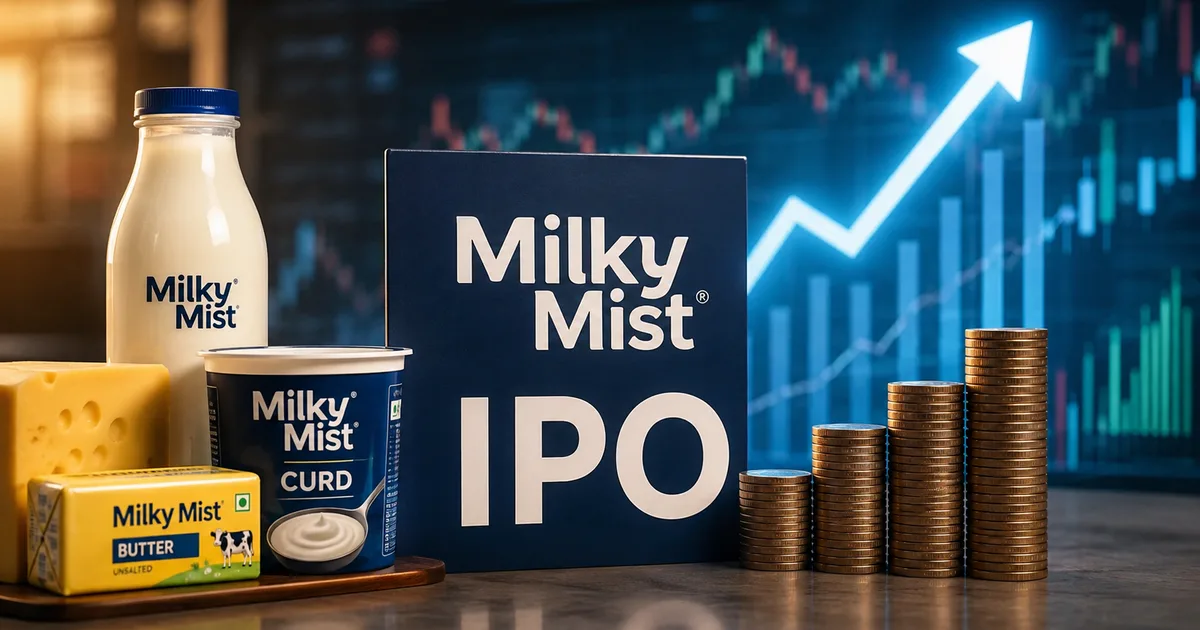
So you're looking at the Milky Mist IPO 2026, wondering if it's worth tying up your capital. I get it. Every time a food brand we actually use hits the market, the hype gets completely out of control. But here's the deal. This Milky Mist IPO 2026 explained in plain English is exactly what you need before checking your allotment status today. We're talking about a massive Rs 1,553 crore issue that just got subscribed over 56 times. That's serious demand from everyday retail investors and big institutions alike. But does high demand automatically mean you'll make money? Not always. Let's break down the actual numbers, the grey market premium, and what this means for the FMCG space.
The backstory: From Erode to the stock market
You probably have their paneer or cheese in your fridge right now. Milky Mist isn't some new tech startup burning venture capital on customer acquisition. They started small in Erode, Tamil Nadu, way back in the 1990s. Over the years, they built a massive cold-chain network across South India. That physical infrastructure is their actual moat. You just can't start selling perishable dairy products without a rock-solid supply chain.
Now they're backed by Temasek, so they've officially gone public. Temasek is a Singaporean state holding company. Their involvement brings serious corporate governance to the table. When international funds back a regional Indian dairy brand, it means the unorganized dairy market is getting formalized. If you ask me, that's the real story here. The company set a price band of Rs 133 to Rs 140 per share. The minimum lot size was set at 107 shares.
That means you needed a minimum of Rs 14,980 in your bank account to even bid for a single lot. Honestly, that's a pretty standard retail ticket size for Indian IPOs today. But the response they got was anything but standard.
Breaking down the Rs 1,553 crore issue
When a company raises Rs 1,553 crore, you have to ask where that money is going. Usually, in these mid-cap IPOs, promoters are just looking for an exit. But here, a good chunk of the money will likely go toward debt repayment. And they're setting up new manufacturing capacities. The dairy business is incredibly capital intensive (which makes sense, actually, given the spoilage risks). You need massive chilling centers and refrigerated trucks.
Bidding opened on August 11 and closed on August 13. By the end of day three, the issue was booked 56.06 times.
The retail portion saw huge demand, but the real money came from Qualified Institutional Buyers and High Net-worth Individuals. When the big guys throw money at an IPO, retail investors tend to follow blindly. If you're new to this whole process, you might want to read our guides on evaluating public issues before putting down your hard-earned cash in the future. Just don't jump in blind.
The GMP madness: What Rs 29 actually means
Let's talk about the Grey Market Premium. Look, the GMP is basically the unofficial premium buyers are willing to pay for unlisted shares before they actually hit the NSE and BSE. It's completely unregulated. It operates on trust and phone calls in places like Gujarat and Mumbai.
A few days ago, the Milky Mist GMP was hovering around Rs 20.50. But after the bidding closed with that insane 56x demand, the GMP jumped straight to Rs 29.
So what does that mean for your money? Let's do the math.
- Upper price band: Rs 140 per share
- Current GMP: Rs 29 per share
- Expected listing price: Rs 169 per share
That translates to a potential listing gain of around 20 percent. If you snagged a single lot of 107 shares, you're looking at a rough profit of Rs 3,103 on listing day. Honestly, for a Rs 15,000 investment over just a week, that's a very solid return.
But you have to remember something. The grey market changes its mind very quickly. If the Nifty or Sensex crashes tomorrow, that GMP can vanish overnight. We've seen it happen plenty of times with other hyped IPOs. Never treat the GMP as a guaranteed return. It's just a rough estimate.
Valuation: Is the Rs 140 price band justified?
Whenever a company prices its shares, the primary metric everyone looks at is the Price to Earnings ratio. At the upper band of Rs 140, Milky Mist has a valuation that prices in a lot of future growth. They're raising Rs 1,553 crore. The market capitalization upon listing is going to be massive.
When you compare this to listed peers in the Indian dairy sector, the pricing looks slightly aggressive. Companies like Hatsun Agro Product or Parag Milk Foods have seen their own ups and downs in the public markets. Investors are basically paying a premium right now for Milky Mist's aggressive growth trajectory. And the backing of Temasek. Temasek doesn't usually write cheques for companies without a clear roadmap.
But valuation is a mess. A stock is only worth what someone is willing to pay for it on the exchange. Right now, retail investors are ignoring the fundamentals and focusing purely on the listing pop. That's a dangerous game. I'm not sure exactly why people forget this so quickly. If you're buying this for your retirement portfolio, you need to ask if they can double their revenue in the next three years to justify this valuation multiple.
They'll have to capture market share from established giants in North India to do that. And that's an expensive fight.
The FMCG market impact and the competition
Milky Mist sells more than just liquid milk. They're pushing heavily into value-added dairy products like mozzarella cheese and set curd. That's where the actual profit margins live in the Indian dairy market. Selling plain milk in pouches is a brutal, low-margin business dominated by giant cooperatives like Amul. But value-added dairy is highly profitable if you get the branding right.
By raising this massive amount of capital, Milky Mist is gearing up for a price war. They're taking on the big boys directly. We've seen similar aggressive moves in the space before. Milky Mist has deep pockets now, and they already hold a very tight grip on the South Indian market.
Anil Singhvi pointed out some clear growth prospects for the company recently. But he also flagged the risks of regional concentration. Expanding to North India is going to be their biggest challenge. The north is already saturated with local dairy giants. Building a new cold-chain logistics network in states like Uttar Pradesh or Punjab will require burning a lot of cash. If you read our explainers on market dynamics, you know that geographical expansion in India is notoriously difficult for regional food brands.
How to check your allotment status
If you applied via your broker, you're probably constantly refreshing your phone right now. The allotment date is today. The entire process in India is mostly digitized now through systems like UPI and ASBA. Your money is just blocked in your bank account until the allotment is finalized.
Here's exactly how you check if you got lucky:
- Go to the BSE website or the official registrar's portal online.
- Select 'Milky Mist Dairy Food' from the drop-down company menu.
- Enter your PAN number, application number, or your DP Client ID.
- Hit submit and see the result on your screen.
A lot of people panic if they don't get an allotment but their money is still blocked. Don't worry. The ASBA system ensures the money never actually leaves your account until shares are allotted. If you didn't get the shares, the mandate on your UPI app like Google Pay or PhonePe will get revoked automatically. Sometimes, due to banking server issues, this takes an extra 48 hours. Your blocked Rs 14,980 will eventually be available in your bank balance again.
If you face persistent issues with UPI blocks not releasing after a week, you should contact your bank directly.
Don't search for customer care numbers on social media. Scammers actively target people complaining about IPO refunds. Read our scam awareness content to ensure you aren't falling for fake helpline traps. The numbers here are a bit fuzzy, but the scam rate is high.
The bigger picture: Is it worth holding?
This is the part where retail investors always get confused. Do you flip the stock on listing day for that quick 20 percent gain, or do you hold it for the long term?
"The dairy sector in India is shifting rapidly towards premium, value-added products, and companies with strong distribution networks are positioned to capture this margin expansion."
That's the general consensus among analysts at major brokerages right now. Personally, I think the FMCG space is getting very crowded. But the dairy sector has a surprisingly high barrier to entry. You can't just spin up a cold-chain logistics network overnight with software. You need physical trucks and chilling centers. Milky Mist spent decades building that physical infrastructure.
But there are serious risks to consider. Milk procurement prices fluctuate wildly in India depending on monsoons and cattle diseases. Remember the Lumpy Skin Disease outbreak a while back? When raw milk prices go up, companies like Milky Mist have a very hard time passing the entire cost increase to consumers immediately.
Customers will just switch back to Amul. That pinches their profit margins severely. You should track our daily updates to understand how rural inflation is hitting consumer demand across the country right now.
What to expect on listing day
The 56x subscription tells you everything you need to know about the current market liquidity in India. People have cash in their bank accounts. And they aggressively want quick listing gains. The Rs 29 GMP is undeniably strong. If you get the allotment, you're very likely opening in the green when the bell rings.
But if you're planning to buy this stock on listing day straight from the open market, I'd honestly suggest waiting. Let the initial hype settle down. Let the short-term flippers sell their shares and take their profit. The stock will probably find its actual fair value a few weeks down the line.
I'll be tracking their next quarterly results closely. That specific earnings report will show us if they can actually maintain their profit margins while spending heavily on geographical expansion (which is always a sketchy phase for regional brands).
The Indian stock market is hitting new highs regularly. IPOs are the easiest way for retail investors to ride the momentum. Just make sure you understand the business you're buying into. Milky Mist is a strong brand with a good product line. We'll have to see if they can hold their ground against the national players in the coming months.