If you told an Indian parent you were dropping out of engineering at 18, you know exactly what would happen. Total chaos. Relatives would call, and your neighbours would ask uncomfortable questions. But Rohan Naidu did exactly that. Now, he's the Hyderabad-born MIT astronomer leading the MIT black hole star discovery 2026. His team just found something called MoM-BH-1 using the James Webb Space Telescope. It's a cosmic object so weird that it breaks a lot of what we know about the early universe.
I read the Nature study this morning. The object is sitting around 660 million years after the Big Bang. That sounds like a long time, but in universe years, it's basically a toddler. And the numbers here are a bit fuzzy, but this toddler is around 100 billion times brighter than a normal star.
Think about that number for a second. 100 billion.
You can check our explainers section for more on how telescopes measure brightness, but 100 billion isn't a typo. It's so bright that astronomers initially had no idea what they were looking at. They thought it was a galaxy or a glitch. But it was real.
What exactly is the MIT black hole star discovery in 2026?
To understand why this matters, we have to look at normal space rules. Honestly, stars are hot balls of gas running on nuclear fusion. Black holes are dense points of gravity that eat everything. They don't usually mix well. If a black hole gets close to a star, it tears the star apart and eats it. It's a messy process. Astronomers call it a tidal disruption event (which is just a polite way of saying the star got shredded).
But MoM-BH-1 is different. It isn't shredding a star from the outside.
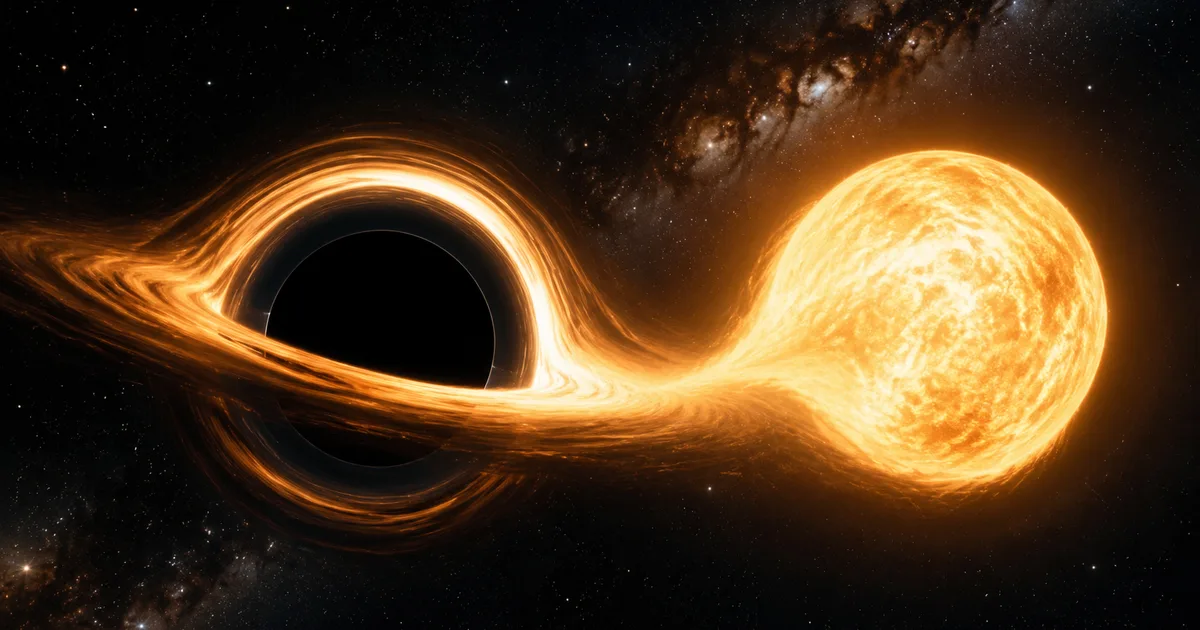
The MIT researchers modelled this object as a black hole wrapped inside a star. Imagine a massive, dense cloud of gas. Deep inside that cloud, right at the center, is a black hole. The black hole is eating the gas from the inside out. As it eats, it generates massive amounts of energy. That energy pushes outward, keeping the rest of the gas from collapsing inward immediately. It's a strange balancing act.
I like to think of it like a giant cosmic pressure cooker. The heat inside is intense, but the heavy lid of the star keeps it contained. Eventually, the black hole will probably eat the whole thing, though I'm not sure exactly why it hasn't already. But right now, we're catching it in the act. And it's shining ridiculously bright.
And yes, this is completely new. We've never seen a black hole star before. We only theorised they might exist. Some older research papers called them quasi-stars. But no one had actually found one until now.
The Hyderabad dropout behind the astrophysics breakthrough
The scientist who found this is Dr. Rohan Naidu.
He grew up in Hyderabad. Like a lot of kids in India, he went into engineering. It's the default setting for smart students here. But at 18, he realised it wasn't for him. He bought his first plane ticket and switched to astronomy. He ended up as a student at Harvard and is now an astronomer at MIT. He also apparently loves Test cricket, which is a great detail. It takes serious patience to watch five days of cricket. You need that exact same patience to sift through space data from satellites.
"The discovery of MoM-BH-1 is a perfect example of why we need different perspectives in science. Sometimes you have to look at the same data everyone else has and ask a completely different question."
His story is a good reminder. In my experience, we have this obsession in India with a very narrow career path. School, coaching classes, an engineering degree, and maybe an MBA. But science needs people who take weird paths. If you ask me, if you have a kid interested in space, let them read our guides on unconventional careers. Don't force them into coding if they want to look at stars. We need more people looking at the sky.
How the James Webb space telescope spots a black hole star
You can't see this stuff with a backyard telescope. MoM-BH-1 is incredibly far away. Because light takes time to travel, looking far away means looking back in time. We're seeing this object as it was 660 million years after the Big Bang. For context, the universe is around 13.8 billion years old.
The James Webb Space Telescope, or JWST, is the only machine capable of this. It looks at infrared light. As light travels through the expanding universe, it stretches out. What started as visible light stretches into the infrared spectrum by the time it reaches Earth. JWST has these massive gold mirrors that catch that infrared light perfectly. It operates in deep cold, parked a million miles away from Earth.
When JWST looked at this spot in space, it saw a signature that didn't make sense. It was too bright to be a normal galaxy of early stars. It was too weird to be a standard quasar. A quasar is just a naked supermassive black hole eating gas, and we've seen plenty of those. So the MIT team had to build a completely new computer model.
They realised the only thing that fit the data was a heavy black hole buried deep inside a massive envelope of gas. A black hole star. The light from the eating process was getting filtered through the gas envelope. That's why it looked sketchy on the telescope sensors.
Why this solves a massive problem in physics
Look, astrophysicists have had a headache for years. It's called the supermassive black hole problem. We see these giant black holes, billions of times heavier than our sun, existing very early in the universe. We see them when the universe was less than a billion years old. But they shouldn't be there.
Thing is, here's why it doesn't make sense.
- Normal black holes form when a single massive star dies and collapses under its own gravity.
- They start small, maybe 10 or 20 times the mass of our sun.
- To get to a billion solar masses, they have to eat a lot of material over a very long time.
- Eating takes time because there's a physical speed limit to how fast a black hole can swallow gas. Physics calls this the Eddington limit. If it eats too fast, the energy pushes the food away.
If they start small and eat at the maximum speed limit, there simply isn't enough time between the Big Bang and when we see them for them to get that big. The math completely fails. It's like finding a giant banyan tree in a garden that was planted yesterday.
But the MIT black hole star discovery 2026 changes the math.
Basically, if black holes in the early universe formed directly from massive clouds of gas collapsing, they could start out huge. They could skip the small phase completely. This is called a direct collapse black hole. MoM-BH-1 might be exactly that. It's the missing link. It's the awkward teenage phase of a supermassive black hole. It proves that the universe had a shortcut for making giant black holes.
How Indian space efforts fit into this new astrophysics breakthrough
While the James Webb Space Telescope is an American and European project, India isn't sitting on the sidelines of astrophysics. We have our own space observatory, AstroSat. It has been doing incredible work looking at X-rays and UV light from distant black holes. And high up in the Himalayas, at Hanle in Ladakh, we have some of the highest ground-based telescopes in the world. They watch the sky every single night.
The difference is scale. JWST can see things that are impossibly faint and far away. But space is a big place, and you need multiple eyes on it. When JWST finds something bizarre like MoM-BH-1, other telescopes around the world often point their lenses at the same spot to gather different types of data. It's a massive global collaboration.
You can read our tools section to see how amateur astronomers even track some of this public data from their laptops. You don't need to be at MIT to look at the numbers. The data from these big telescopes eventually becomes public (which makes sense, actually). Anyone with a good internet connection and enough curiosity can download it and start looking for patterns.
That's the beauty of modern astronomy. It's democratic. The data is out there. You just need someone with the patience of a Test cricket fan to sit down and look at it properly.
What this means for everyday science fans in India
I know what you're thinking. Does a black hole star 13 billion light-years away affect the price of milk in Mumbai? No. Will it change how your UPI app works or help you link your Aadhaar card? No. You can check our news section for things that actually impact your wallet.
But it matters because it's about human curiosity.
India is spending a lot of money on space right now. We have ISRO launching satellites constantly, from Chandrayaan to Aditya-L1. We have private space startups popping up in Bengaluru and Hyderabad building their own rockets. When an Indian-origin scientist like Rohan Naidu leads a discovery like this, it proves that we have the talent to do fundamental science. We write software for foreign banks and run tech support. But we can also figure out how the universe started.
It also shows how messy and unpredictable science is. We build a ten billion dollar telescope, point it at the sky, and almost immediately find something that breaks our textbooks. That's the fun part. Science isn't a finished book. It's a live argument.
And honestly, we need more of this. If you're a student reading this, or a parent pushing your kid into the JEE rat race, take a pause. The universe is massive. There are black hole stars sitting out there waiting to be found. We need Indian kids to look up and wonder. They shouldn't spend all day looking down at a textbook memorising formulas. We need the dropouts and the cricket fans. We need the kids who ask annoying questions.
So next time you look up at the night sky, just remember that somewhere out there, a black hole is hiding inside a star. It's shining 100 billion times brighter than the sun. And a guy who dropped out of an Indian engineering college was the one who figured it out.
I think the universe is a mess, and I can't wait to see what JWST finds next.