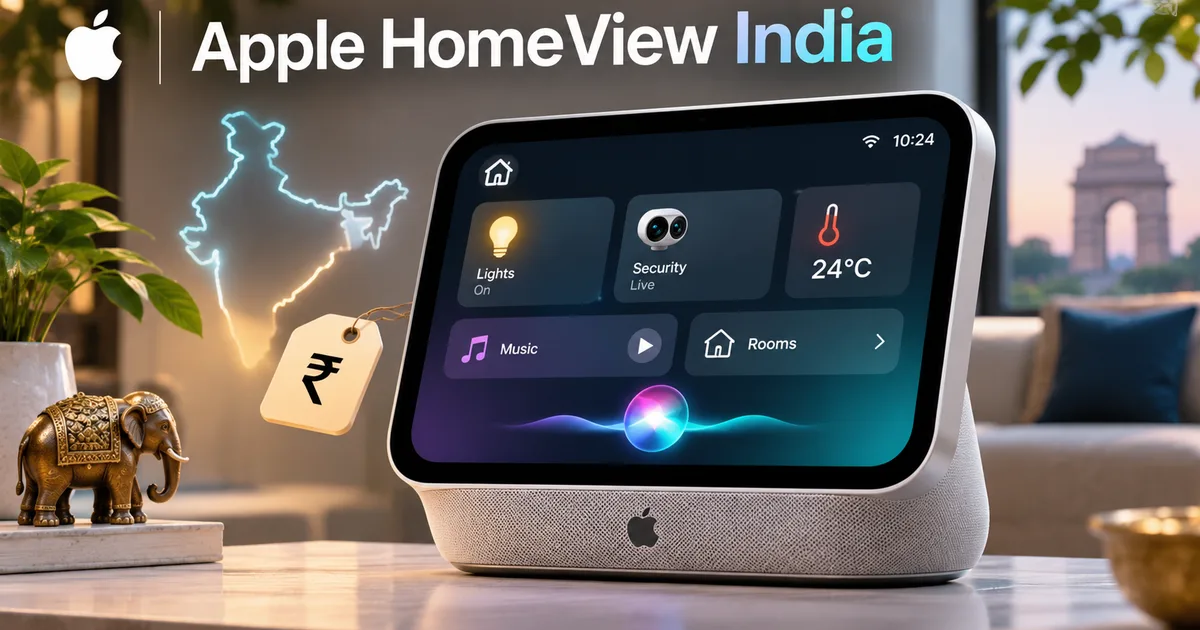
Picture walking into your kitchen in Pune or Bengaluru at 7:30 am. Your hands are coated in atta, your phone is charging in the bedroom, and you need to check whether your calendar or the school bus group says today is a half-day while someone rings the front doorbell. That exact morning chaos is what the Apple HomeView tries to fix, and it officially went on sale in India on November 13, 2026, for Rs 39,900.
Apple showed off its first smart-home display at the 'Welcome Home' event back in October. India is actually among the first eight countries to get it, ahead of the entire European Union, where Siri AI is still blocked on iOS (which is a weird mess, honestly, and I'm not sure when that changes). Seeing India in the first wave alongside the US and UK feels refreshing. Still, Rs 39,900 is steep money for a gadget that just sits on a counter. So if you ask me, you really need to look at what it does before buying one for an Indian home.
What Apple HomeView actually is and what it is not
Think of HomeView as a smart family noticeboard bolted onto a serious speaker. It has a 7-inch Liquid Retina touchscreen paired with either a domed speaker base for a table or a flat back made for your hallway wall. The screen is a square-ish 1088x1088 panel with True Tone, and it dims all the way down to 0.3 nits at night so it won't light up your bedroom like a streetlight.
Inside, Apple put the A18 chip, the exact processor inside the iPhone 16. Sounds like overkill for a kitchen screen, right? Thing is, it needs that silicon to run local AI models while handling video calls and live camera feeds at the same time.
Here is what it isn't, though: it's not an iPad glued to a speaker.
Before launch, developers Steve Troughton-Smith and Guilherme Rambo poked around a virtualised build of the software and confirmed there's no App Store on HomeView at launch. You can't download Swiggy or Zomato onto it. Instead, you get built-in system apps like Music, a video player, Timers, Alarms, World Clock, Calendar, Messages, FaceTime, and Home controls. They come with Liquid Glass visuals and Flow or Snoopy clock faces.
No App Store for nearly forty thousand rupees? I know that sounds stingy at first. In my experience, though, shared family tablets always turn into a disaster after relatives hand them back with twelve sketchy apps installed. Keeping HomeView locked to household basics makes daily life way calmer. If you want to see how hardware is shifting toward dedicated AI screens, check our tech explainers section.
Apple HomeView price in India and the hidden mount costs
Let's talk rupees, because the pricing sheet has a nasty surprise. Both the tabletop Apple HomeView and the wall-mounted model have an MRP of Rs 39,900 inclusive of taxes in India, and monthly EMIs start around Rs 6,964. The tabletop unit is available in silver, starlight, rose pink, and space grey, while the wall-mounted one only comes in silver and space grey.
Compare that to the US price of $299, which is roughly Rs 25,000 to Rs 26,000 before state taxes. Indian buyers are paying a hefty import and GST premium here (annoying, I know, even if we're used to it by now). Want AppleCare+ for drops or kitchen spills? That's another Rs 5,590.
And if you pick the wall-mounted version, check the fine print. It doesn't have a wall bracket or power supply in the box because it needs a custom Schneider Home mount sold separately. Basically, you have three options:
- The Power Mount USB-C Wall Connector costs Rs 6,900 for self-installation, and you still need to buy or own a minimum 20W USB-C power adapter separately.
- The Power Mount AC Wired version costs Rs 8,900 for a clean, wire-free finish, and Apple recommends calling a qualified electrician to fit it into your wall.
- The Power Mount PoE Wired option arrives in early 2027 for Rs 14,900, built for homes that already have Power over Ethernet cabling running inside the walls.
Do the quick math. A wall-mounted unit with that AC mount and AppleCare+ easily crosses Rs 55,000 once you pay an electrician. And if you ask me, unless you're already renovating a flat to hide wires in the walls, the tabletop version is the only one that makes sense.
How Siri AI works without leaking your chats
For years, Siri felt like a clunky bank helpline that panicked the second you asked a follow-up question. Siri AI is a real rebuild. Running in beta on HomeView software version 27.2 using Apple Intelligence, it actually handles follow-up questions and understands what's on your 7-inch screen. It gives real answers instead of dumping blue web links at you.
Say you tell it to play an old Kishore Kumar track, then immediately say 'turn down the hall lights and tell me when my flight lands'. Siri AI gets chained requests like that without choking. We're seeing conversational AI pop up on Indian gadgets everywhere right now, from budget phones like the OnePlus N6x AI features to smart speakers. Apple's whole pitch here is keeping your private data locked down.
So how does it protect privacy when four microphones are always listening? Think of the Secure Exclaves inside the A18 chip like a sealed ATM vestibule inside a bank. Mic and camera signals go straight into that isolated compartment. Apple says data processed inside Secure Exclaves can't be touched by third-party apps or even Apple itself.
When a question is too heavy for the A18 chip, HomeView sends it over to Apple's Private Cloud Compute servers, where your data isn't stored or visible to anyone. Look, there's one big catch Indian buyers need to know upfront. At launch, Siri AI on HomeView only works in English in India. Apple promised Canadian French in a future update, though the rollout timeline for other languages is honestly pretty fuzzy. There's no official date for Hindi or any regional Indian languages yet. If your parents or grandparents prefer speaking in Hindi, Tamil, Telugu, or Marathi, I think this will frustrate them right out of the box.
How face recognition handles a busy Indian household
Putting a shared screen in an Indian living room creates an obvious problem when nobody wants their dad or a visiting cousin reading private bank alerts on the dining table.
Apple's fix is some clever multi-user logic. HomeView's 12MP Center Stage camera recognises up to six family members by face. Walk up to it, and the Home Screen shifts from a neutral dashboard into your personal view with your own widgets and Calendar.
Apple HomeView is designed to be shared by everyone in the home yet feel completely personal to each user.
That's how Greg Joswiak, Apple's marketing chief, pitched it (which makes sense, actually). Personal content from Messages and Calendar actually sits behind a strict two-step lock. First, the camera has to recognise your enrolled face. Second, your paired iPhone or iPad has to be physically nearby and recently unlocked.
If you step out to buy milk and someone else walks past the screen, your texts stay hidden. Honestly, though, one detail bugs me: the 12MP camera has no physical sliding shutter. You're trusting software controls and Secure Exclaves instead of a piece of plastic blocking the lens, which still feels a bit sketchy if you're the type who tapes over laptop webcams.
Smart home controls, sound, and the iPhone catch
Once you get past the AI buzzwords, HomeView is a proper central hub for HomeKit and Matter smart gear. It connects over Wi-Fi 6E and Bluetooth 6.0 alongside Thread. You can tap or speak to turn off bedroom ACs, dim living-room lights, check door locks, or close motorised blinds. A dedicated Home Camera clock face can even show up to nine security camera feeds on one screen.
Apple launched it alongside the HomePod mini 2 and a new Apple TV 4K. There's also the Apple Home Collection of cameras, thermostats, switches, and locks built with LG Electronics and Schneider Electric. Exact Indian prices for those bundles aren't out yet. For now, Matter support matters most if you already own smart plugs or bulbs bought off Amazon India.
The audio is surprisingly punchy for a small counter unit. Inside the tabletop model, you get two full-range drivers paired with a down-firing woofer and two force-cancelling passive radiators. It has Spatial Audio with Dolby Atmos too, while the wall model drops the woofer to stay slim. Sound Recognition also listens in the background for smoke or carbon monoxide alarms.
Now for the biggest catch in India: the Apple ecosystem wall. Anyone who wants a personal profile or Siri AI personal context needs an Apple Intelligence-capable iPhone or iPad on the latest OS. Most Indian homes are mixed Android-and-iOS setups, if you ask me. Maybe you use an iPhone, while your spouse has a Vivo T5e 5G phone and your dad uses a Motorola Signature 27 smartphone. They can still tap lights on the screen or ask Siri basic trivia, sure. But they can't get personal profiles or FaceTime integration on it. If you're trying to mix Android and Apple gear at home, our how-to tech guides can help you avoid buying accessories that ignore half the family.
Should you spend Rs 39,900 on Apple HomeView?
Here's the honest verdict without any marketing fluff. Apple HomeView is well built and genuinely thoughtful about family privacy, plus it sounds way better than cheap smart displays.
If everyone in your house uses recent iPhones and you already FaceTime relatives abroad, HomeView slots right into your living room. Especially if your flat already has Matter-compatible smart switches or cameras. Having one fixed screen for music and doorbell feeds beats hunting around for your phone every twenty minutes.
Skip it if half your family is on Android, or if older parents need regional Indian voice commands. And it has no battery inside (which feels like a miss for Indian flats). If a summer power cut hits a socket without inverter backup, HomeView goes completely dark. For Rs 39,900, you could almost buy a standard iPad on sale alongside a decent Bluetooth speaker and get a full App Store you can carry room to room. In my book, HomeView is a slick luxury hub that most Indian budgets don't really need.