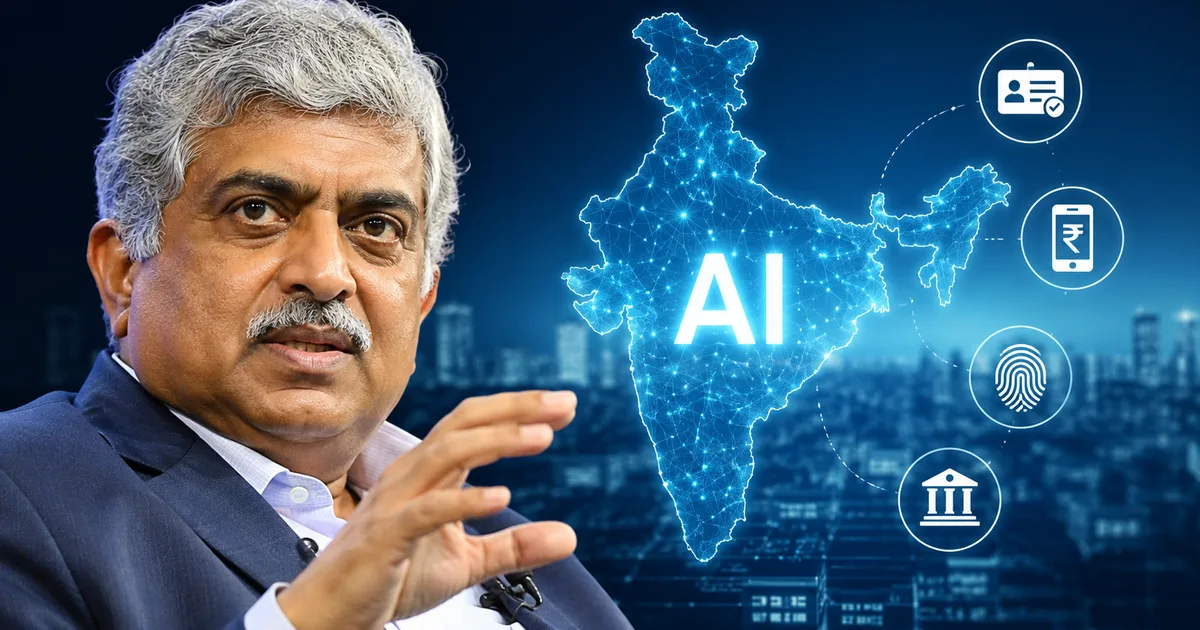
If you've been watching the Indian tech space this year, you've probably noticed a major shift in the conversation. People aren't focusing on chatbots anymore. Or generating funny images. The conversation is entirely about building massive systems. And when it comes to building systems that actually work for a billion people in India, one name constantly dominates the discussion. The Nandan Nilekani AI Vision 2026 is a highly practical roadmap for how Digital Public Infrastructure and artificial intelligence will change how we live, work, connect, and interact with the government.
I know the term DPI sounds like a boring government acronym. But think about UPI for a second. Think about Aadhaar. And DigiLocker. These platforms completely rewired our economy over the last decade (which makes sense, actually, given the scale). Now, imagine plugging artificial intelligence into that exact same scale. That's the future Nilekani is pushing for. Honestly, it makes a lot of sense.
Fixing the national exam system with technology
We should start with an issue that affects almost every middle-class Indian family right now. The national exam system. It's a complete mess. After the massive NEET paper leak mess that caused nationwide protests, the government didn't just form another slow-moving committee. Prime Minister Narendra Modi set up a task force to reform the entire exam system across the country. And he picked Nandan Nilekani to lead it.
This matters a lot. When an Indian system breaks down completely, he's usually the person the government calls to build a permanent solution. I think they're actively looking at how to use technology to make exams transparent and actually leak-proof.
I'm genuinely curious to see how this plays out over the next few months. Installing better CCTV cameras in exam halls isn't enough anymore. We need data and AI to track anomalies. Also to secure the logistics chain, or maybe even change how question papers are generated and delivered to centers securely. I'm not sure exactly why it took this long, but if they can fix this mess, it's a massive win for millions of students who spend years preparing for tests. You can read more about how AI is impacting education in our comprehensive guides.
Betting ₹2,200 crore on Indian AI startups
His focus goes way beyond government systems. He's heavily involved in shaping the Indian startup ecosystem. Recently, Nilekani stepped down from his General Partner role at Fundamentum. But at the exact same time, Fundamentum launched its third fund. It's a massive $200 million pool of capital. That's roughly ₹2,200 crore.
And where is that money going? A huge chunk of it is heading straight into Indian AI startups. They aren't looking to build another generic ChatGPT clone. Instead, they want companies solving specific, difficult Indian problems. If you ask me, that's exactly the right approach. Think about healthcare diagnostics in rural areas and customer service models trained purely on local Indian languages.
Look, building a large language model from scratch takes insane amounts of money and raw compute power. We probably can't beat Silicon Valley at that game right now. But building AI apps that actually work for a small shopkeeper in Jaipur or a farmer in Punjab? That's exactly where Indian founders have a massive advantage. They understand the local context that a tech giant in California simply misses.
The $400 billion Infosys perspective
Then there's the corporate side of the equation. As the chairman of Infosys, Nilekani recently spoke to shareholders. He addressed the biggest fear in the industry right now. Is artificial intelligence going to steal all the Indian IT jobs?
His answer was a hard no. He said AI will amplify human potential, not replace companies like Infosys. In fact, Infosys is actively positioning itself to tap into an AI market opportunity worth up to $400 billion globally by the year 2030. That's a ton of money.
I think this is the most realistic take I've heard in a very long time. Everyone is panicking about AI wiping out the entire coding and BPO industry overnight. But enterprise tech is extremely messy. Big global banks and healthcare providers have decades of legacy code running their core operations. They can't just plug an AI tool into their servers and fire everyone. It just doesn't work that way. They absolutely need companies like Infosys and TCS to implement the AI and clean up the messy internal data. Otherwise, the whole system might crash and burn.
"The transition to AI is going to require massive amounts of systems integration, data engineering, and change management. This is exactly what Indian IT firms have excelled at for the last three decades."
If you're worried about job security in the tech sector, you should probably focus on adapting rather than panicking. The nature of the work will change. But the volume of work might actually increase as companies scramble to upgrade their systems. At least, in my experience, that's usually how these tech shifts go.
How DPI makes Indian AI different
So how does this all tie together in the end? This is where the Nandan Nilekani AI Vision 2026 gets really interesting. It's about combining the raw power of AI with our existing Digital Public Infrastructure.
We already have the digital rails built. UPI handles billions of financial transactions every single month. DigiLocker holds our most important official documents securely. Aadhaar handles identity verification for over a billion people. And ONDC is currently trying to democratize e-commerce and break the monopoly of big platforms.
Now, imagine an AI assistant that can talk to you naturally in Hindi or Tamil. You tell it you want to buy a train ticket to Mumbai. The AI uses ONDC to find the best route. Then it uses your UPI app to complete the payment instantly and fetches your ID details from DigiLocker. Or imagine an AI tool that helps a small business owner file their GST returns. It could do this by directly connecting to their bank statements through the Account Aggregator framework.
That's the real play here. The goal is to make a smarter, more efficient system for the entire country. A better chatbot to write emails is completely missing the point.
What this means for ordinary users
If you're a student or running a small business in India today, you need to pay close attention to these developments.
- Upskill practically: Do not just learn how to write basic prompts for ChatGPT. Learn how AI tools actually integrate with existing databases, spreadsheets, and business workflows.
- Look for local problems: If you are building a startup or a new product, build for Indian realities. The ₹2,200 crore Fundamentum fund is looking for exactly that kind of local focus.
- Expect rapid changes: From how you register for government exams to how you interact with bank customer service, the underlying technology is shifting very fast.
Honestly, the next few years are going to be wild. Silicon Valley is currently building the brains of these AI systems. But India is building the nervous system to actually use them at a massive scale. And with leaders pushing the deep integration of DPI and AI, we might just build a technological ecosystem that the rest of the developing world ends up copying.
A quick note on the hype and risks
Look, I'm not saying this transition is going to be flawless. Every time we roll out massive technology projects in India, there are serious glitches. People get locked out of their accounts. Government servers crash on the last day of tax filing. Scams get more sophisticated and dangerous. It's just a reality we have to deal with.
We've already seen a massive rise in sophisticated digital frauds. You can check our scam alert section for details on fake IPO allotment SMS tricks and WhatsApp groups trying to steal UPI details. As AI voice cloning and deepfakes get better, these scams will become much harder to spot. You really need to be extremely careful with your personal data and financial information.
But the overall direction is clear. The deep integration of artificial intelligence with India's digital infrastructure is no longer a theoretical concept. It's happening right now. And it has massive funding and top-level government task forces behind it.
The companies that figure out how to bridge the gap between advanced AI models and the daily realities of Indian consumers are going to win big. And the professionals who learn how to use these integrated tools will command the best salaries in the market. The numbers here are a bit fuzzy right now, but the trend is obvious. It's time to stop treating AI as a novelty. You have to start treating it as the new baseline for Indian tech.