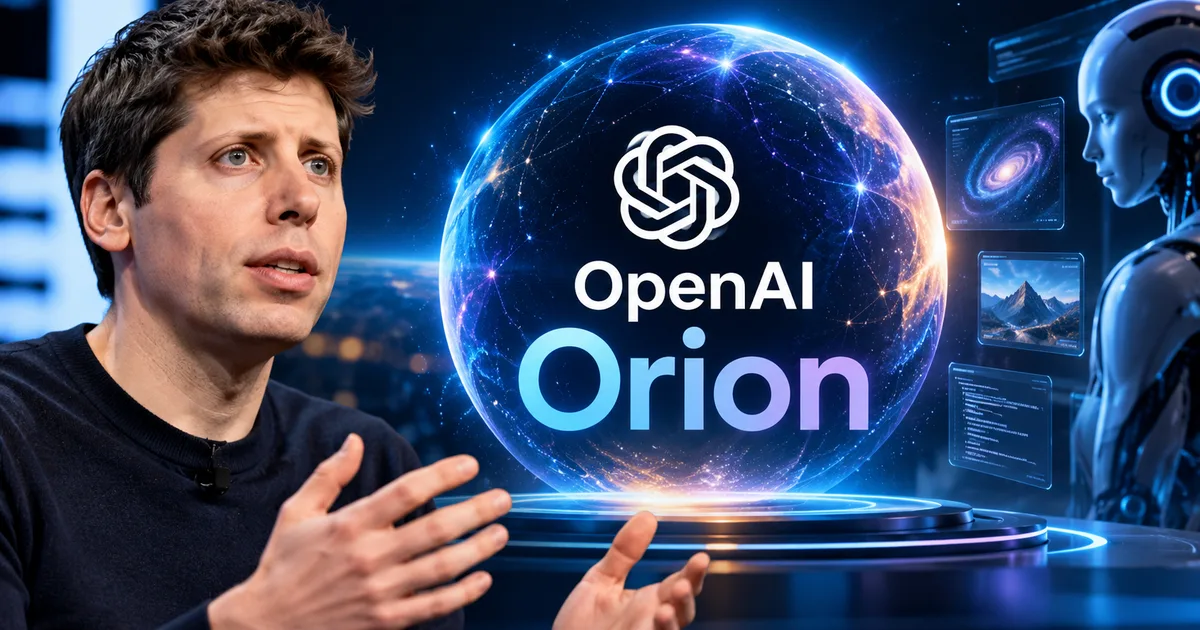
What is OpenAI's Project Orion?
If you've been following AI news in 2026, you've almost certainly heard the name Project Orion floating around. It's OpenAI's next-generation frontier model, the one that's supposed to make GPT-4.5 look like a practice run. And based on everything that's leaked and been said publicly, it's a big deal.
To understand where Orion fits, a quick rewind helps. OpenAI released GPT-5.5 (internally called "Spud") on April 23, 2026. Sam Altman confirmed its pretraining wrapped up on March 24, 2026, and described it as "a very strong model that could really accelerate the economy." Greg Brockman, OpenAI's President, went further on the Big Technology podcast: "There are two years of research inside this model. It has a big model feel, it's not an incremental improvement, it's a significant change in the way we think about model development."
So GPT-5.5 was already a serious leap. Orion is meant to be the step right after that. And if you ask me, the sheer volume of chatter around it makes complete sense given where OpenAI wants to go next.
What Sam Altman has said about Orion
Look, Altman has a very recognizable habit before big model drops. You start noticing it if you follow OpenAI closely. He goes quiet. Then he starts dropping roadmap comments, and that's when you know an announcement is around the corner. That pattern held with Orion too.
Multiple sources close to OpenAI's internal teams pointed to May 14, 2026 as the target unveiling date at a San Francisco event. According to reporting from Startup Fortune, Altman restarted his roadmap commentary in the weeks before that date, which anyone tracking the company knows is a reliable pre-launch signal.
Altman has also had to handle some awkward moments around Orion's schedule. OpenAI's safety team flagged serious concerns about the model's cybersecurity capabilities. Specifically, OpenAI admitted it "cannot rule out" that the model has what it classifies as "critical" cyber capabilities, a designation that triggered expanded safety testing and paused several internal activities. The Hindu reported that OpenAI eventually cancelled the release of a model called Astra 6.1 after internal testing showed it didn't meet safety standards. (Honestly, I'm not totally sure whether Astra 6.1 and this Orion build are the exact same model or just parallel tracks, since OpenAI's 2026 naming scheme has been a bit of a mess.)
What's clear is that Altman is balancing urgency against caution. If you ask me, that tension is actually a relief.
The technical architecture: what makes Orion different
Here's where things get interesting. The architecture being described for Orion is a major departure from how older GPT models worked.
Early technical leaks point to Orion running on a Mixture of Agents framework, which is basically a setup where specialized sub-models collaborate to solve tough tasks instead of pushing every query through one monolithic model. Think of it as a team of focused specialists instead of a single generalist trying to do everything alone.
The reported specs, if they hold up:
- A 40% reduction in inference costs compared to current-generation models
- A context window of up to 10 million tokens
- Designed for agentic workflows (AI that executes complex, multi-step tasks autonomously without waiting for a new prompt each time)
That 10 million token context window is staggering. To put it practically, a developer could feed an entire enterprise codebase into a single prompt. A researcher could load thousands of research papers at once. The basic back-and-forth chat model that most people still picture when they think of AI becomes almost irrelevant at that scale.
OpenAI's CTO Mira Murati spent much of the past quarter restructuring OpenAI's research division around what the company internally calls "Applied AGI capabilities." That framing is deliberate. Orion is designed as the base engine for autonomous agent systems, moving way beyond simple conversational chatbots. In my experience with early automation tools, that kind of architectural pivot is what actually makes complex workflows work. OpenAI's concurrent discussions with the US Department of Commerce around Level 3 safety compliance certifications point in the same direction. That certification tier is required for deploying autonomous agents in critical infrastructure, and companies don't pursue that kind of paperwork speculatively.
Who already has access?
Enterprise partners reportedly received controlled access to Orion during Q1 2026. So by the time of any public launch, this wouldn't be a cold introduction, but a formal commercial opening of something already in qualified hands. That staged approach is OpenAI's usual risk management playbook, and it makes sense for a model at this capability level.
For regular users like students, coders, freelancers, and small business owners, the rollout will likely follow the same pattern as GPT-5.5. Plus and Pro accounts get it first, while broader business tiers and API access come later. If you're on a free ChatGPT account in India, expect a wait. GPT-5.5 itself is currently available to Plus, Pro, Business, and Enterprise users in ChatGPT and Codex. Free users still don't have it as of late October 2026.
For Indian users specifically, ChatGPT Plus runs at roughly ₹1,675/month (around $20 USD), which remains the primary access tier for premium models. There's no INR-specific pricing for Orion yet, and no confirmation of any India-specific launch event either. If you ask me, that steep pricing keeps too many great Indian builders stuck on older free models. Take a look at Sam Altman's 2026 India plans and OpenAI's strategy for the Indian market for broader context on how OpenAI is thinking about this region.
How does this compare to the competition?
Orion isn't launching into a vacuum. The model race in 2026 has been frantic, with rival labs pushing out major releases almost back-to-back.
| Model | Company | Key strength | Status (Oct 2026) |
|---|---|---|---|
| Project Orion | OpenAI | Agentic tasks, 10M token context | Enterprise access; public TBD |
| GPT-5.5 "Spud" | OpenAI | Agentic coding, computer use | Live for Plus/Pro/Business |
| Claude (Anthropic) | Anthropic | Safety, long documents | Active; Mythos rumoured |
| DeepSeek V4 | DeepSeek | Open weights, cost efficiency | Rumoured Q2/Q3 2026 |
| Gemini 4 | Multimodal, Google ecosystem | Partial rollout |
Honestly, the pressure from DeepSeek is the one OpenAI probably watches most closely. DeepSeek's V3 and R1 models showed that comparable performance was achievable at a fraction of standard training costs, which put real pressure on OpenAI's pricing model. Orion's claimed 40% inference cost reduction looks like a direct answer to that pressure.
For a broader look at how competitive models are shaping up across the market, the tech explainers section has solid coverage on rival systems too. And if you're curious specifically about Google's next big move, the Gemini 4 2026 leaks and India launch details gives you the full story on what they're prepping.
What does this mean for Indian users practically?
It's a fair question, and one that doesn't get asked nearly enough in the rush around these launches.
If Orion's agentic tools work as promised, the practical payoff for India is going to be massive. Small business owners could use it to automate complex workflows: drafting replies, organizing invoices, following up on leads, and managing client queries without constant prompting. Students and researchers could load entire textbooks or research volumes in one go. Developers at Indian IT firms could turn it loose on serious codebase analysis. Plus, that 40% reduction in inference costs, if passed along into API pricing, would make building custom tools far more accessible for Indian startups.
Then there's the payment side of things (which matters a lot, honestly). OpenAI has been exploring local payment options for ChatGPT subscriptions in India, and a flagship model like Orion could accelerate that push. Right now, paying for ChatGPT Plus requires an international credit card or an enabled debit card. Adding seamless UPI support would immediately open the doors to a much wider audience across the country.
Thing is, none of that is locked down yet. Orion is still partly a puzzle of leaks and executive quotes. The safety delays are real, and OpenAI has proven it will pull back a release if testing raises red flags. The Astra 6.1 situation made that abundantly clear. So treat the May 2026 date strictly as an early target rather than a sure thing.
For now, GPT-5.5 is what's actually in your hands, and in my experience, it's genuinely capable for what most users in India care about: writing, coding help, research, and data analysis. If you're a freelancer or a student, that's your practical everyday starting point. See the AI tools section for reviews of what's actually usable today.
When will Orion actually launch?
The honest answer: it's completely unclear as of late October 2026.
I think that May 14 date slipped because of safety reviews. OpenAI has grown much more cautious about major launches after facing heavy internal and external scrutiny over advanced capabilities. The expanded testing framework (which now covers targeted checks for advanced cyber and biology capabilities) takes serious time.
What's far more likely is a phased rollout. Enterprise partners first, then paid Plus and Pro subscribers, followed later by business tiers and general API access. Based on how GPT-5.5 rolled out, expect a gap of several weeks between the first public demo and the moment a regular user in India can actually try it out.
Keep an eye on the latest tech news for updates as they come. This story moves fast.
"There are two years of research inside this model. It has a big model feel, it's not an incremental improvement, it's a significant change in the way we think about model development." (Greg Brockman, President of OpenAI, Big Technology Podcast)