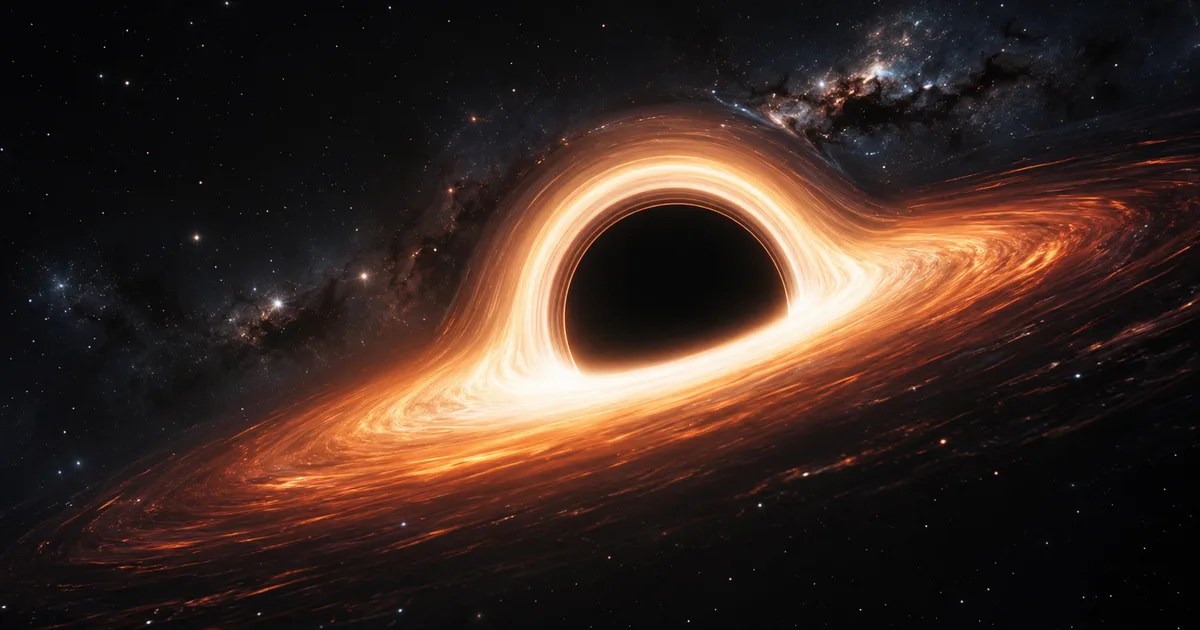
I remember sitting in my high school physics class in Mumbai, trying to wrap my head around black holes. The teacher explained them as these cosmic vacuum cleaners that just eat everything, even light. You fall in, you never come out. End of story. We had just finished a chapter on basic gravity, and this felt like science fiction.
But here's the deal, that story was incomplete. For the last fifty years, physicists have been fighting over a massive headache called the information paradox. Thing is, if a black hole destroys the information of what falls into it, it breaks the fundamental rules of quantum mechanics. It's like deleting a UPI transaction history entirely from the bank's servers so nobody, not even the RBI, can trace it. Physics hates that. Every single law of the quantum world relies on information being conserved.
Now, in 2026, we actually have a new black hole mechanics theory 2026 that seems to fix this mess. And honestly, it's wild.
I spent the weekend reading through the latest research papers, mainly because the news headlines were making my head spin. I want to break down exactly what this new black hole mechanics theory 2026 actually means for us without the confusing academic jargon. You don't need a PhD to understand why this matters. (And honestly, I think most people can grasp the core idea pretty fast.)
What exactly was the 50-year-old problem?
Before we talk about the fix, we need to understand the bug in the system.
Back in the 1970s, Stephen Hawking proved that black holes aren't completely black. They leak a tiny amount of radiation over billions of years, slowly shrinking until they evaporate entirely. This is called Hawking radiation. It was a huge revelation at the time. He combined gravity with quantum mechanics in a way nobody had ever done before.
There was a massive catch, though. According to Hawking's original math, this radiation is purely thermal. It carries absolutely zero information about the stuff that originally fell into the black hole. So, if you throw your old smartphone into a black hole and wait a few trillion years for the black hole to evaporate, the resulting radiation won't tell you anything about the phone. Was it a Samsung? An iPhone? The information is just gone.
But quantum mechanics says information can never be truly destroyed. It can be scrambled or crushed. Theoretically, you can always piece it back together if you have enough computing power. So, we had a contradiction. Hawking's laws of thermodynamics for black holes clashed directly with quantum physics.
This information paradox kept theoretical physicists awake at night for decades. Some physicists argued the information was hidden deep inside the singularity. Others thought it was left behind in a tiny remnant after the black hole evaporated. Nobody had a clean answer. If you ask me, the math back then was just a total mess.
The 2026 breakthrough explained
Look, theoretical physics is messy. I couldn't find a single sentence that explains the entire new theory perfectly, but I can give you the core idea of what changed.
The new models suggest that dynamic black holes follow a slightly different set of thermodynamic rules. For a long time, physicists used simplified models of black holes because the math was easier. But real black holes are dynamic. They are actively feeding and spinning. Researchers found an alternative measure of entropy for these dynamic black holes that actually allows information to escape.
Think of it like this. When you send a WhatsApp message, it gets end-to-end encrypted. To anyone intercepting it on the network, it looks like random garbage data. But the information is still there. It's just scrambled. The new theory implies that as a black hole evaporates, the information about what fell in is encoded in the Hawking radiation. It's heavily encrypted by the extreme gravity, but it isn't destroyed.
This is a massive relief for physicists. It means we don't have to throw out quantum mechanics. We just had to upgrade our understanding of black hole thermodynamics. The information is safe. It's just incredibly hard to read. (Which makes sense, actually, given the forces involved.)
Wait, does the universe have seven dimensions?
This is where things get a bit weird. To make the math for this new black hole mechanics theory work smoothly, some researchers are relying on string theory concepts.
A specific paper I saw linked the solution of the information paradox to the universe having seven extra dimensions that are curled up so small we can't see them. I know, it sounds complicated. It isn't actually that crazy if you look at string theory history. But it's hard to visualise in everyday life.
If you're walking on a tightrope, you can only move forwards or backwards. That's one dimension. But an ant on that same rope can walk around it in a circle. The ant experiences an extra dimension that you ignore because of your size. These extra seven dimensions are supposedly like that. They're just curled up infinitely small at every single point in space.
Do we know for sure these extra dimensions exist? No. Honestly, I'm not exactly sure the scientific community is fully sold on the seven dimensions part. But the math for the black hole entropy works beautifully with it. It allows the information to leak out in ways that wouldn't make sense in our standard three dimensions of space.
James Webb is finding monsters in the dark
While theorists are crunching numbers on whiteboards in universities, our telescopes are finding things that challenge our understanding of how these objects form in the real world.
Recently, the James Webb Space Telescope spotted a sleeping giant. We're talking about a black hole six billion times the mass of our sun, sitting quietly in the early universe. Finding something this massive so soon after the Big Bang is extremely confusing. It's like walking into a kindergarten and finding a fully grown, six-foot-tall man sitting in the sandbox playing with blocks.
We don't fully understand how it got that big, that fast. The traditional model of black holes slowly eating gas and merging with other black holes takes way too much time. It forces us to rethink the timeline of the early universe entirely. The numbers here are a bit fuzzy.
"The discovery of such massive black holes in the early universe indicates that our models of black hole growth are missing a fundamental mechanism."
This is why the new black hole mechanics theory 2026 is so relevant right now. We need better mathematical models to understand these wild observations. The old rules simply can't explain a six-billion-solar-mass black hole existing when the universe was just a toddler.
What about the black hole in our own Milky Way?
We've all seen that blurry orange donut photo of Sagittarius A*, the supermassive black hole at the centre of our galaxy. The Event Horizon Telescope team worked for years to get that image. But science never stops questioning itself, even when it has a photograph.
A new theoretical model proposes that the object at the centre of the Milky Way might not be a black hole at all. The researchers suggest it could be a dense clump of dark matter behaving exactly like a black hole. I think this idea is pretty sketchy.
Honestly, this is one of the more controversial ideas I've seen this year. Most astronomers still strongly believe it's a standard supermassive black hole. They've even discovered powerful winds coming from it recently. This is a natural consequence of a black hole feeding on surrounding gas. Gas spiralling inward gets compressed and heated, creating these winds. But the fact that a dark matter model can even attempt to explain the observations shows how much we still have to learn about gravity and dark matter.
If you want to read more about how scientists spot these things, you can check out our latest explainers on space tech.
Breaking the third law of black hole mechanics
Let's get slightly technical for a moment, just to understand the scale of the changes happening in physics right now. It's a big deal.
There are four laws of black hole mechanics. They directly mirror the standard laws of thermodynamics you might have learned in college chemistry. The third law basically says you can't reduce the surface gravity of a black hole to exactly zero in a finite number of physical steps. It's similar to saying you can't cool something down to absolute zero degrees. It's practically impossible.
But new research indicates that in specific conditions, you might actually be able to violate this third law mathematically. Especially in vacuum gravity without extra matter fields interfering. I couldn't find a clear official answer on what this means for physical reality. But it shows that the established rules from the 1970s are being aggressively broken down and rebuilt by today's physicists.
We're also seeing strange signals from LIGO. LIGO detects gravitational waves, ripples in space-time caused by massive collisions. Some recent signals could potentially reveal the missing link behind dark matter, tying all these cosmic mysteries closer together.
Why should you care about this in India?
You might be thinking, what does a black hole millions of light-years away have to do with me paying my electricity bill via UPI in Bangalore? Or ordering food in Delhi?
Fair question. Directly, nothing. But indirectly, everything. Basic science research is the foundation of modern life.
- The math and physics developed to understand black holes often lead to breakthroughs in quantum computing and cryptography. The security protocols protecting your Aadhaar data, your DigiLocker documents, and your bank transactions rely heavily on quantum mechanics concepts. Understanding the extremes of quantum physics eventually leads to better, more secure technology here on Earth.
- India is pushing hard into space exploration. We have the Gaganyaan mission coming up soon to put Indians in space. While ISRO is currently focused on near-Earth space and the moon, our astrophysics institutes, like IUCAA in Pune, are deeply involved in global research. Indian scientists contribute heavily to projects like the LIGO gravitational wave detectors.
- We have millions of students preparing for JEE and NEET every year. Exposing them to cutting-edge physics shows that science isn't just memorising old textbooks for an exam. It is an active, unsolved puzzle. We need young Indian minds working on these problems. Students studying these topics can use various tools to simulate gravitational waves online.
We're watching a major scientific revolution happen in real time. The physics textbooks being written for Indian schools ten years from now will look very different because of the research being published this year. (Which is pretty awesome, if you think about it.)
What happens next?
The new black hole mechanics theory 2026 is definitely not the final answer. It's a massive step forward. But physicists will spend the next decade arguing over the details. They'll run supercomputer simulations and try to find observational proof in the sky.
We're waiting for more data from the James Webb telescope. The ESA's Euclid space telescope is also out there right now. It's finding the universe's most ancient quasars, which are powered by supermassive black holes. Every new telescope brings new data that either breaks the old theories or confirms the new ones.
Physics is messy. It's confusing. And right now, it's incredibly interesting to watch. You don't have to understand the math to appreciate the fact that we are finally figuring out the darkest secrets of the universe. You can follow local ISRO developments in our news section.