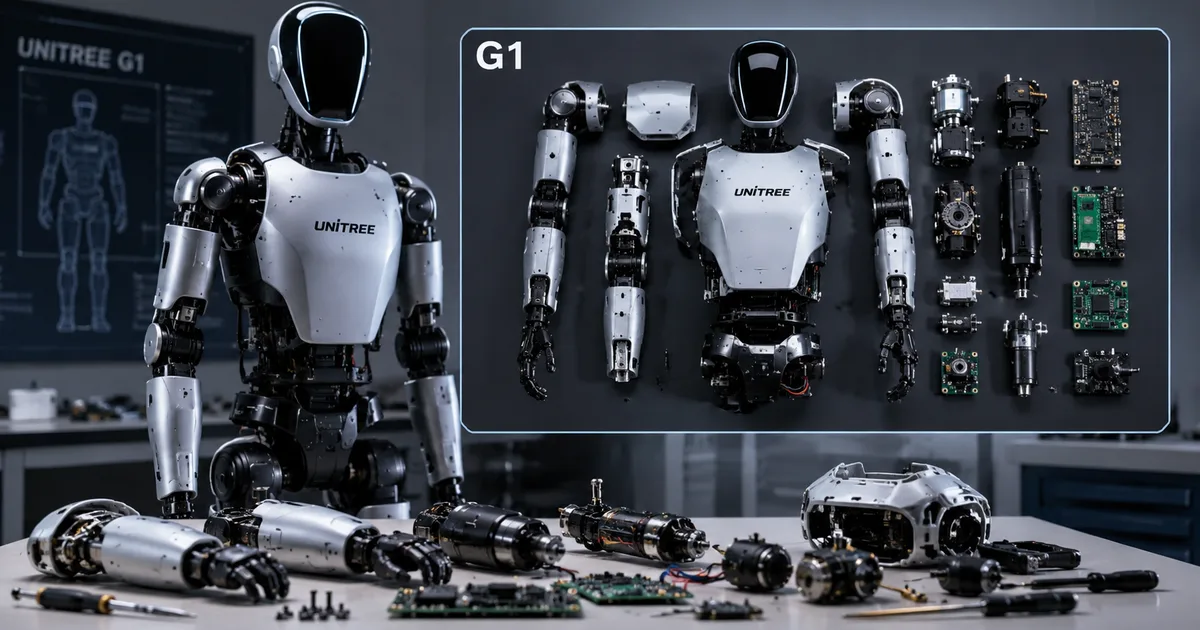
You've probably seen the videos. A humanoid robot doing backflips, recovering from being kicked, or taking a robot dog for a stroll. Most of us look at that and think it costs millions of dollars. We assume it's something only massive corporations or universities can afford. But the robotics world got a massive shock recently. The full Nikkei xTech Unitree G1 Teardown 2026: Engineering Secrets of the Affordable Humanoid Robot Explained report dropped this week. And it's making serious waves across the global tech industry.
Look, here's the deal. A Japanese engineering publication called Nikkei xTech bought a Chinese humanoid robot called the Unitree G1. They didn't just review it. They ripped it apart piece by piece to figure out how it actually works. More importantly, they wanted to know how it's so incredibly cheap.
The G1 sells for around $6,800. In Indian Rupees, that's roughly ₹5.6 lakh before taxes and import duties. For context, you pay that much for a decent entry-level hatchback car.
When the Japanese engineers looked inside, they admitted something pretty rare. They straight up said they can't catch up to China in the short term. I read through the teardown reports and financial analysis so you don't have to (annoying, I know). The engineering secrets they uncovered are surprisingly straightforward.
The shocking truth about the Unitree G1 price tag
To understand why this teardown is such a big deal, you have to look at the money. American companies like Boston Dynamics built amazing robots for years. Those cost tens of thousands, sometimes hundreds of thousands of dollars.
They're research tools.
Then comes Unitree. They launched the G1 at a bargain price that had everyone scratching their heads. People assumed the company was selling them at a huge loss just to grab market share. It's a common strategy in tech. But the teardown and a subsequent financial analysis by SemiAnalysis proved everyone wrong.
The gross profit margin on the Unitree G1 is actually estimated to be over 40%. Some analysts at SemiAnalysis point to a massive 67% gross margin (the numbers here are a bit fuzzy, honestly). They aren't losing money. They're printing it.
"The teardown revealed a supply chain fully exposed and optimized for mass production. It points to a BYD-style hardware dominance in robotics."
Basically, they got this by treating robot manufacturing like smartphone or electric vehicle manufacturing. They aren't hand-building parts in a lab. They rely on a massive supply chain. If you read our explainers on how Chinese smartphone brands took over the Indian market, you'll recognize this exact playbook.
What the Japanese engineers found inside
Nikkei xTech found simplicity when they unscrewed the casing.
And that's the hardest thing to engineer.
The internal structure isn't overly complicated. It uses standardized parts wherever possible. Let me give you a clear picture of the specific engineering choices they made.
Custom actuators over off-the-shelf parts
The joints of a robot are powered by actuators. Think of them as the robot's muscles. Robotics companies usually buy high-end actuators from specialized manufacturers. Those parts are expensive. Unitree designed and built their own. By keeping this in-house, they slashed the cost of the most expensive components in the robot by a massive margin. It's the same reason Apple designs its own silicon chips now.
Wiring and power management
Older robots look like a massive tangle of wires inside. Every sensor and motor needs a direct line to the main brain. The G1 has a centralized bus system. This means fewer wires and less weight. It also means less manual labor required to assemble the robot on the factory floor. Fewer parts mean fewer things that can break down.
Software compensating for hardware
This is perhaps the smartest thing Unitree did, if you ask me. Instead of using ultra-precise gears that have zero tolerance for error, they used slightly cheaper physical parts. But they wrote brilliant software to compensate for those physical imperfections in real-time. The AI balances the robot perfectly, even if the physical joint has a tiny bit of play in it. It's a classic example of software eating hardware.
Supply chain optimization
The Nikkei teardown showed exactly where the parts come from. Almost everything inside the G1 is sourced locally in Shenzhen and surrounding tech hubs in China. When a company doesn't have to ship parts across the ocean just to assemble them, costs plummet. The supply chain is fully exposed now. But knowing how they do it doesn't mean competitors can easily copy it. Building that network of suppliers takes years.
It is not just the G1
Unitree isn't a one-hit wonder stopping with the G1. They have an entire lineup making waves. If you look at the older Unitree R1, the progress is obvious. The R1 was good. But it was still clunky in comparison. The G1 takes everything they learned and packages it into something much more refined. Tech enthusiasts are constantly debating the R1 vs G1 online, but honestly, the G1 is superior in almost every metric that matters for mass production.
They're even experimenting with crazier concepts. Recently, they brought a pilotable giant robot to market called the GD01. Yes, a giant robot you can literally sit in and pilot. While that sounds like an expensive toy for billionaires, it proves they have the engineering chops to scale their technology up and down as needed.
And let's not forget the viral videos. The internet went crazy over footage of a humanoid robot taking a robot dog for a stroll. The machines were the Unitree G1 and the Unitree Go2 robot dog. It's brilliant marketing. They're showing that these robots aren't industrial tools only. They can navigate the real world and interact with each other. They do it all without a tether.
Can you buy the Unitree G1 in India?
This is the question I get asked the most. You have the money and you want a robot butler. Can you just order one on Amazon?
No. You can't.
Right now, the Unitree G1 isn't officially sold in India through standard retail channels. If you want one, you have to import it. Importing electronics with batteries and motors into India is a mess. The base price is roughly ₹5.6 lakh. By the time you pay customs duty and GST, you're looking at a big bill. Add international shipping, and you're easily looking at closer to ₹10 lakh.
Plus, there's the whole issue of after-sales service. If a motor burns out in Bengaluru, you can't just take it to a local repair shop. You'd have to ship parts back and forth to China. If you want to know how complicated importing tech can get, check out our guide on importing electronics.
- The base price is roughly $6,800, which converts to about ₹5.6 lakh.
- Estimated import duties can range from 30% to 40% depending on customs classification.
- GST adds another 18% on top of the base and duty.
- Total estimated landed cost in India sits between ₹9,00,000 and ₹10,50,000.
Some third-party sites like Xboom claim to help import humanoid robots into India. I strongly advise caution. Always verify exactly what you're paying for and what warranty support you actually get. You don't want to fall for online scams when dealing with lakhs of rupees (which makes sense, actually). If you suspect fraud, always report it to the 1930 helpline or cybercrime.gov.in.
The BYD effect in robotics
What we're seeing with the Unitree G1 is often called the BYD effect. Tesla paved the way in the electric vehicle market. But Chinese companies like BYD figured out how to manufacture them at a scale and cost that traditional automakers simply can't match.
Unitree is doing the exact same thing to humanoid robots. They aren't trying to build the most perfect robot in the world. They're building a good enough robot that they can mass-produce cheaply.
That terrifies traditional robotics companies. The Japanese engineers admitted defeat because they realized their entire approach to manufacturing is too slow and too expensive to compete with this model.
Think about the computing power needed to run these machines. It relies heavily on modern AI models. We cover that heavily in our news section. The G1 essentially runs a localized AI model to process its environment. This keeps latency low so it doesn't trip over a chair.
The software opportunity for India
Thing is, there's a massive silver lining here for the Indian tech industry. China might be dominating the hardware and manufacturing side of the robotics race. But these robots are essentially blank slates without good software. They run on complex operating systems and require constant updates to their AI models to function safely in human environments.
This is where Indian developers come in. Writing the logic for how a robot should pick up a fragile package without crushing it requires incredible software engineering. Or how it should navigate a crowded warehouse. The global demand for robotics software engineers is going to skyrocket over the next five years. Indian IT companies and startups are perfectly positioned to build the software brains for these cheap Chinese hardware bodies.
We're already seeing DeepSeek AI and other coding assistants helping Indian developers write better code faster. If our tech sector pivots towards robotics software, we could own a massive piece of this emerging market without ever needing to build a factory.
Why does this matter for us?
You might be thinking this is just a cool toy. Why should you care?
You should care because affordable humanoid robots will change the labour market. Maybe not tomorrow. And maybe not next year. But it's coming faster than we thought. If a robot costs ₹6 lakh and can work 24/7 without a break, businesses will start doing the math. That's roughly equivalent to the yearly salary of a mid-level warehouse worker in India.
We already see automation in manufacturing. A humanoid robot can work in spaces designed for humans, though. It can walk up stairs. It can open standard doors and use human tools. You don't have to redesign your factory or warehouse to accommodate it.
And it's not physical labour only. As these robots get integrated with advanced AI, they will handle more complex tasks. We recently talked about this in our tools coverage. The hardware is finally catching up to the software.
Final thoughts
The Nikkei teardown of the Unitree G1 is a wake-up call in my experience. The era of the million-dollar research robot is ending. The era of the mass-produced, affordable humanoid robot is here. Japan is long considered the undisputed king of robotics. Today, they're looking at China's supply chain and sweating.
I don't think we'll see these walking down the streets of Mumbai or Delhi anytime soon. Our infrastructure is chaotic enough for humans. A robot trying to process an auto-rickshaw driving on the wrong side of the road would probably freeze. But in controlled environments like warehouses or large factories, these machines are going to become a common sight much sooner than anyone predicted.