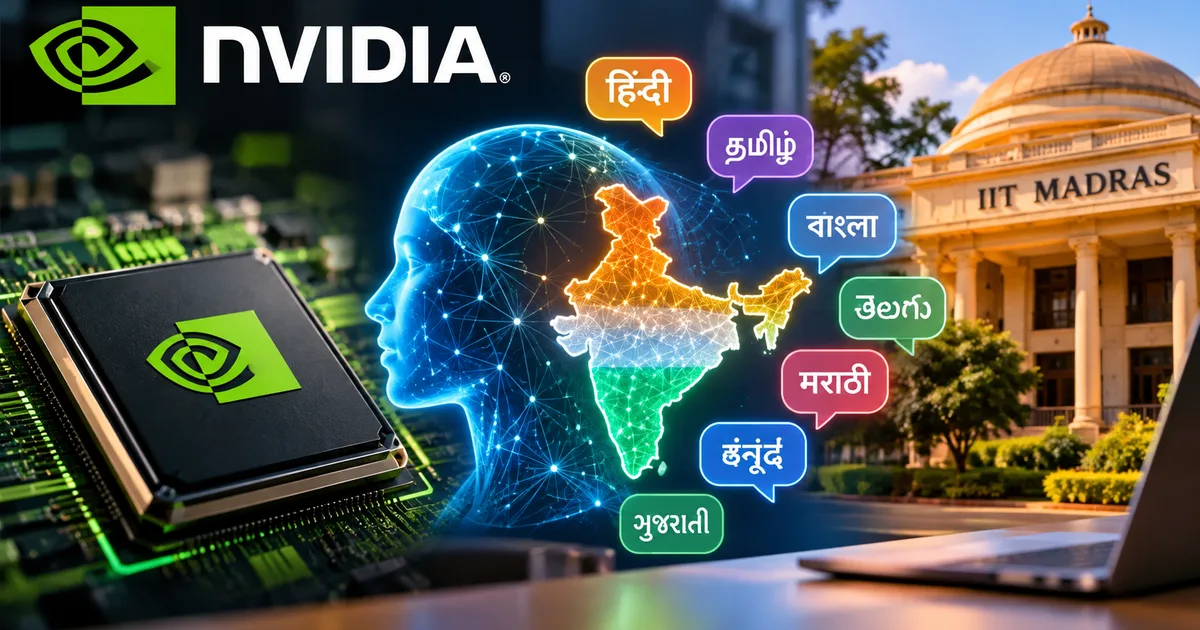
If you've ever tried asking a popular AI chatbot to explain a class 10 physics theorem in Tamil, Marathi, Telugu, or Odia, you already know how awkward things get. The words feel translated. Technical terms sound completely alien, and half the time the chatbot gives up and slips back into English. The rollout of NVIDIA Nemotron Indic AI on October 16, 2026, takes aim at that exact headache. Built through a collaboration between NVIDIA and the AI4Bharat research lab at IIT Madras, alongside its incubated education initiative Bodhan AI, this release puts 2.8 trillion tokens of open Indic language training data and four foundational AI models directly into the hands of Indian researchers and developers.
That's a massive number. Seriously.
Most open models floating around Silicon Valley treat Indian languages as an afterthought. They toss in maybe one or two percent of multilingual text that barely handles casual conversational Hindi. I spent a couple of hours going through the open release notes early this morning. NVIDIA brought the heavy compute clusters, while IIT Madras supplied the linguistic rigor (which, if you ask me, is actually a great thing). By making both the dataset and the training pipeline open to the public, our regional colleges, state departments, tech non-profits, and young startups won't have to keep renting expensive foreign APIs just to build tools that understand Indian citizens.
Why 22 Indian languages broke conventional language models
Look, most commercial artificial intelligence systems suffer from severe token starvation when dealing with non-Latin scripts. Open an American model and feed it a simple sentence in Telugu or Bengali. It stumbles. Because the underlying tokenizers were built around English text, they chop a single Indian language character into three or four separate numeric fragments. That makes inference agonizingly slow. And it makes running those models around three to five times more expensive on Indian server infrastructure (annoying, I know).
Then there's the sheer lack of clean digitized text on the open web.
English has decades of digitized journals, forums, Wikipedia pages, and scanned books. Indian languages simply don't have that volume of clean digital text sitting around on public websites. While Hindi and Tamil have decent web representation, the data dries up fast once you look at Maithili, Dogri, Santali, or Bodo. If you feed an algorithm noisy scanned documents or broken web crawls, the model spits out unusable garbage. In my experience, even the cleanest model architecture falls apart once the input text turns to mush.
Researchers at IIT Madras realized years ago that waiting for the public internet to produce trillions of high-quality Indian language sentences was a losing battle. You can check our detailed software architecture explainers to see how tokenizer compression impacts regional language speed on modest computers. The bottleneck was never the math. The bottleneck was clean text.
Inside the 2.8 trillion token synthetic pretraining dataset
To overcome that data drought, the team created Nemotron-pretraining-Indic-v1. This is a synthetic pretraining corpus with around 2.8 trillion tokens covering all 22 languages listed in the Eighth Schedule of the Indian Constitution. That covers widely spoken tongues like Bengali, Marathi, Gujarati, and Telugu, alongside lower-resource languages like Konkani and Manipuri. The exact token breakdown across some of the smaller tongues is still a bit fuzzy in the repo, but having all 22 in there is a massive step forward.
Now, when people hear the word synthetic, they usually worry about low-grade computer hallucinations (which makes sense, actually, given how messy cheap AI text looks). But AI4Bharat didn't just scrape random sentences and run them through a cheap translator. Instead, they took high-grade educational curricula, school syllabi, scientific literature, and civic reference documents, running them through strict grammatical filters and human review loops.
This process of controlled synthetic text generation ensured that complex terms in geometry and agricultural science were translated accurately rather than literally. Honestly, this is one of the more useful technical contributions to come out of an Indian university lab in years.
The open release of 2.8 trillion tokens across 22 languages provides the public digital infrastructure needed so Indian developers don't have to rebuild language foundations from scratch.
Here's the deal: because the dataset generator pipeline is open source, universities in Pune, Coimbatore, Jaipur, or Guwahati can take the exact same recipes and generate specialized datasets for local dialects. Thing is, proprietary foreign labs simply won't build for those regional needs.
The four open models shipping in the Bharat EduAI Stack
Having a mountain of training text is great for research papers, but working teachers and app developers need working software today. That's where Bodhan AI, the IIT Madras-incubated Centre of Excellence in AI for Education, entered the project. Alongside the dataset, the partnership released four foundational models designed specifically for the Bharat EduAI Stack.
These models focus directly on practical classroom tasks:
- Automated speech recognition models tuned to capture regional accents, classroom background noise, and colloquial phrasing across Indian states.
- Bidirectional translation models that convert school textbooks, board exams, and lecture notes between English and regional languages without losing subject context.
- Text generation and reasoning models capable of solving step-by-step math problems and summarizing complex chapters in local mother tongues.
- Teacher assistance tools that generate practice quizzes, homework worksheets, and reading assessments tailored to state education board syllabi.
Think about a government school teacher in rural Madhya Pradesh or a private tutor in rural Karnataka. Today, they spend hours manually translating English study material or drafting bilingual exam questions. It's a huge time sink. Having lightweight, open-weight models means these tools can run inside local school administration apps without sending student data to third-party overseas servers. You can read our latest tech policy updates to see how this fits into India's stricter data protection requirements under the DPDP framework. In my experience, keeping data locked inside local infrastructure is going to save institutions a ton of compliance headaches down the road.
What this means for Indian college labs and app builders
Money is where the real shift happens.
When an Indian engineering student or a four-person startup in Bengaluru wants to build an app using foreign commercial APIs, the economics fall apart fast. Paying in dollars per thousand tokens quickly racks up monthly bills of ₹50,000 to ₹2,00,000. For an unfunded college project or an early-stage bootstrapped business, that's impossible to sustain. If you ask me, paying dollar rates while earning in rupees has always been a financial trap.
Because the Nemotron Indic models are open-weight, anyone can download them and run them on local hardware. A college computer lab equipped with consumer graphics cards or a modest rented cloud instance costing ₹15 to ₹25 an hour can serve real student queries. That cuts the barrier to entry down to almost nothing.
And this development arrives during noticeable Indian tech hiring shifts, where local software firms are moving away from surface-level API wrappers toward deep, in-house model fine-tuning. If you want to build a voice bot for rural banking or a voice-based mandi price tracker, you need models that understand how real people talk, complete with code-mixing between Hindi and English.
When you look at overseas commercial tool pricing, the contrast becomes obvious. Basically, open weights give Indian engineers direct control over their tech stack. If an overseas vendor hikes prices or changes API terms overnight, your local hospital software or farm advisory app doesn't break.
The real obstacles Indic language AI still faces
I'm not going to pretend this release solves every hurdle for Indic languages overnight. Training models on Indian languages involves messy real-world hurdles that synthetic data alone can't fix. The most obvious challenge is stylistic authenticity. Synthetic data is a clever workaround, but it still carries subtle biases from its source materials. If the seed documents lean heavily toward formal textbooks and government notifications, the resulting model sounds stiff and bureaucratic when answering casual queries on WhatsApp. Real people don't talk like that. They speak in colloquial expressions, regional slang, audio notes, and blended sentences that mix vernacular verbs with English nouns.
Then there's the hardware constraint.
While these open models are much more efficient than giant closed models, fine-tuning them still demands decent graphics cards. A student living in a hostel with an older laptop without a dedicated GPU still has to rely on shared college servers or cloud credits.
So where does that leave us? The exact long-term benchmark numbers against upcoming commercial models are still a bit fuzzy, and we won't know for sure until independent benchmarks publish their findings next month. But having 2.8 trillion tokens and open pipelines freely accessible on platforms like Hugging Face changes the entire equation for local research. By combining IIT Madras's deep linguistic work with NVIDIA's computing power, we finally have an open foundation built for India's actual linguistic reality.