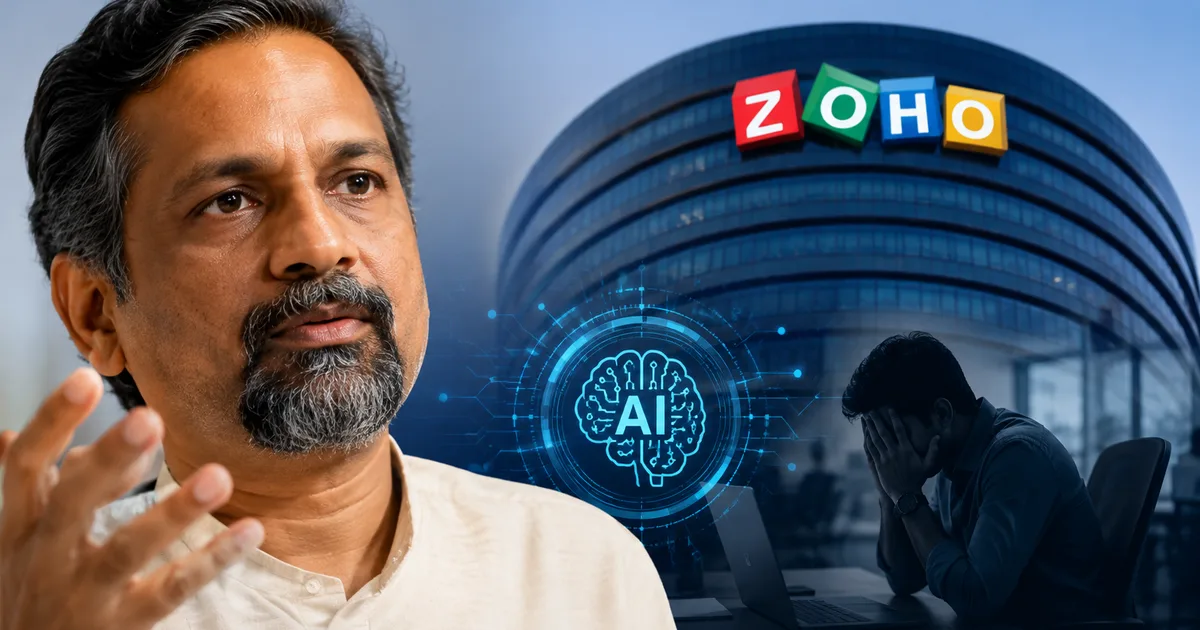
The end of the massive IT hiring spree
Look, we need to talk about the Zoho CEO Sridhar Vembu 2026 statement on AI's impact on the Indian tech job market. It's something every engineering student and IT professional in India should pay attention to right now. The tech hiring scene has changed completely over the last couple of years. And honestly, it's not a temporary dip or a regular market correction. Vembu just came out and said what many people in the industry have been whispering about for the last twelve months. IT companies are simply not creating new jobs at the scale they used to.
You probably remember the days when major IT firms would hire tens of thousands of freshers from campuses across India in a single quarter. Those days are gone. Basically, Vembu said even companies that avoided mass layoffs, including his own company Zoho, aren't generating significant new employment. The money that used to go into hiring budgets is going elsewhere. It's going to artificial intelligence infrastructure and massive data centers. Companies are spending massive amounts on AI costs. Those costs are a total mess right now.
I've been tracking the news about tech hiring for a while now. The shift is undeniably real. When the founder of Zoho warns that AI is slowing tech hiring, you have to listen closely. He specifically raised concerns over jobs for the young workforce in India. Every single year, lakhs of students graduate with engineering degrees hoping to land a stable IT job that will support their families. But the fundamental economics of the software industry are being reshaped by automation right before our eyes. (It's a scary thought, actually.) If you ask me, this shift is the biggest story in Indian tech.
Why are AI costs eating up job budgets?
Honestly, building and running these advanced AI models is ridiculously expensive. You need massive computing power to train them. You need data centers that consume enormous amounts of electricity. And you need expensive hardware like GPUs. Those GPUs are always in short supply and cost a fortune. All of this requires sustained capital investment from tech companies.
So company leaders are looking at their annual budgets and making a harsh choice. They're prioritizing infrastructure spending over recruitment. They feel they have to spend on AI to stay competitive globally. The only place to find that kind of cash is the payroll budget.
The IT industry has not generated significant new employment in recent years. Funds that would previously have gone toward hiring are now being spent on artificial intelligence infrastructure.
Think about a standard IT services project that Indian firms handle for global clients. In the past, a company might throw a hundred junior developers at a massive coding problem. It was a numbers game. Now, they might use a much smaller team of senior engineers armed with advanced AI coding assistants. Productivity rises dramatically. But the overall headcount stays flat, or it even shrinks. The money saved on thousands of fresher salaries goes straight to paying cloud providers and software licenses for enterprise AI tools. In my experience, clients are explicitly asking for smaller teams now.
Vembu pointed out that this is the real issue facing our nation right now. We have a massive demographic dividend in India. Millions of young people enter the workforce every year looking for decent wages. But if the biggest engine of middle-class job creation, the IT sector, stops hiring at scale, we have a serious macroeconomic problem on our hands. He asked a very valid question. If software and large-scale manufacturing create fewer jobs because of automation, what other industry can possibly absorb the slack? I'm not sure exactly why nobody else is talking about this math.
The global landscape and the pressure on Indian tech
We also have to look at what's happening outside India. The tech industry is totally globalized. When a major company in the US or Europe decides to cut costs and invest heavily in AI, the impact is felt directly in Indian tech parks. Vembu framed this issue as a broader economic problem. He's exactly right. We're operating in a very uncertain global landscape right now. Interest rates have been unpredictable. Inflation is a persistent concern. Geopolitical tensions remain high. All of this makes big corporations nervous about spending money on expanding their human workforce.
When these global giants get nervous, they squeeze their vendors. Indian IT service companies are often those vendors. So, the pressure comes from both sides. Clients want cheaper solutions driven by AI. They don't want to pay for a massive team of human developers billing by the hour. This means Indian companies have to adapt to these new demands while managing their own rising infrastructure costs. It's a tough balancing act. Unfortunately, entry-level hiring is usually the first casualty when budgets get tight.
I've spoken to several people working in mid-level management at large IT firms recently. They all say the exact same thing. The mandate from the top is clear. Do more with less. Automate everything you can. Use AI tools to speed up delivery. If a project required twenty people last year, management wants it done with twelve people this year. This push for efficiency is great for profit margins in the short term. But it's devastating for job creation in the long term. You can read more about how companies are handling these shifts in our tools and industry analysis sections.
The impact on freshers and entry-level roles
Here's the deal for freshers graduating this year or next. The traditional entry-level jobs are the most vulnerable to this shift. Think manual testing or basic code generation. AI tools can handle a lot of this grunt work now. Or at least, they make a single senior developer fast enough to do the work of four juniors without breaking a sweat.
This means the bar for entry has gone way up across the board. Companies simply don't want to spend six months training a fresher on basic syntax when an AI can write that syntax instantly. They want people who can understand complex systems from day one. People who can solve actual business problems. People who know exactly how to use these new AI tools to deliver results faster than a human could alone.
- Basic programming skills are no longer enough to secure a high-paying job.
- Companies expect new hires to be productive and billable much faster than before.
- There is far less willingness to invest in long training bench periods for new recruits.
- Adaptability and critical thinking are now valued higher than knowing a specific programming language.
If you're looking for guides on how to prepare for interviews now, the advice is changing rapidly. You can't just memorize textbook definitions or practice standard coding problems anymore. You need to build real things. You need to show that you can adapt to new tools and understand the broader architecture of a software product. (Which makes sense, actually, given how fast things are moving.)
The contrast with India's digital public infrastructure
What makes this situation particularly frustrating is the contrast with our domestic tech success. India has built world-class digital infrastructure. Look at UPI handling billions of transactions seamlessly. Look at how Aadhaar and DigiLocker have transformed government services. We clearly have the engineering talent to build massive, scalable systems that solve real problems for a billion people. But the traditional IT services model is fundamentally threatened by AI. It relies heavily on billing foreign clients by the hour for human labor.
We have a bizarre disconnect right now. On one hand, the government is pushing hard for more digital integration and indigenous tech development. We see constant updates about new regulations like the DPDP Act trying to secure our digital borders. We have ambitious local startups trying to build specialized AI models for Indian languages. On the other hand, the legacy IT sector is stalling out on hiring. This sector still employs the vast majority of our tech workforce. It's struggling to figure out its identity in a world where an AI can write thousands of lines of boilerplate code in seconds. We need a massive pivot. We need to move from being the world's back-office to being a primary creator of AI-native products. That's a painful transition. And the lack of new fresher jobs is the first noticeable symptom of that pain. I think this transition will take at least five to ten years to fully play out.
Is the IT job market completely dead?
No, it's definitely not dead. But it's different. Very different. While general mass hiring is slow, there is still intense demand for specific high-level skills. But those skills are much harder to get just by sitting in a classroom.
Companies are desperately looking for people who can actually build, secure, and manage these massive AI systems. They need data engineers who can clean and organize the data that feeds the AI models. They need machine learning specialists who can tweak the algorithms. They need cloud architects who understand how to deploy AI models efficiently. And they need cybersecurity experts more than ever. Because as systems get more complex and automated, they get significantly more vulnerable to attacks. You can check our explainers on data privacy and recent security breaches for more context on that rapidly growing field. The numbers here are a bit fuzzy, but the demand for these roles is clearly huge.
But we have to be honest with ourselves here. These high-level roles won't replace the sheer volume of entry-level jobs that might be lost to automation. You can't take a million freshers and turn them all into senior AI architects overnight. It takes years of real-world experience. That's the exact math that worries people like Sridhar Vembu.
What you should do right now to protect your career
If you're worried about your job or your career prospects in tech, sitting around and panicking won't help anyone. You have to adapt quickly. The rules of the game have changed. You have to learn the new rules.
Start using AI tools yourself every single day. Don't just read news articles about them. Use them to write code and draft emails. Understand their limitations thoroughly. Know exactly when they hallucinate and make embarrassing mistakes. A developer who knows how to review, debug, and fix AI-generated code is going to be incredibly valuable in the coming years.
Focus heavily on things AI is currently bad at. Deep domain knowledge in specific industries like healthcare or finance is huge right now. Complex problem-solving that requires understanding nuanced human context and messy real-world constraints is another big one. Client communication and empathy are still strictly human domains. High-level architecture design also requires human insight. Remember, AI is a tool. It's not a full replacement for human judgment and creativity.
Keep learning constantly. The tech landscape is shifting faster than ever before. What you learned three years ago in college might already be completely outdated today. You have to stay fiercely curious. Read official documentation. Build interesting side projects. Talk to people who are working on the cutting edge. (It sounds exhausting, I know, but it's mandatory now.)
The bigger picture for India's economy
This isn't just an isolated IT industry problem. It's a massive India problem. The IT sector has been the most reliable ticket to the middle class for millions of Indian families for the last two decades. It has fueled the explosive growth of cities like Bengaluru, Hyderabad, Pune, and Chennai. The salaries from IT jobs have driven real estate markets. They've driven retail spending and hospitality in those hubs too.
If IT hiring slows down permanently, the economic ripple effects will be huge and painful across the country. The government needs to pay serious attention to this shift right now. We need structural policies that encourage job creation in other sectors. We need to boost domestic manufacturing and improve agriculture tech. We also need to support small businesses with better access to capital. We simply can't rely entirely on exporting software services to the West anymore to employ our youth.
Sridhar Vembu is absolutely right to sound the alarm on this issue. We need to find real answers. And we need them soon. We need to figure out how to create meaningful, well-paying work for our youth in an age where machines can do so much of the heavy lifting. It's arguably the biggest challenge of this decade for India. Right now, we're just at the very beginning of figuring it out. The choices we make in the next few years will define what the future of work looks like for the entire next generation.