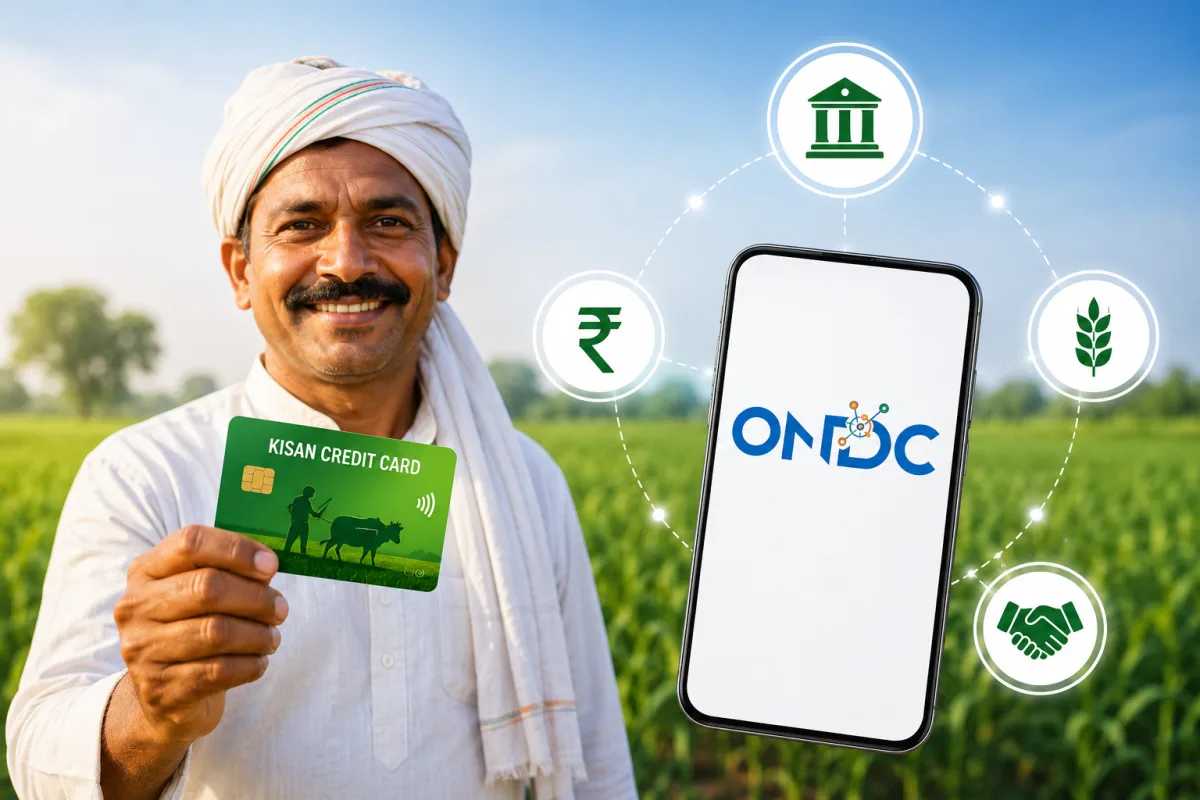
Imagine you're a wheat farmer in Madhya Pradesh. Kharif season is two months away, and you need around Rs 1.5 lakh to buy seeds and fertilisers. Your local SBI branch is 15 km away, the paperwork for a Kisan Credit Card takes weeks, and the loan officer keeps asking for documents you're not sure you have. Meanwhile, the moneylender down the road is already outside with his rates.
This is exactly the problem ONDC for agri-credit is trying to fix. Since 2024, the Open Network for Digital Commerce has been pushing into financial services, well beyond groceries and electronics. And in 2026, one of its more useful applications is finally getting traction. Farmers can now apply for Kisan Credit Card loans, and other agricultural credit, directly through any app on their phone.
What is a Kisan Credit Card, and why does it matter?
The Kisan Credit Card (KCC) scheme has been around since 1998. It's a revolving credit facility for farmers, giving them access to short-term loans at subsidised interest rates, typically 7% per annum. The government adds a 3% interest subvention, which brings the effective rate down to 4% if you repay on time. Credit limits are set based on land holdings and crop type, along with the scale of operations.
Tens of millions of KCC accounts are active in India as of early 2026, according to government data. But coverage is still poor for small and marginal farmers who hold under 2 hectares of land. Getting a KCC traditionally means visiting a bank branch, producing land records, getting them verified, and then just waiting. For farmers in states where land records aren't digitised, this can take months. I'm not sure exactly why some states are so far behind on digitisation, but the gap is real and it slows everything down.
The Gupta Committee report on agri-credit, which RBI formally asked banks to implement in late 2024, specifically flagged this problem. It recommended moving KCC applications to digital channels and cutting turnaround time to under 2 weeks for eligible farmers. That directive is what's been pushing lenders to join ONDC's financial services layer.
How ONDC for financial services actually works
ONDC is a government-backed open network. Think of it like the UPI of digital commerce. Instead of being locked into one app or one seller, buyers and sellers transact across a shared infrastructure. The Economic Times reported that ONDC now lets you get financial products from any provider through any app. Basically, your favourite agri app can show loan offers from multiple banks without you needing to visit each bank's app separately. In my view, that comparison piece is what makes this genuinely different from just going to SBI's YONO app on its own.
For agri-credit specifically, here's what that means in practice. A farmer opens the Jai Kisan app, or the government's Kisan Suvidha app, or a state-specific agri platform. These apps connect to ONDC's financial services layer and show loan offers from multiple lenders, including SBI, NABARD-backed institutions, regional rural banks, cooperative banks, and some NBFCs. The farmer can compare interest rates, loan amounts, repayment terms, and other conditions, then apply directly within the same app.
The lender processes the application on the backend, pulls land records via DigiLocker or the Bhu-Aadhaar system (the 14-digit ULPIN land ID), and makes a credit decision. In straightforward cases with clean land records, this is supposed to happen in days, not weeks.
(Worth saying upfront: the system is still maturing. Not every lender is live on ONDC's financial services layer yet, and rural internet is patchy in Bihar and Jharkhand, and across much of the northeast. The intent is solid. The execution is catching up.)
The 5,000 FPO angle, and why this matters beyond individual farmers
Here's where it gets more interesting. The government announced that 5,000 Farmer Producer Organisations (FPOs) have been onboarded onto ONDC. Separately, Finance Minister Nirmala Sitharaman told Parliament that NABARD has promoted 6,215 FPOs across the country. Those two numbers together tell you the scale of what's being built.
FPOs matter for credit because they give small farmers collective bargaining power. When a group of 200 farmers in Vidarbha forms an FPO and approaches a bank together, the credit assessment works completely differently than for one farmer with 0.8 hectares applying alone. And when that FPO is listed on ONDC, lenders can see their transaction history, what produce they've sold, what prices they've been getting. Faster credit decisions become possible because lenders are working from real trading data, not just land records.
Uttar Pradesh has been especially active here. The UP government announced it's connecting agri startups with ONDC and e-NAM, the National Agriculture Market. So the data loop between what a farmer grows and what credit they need starts to actually close.
Honestly, the FPO-on-ONDC piece is the part of this story that gets the least attention. Individual KCC digitisation is useful. But 5,000 FPOs on a shared network means potentially millions of small farmers getting credit access that a broken branch banking system simply couldn't give them.
Which apps and banks actually support this in 2026?
The honest answer is it's a work in progress. As of mid-2026, apps with some ONDC financial services integration for agri-credit include:
- Jai Kisan by Arya.ag, one of the earliest agri-finance apps, now connected to ONDC's network for KCC and allied credit products
- AgriBazaar, primarily a produce trading platform that is expanding into credit through the ONDC layer
- YONO Krishi, the agri section of SBI's YONO app, which has added ONDC-connected lender comparison for KCC applicants
- Kisan Suvidha, the government's own app, gradually integrating financial products from multiple lenders
- Samunnati's FPO platform, focused on collective credit for producer organisations rather than individual farmers
Banks on the lending side include SBI, Bank of Baroda, Punjab National Bank, and IDBI Bank, which has been actively pushing out digital solutions through 2025-26. A growing number of regional rural banks are also joining the network.
ONDC financial services doesn't replace your bank account. You still need a bank account linked to Aadhaar for the KCC to be issued. What ONDC changes is the discovery and application process, not the underlying banking relationship.
What documents do you actually need?
This varies by lender, but the standard set for a KCC application via ONDC is:
- Aadhaar card for identity verification via e-KYC
- Land ownership proof, ideally via Bhu-Aadhaar or state land records available through DigiLocker
- Bank account details at any scheduled commercial or co-operative bank
- Crop details: what you grow, how many acres, in which season
- A live selfie for biometric match (most apps handle this in-app)
If your land records are in DigiLocker (many states have uploaded Pahani and Record of Rights documents there), the application is largely paperless. If not, you'll still need to visit a bank branch or a nearby Common Service Centre with physical documents.
The Demand for Grants 2026-27 analysis by PRS India noted that land records digitisation is incomplete in several states. That's the single biggest bottleneck to fully digital agri-credit. Everything else in the system is moving faster than the land records are.
Loan limits and interest rates on ONDC: what to expect
KCC credit limits on ONDC are set by individual lenders, not by ONDC itself. ONDC is the network, not the bank. The government's 3% interest subvention applies when you take a KCC through any ONDC-connected lender, which keeps the effective rate at 4% per annum for short-term crop loans up to Rs 3 lakh, as long as you repay within the year.
Above Rs 3 lakh, or for term loans covering equipment and allied activities like animal husbandry or fisheries, rates vary. Some NBFCs on the ONDC network charge 12-15% (annoying, I know), so compare before you accept any offer. The whole point of ONDC is that you can compare lenders side by side. So actually do that before hitting accept.
Under ONDC's agri-credit layer, the government's 3% interest subvention still applies, bringing the effective KCC rate to 4% per annum for crop loans up to Rs 3 lakh, regardless of which app you used to apply.
How to actually apply, step by step
- Download or open an ONDC-connected agri app such as Jai Kisan, AgriBazaar, or check if your state's agri portal has the option
- Register with your mobile number linked to Aadhaar
- Complete e-KYC using Aadhaar OTP
- Enter your land and crop details
- Browse loan offers from different lenders on the network and compare rates and terms
- Select an offer and submit your application
- A lender representative typically does a field visit or a video KYC call
- Once approved, the KCC limit is set and you can draw down as needed, repay, and draw again within the validity period, usually 5 years with annual renewal
If you want to check whether a lending app is legitimate before you apply, our guides section has a step-by-step walkthrough using RBI's DIGITA portal to check registered lenders.
Real talk: how useful is this right now?
For farmers in states with good internet and digitised land records (Karnataka, Andhra Pradesh, Telangana, parts of Maharashtra and Gujarat), this system is genuinely useful today. Compare lenders, apply from your phone, skip the branch visit entirely. It works.
For farmers in states where land records are being digitised slowly, or where home internet is limited, it's still a work in progress. The 2026-27 Agriculture Demand for Grants analysis by PRS India is honest about these ground-level gaps, and they're real. The government's own targets for land record digitisation are behind in at least eight states.
One more thing. If you face problems with a digital loan or see an unauthorised deduction from your account, report it at cybercrime.gov.in or call the 1930 helpline. Agri-finance fraud is less common than urban loan app scams, but apps claiming ONDC or government scheme connections without actually having them do exist (sketchy, but it happens). Always verify through official app stores and the lender's RBI registration before applying. Our scam alerts section has more on spotting fake lending apps and what to do if you've already been caught.