Imagine you're in Bengaluru, late evening, trying to get home after a long day. You open Paytm to check your wallet balance and notice something: there's an auto-rickshaw booking option sitting right there in the app. You didn't download anything extra. You didn't switch to Ola or Rapido. You just booked directly from Paytm. That's ONDC for mobility in 2026, and it's quietly changing how tens of millions of Indians get around.
ONDC stands for Open Network for Digital Commerce. Most people in India know it from food delivery or online shopping. But the network has moved into mobility in a serious way. It now covers autos, cabs, metro, and buses. And if you haven't heard about this yet, you're probably still doing things the slow way.
The basic idea: UPI, but for rides
Before UPI, sending money meant using your specific bank's app. HDFC customers used HDFC's app, SBI customers used SBI's. After UPI, you could use PhonePe to pay someone whose account was at a completely different bank. One protocol, any combination of apps.
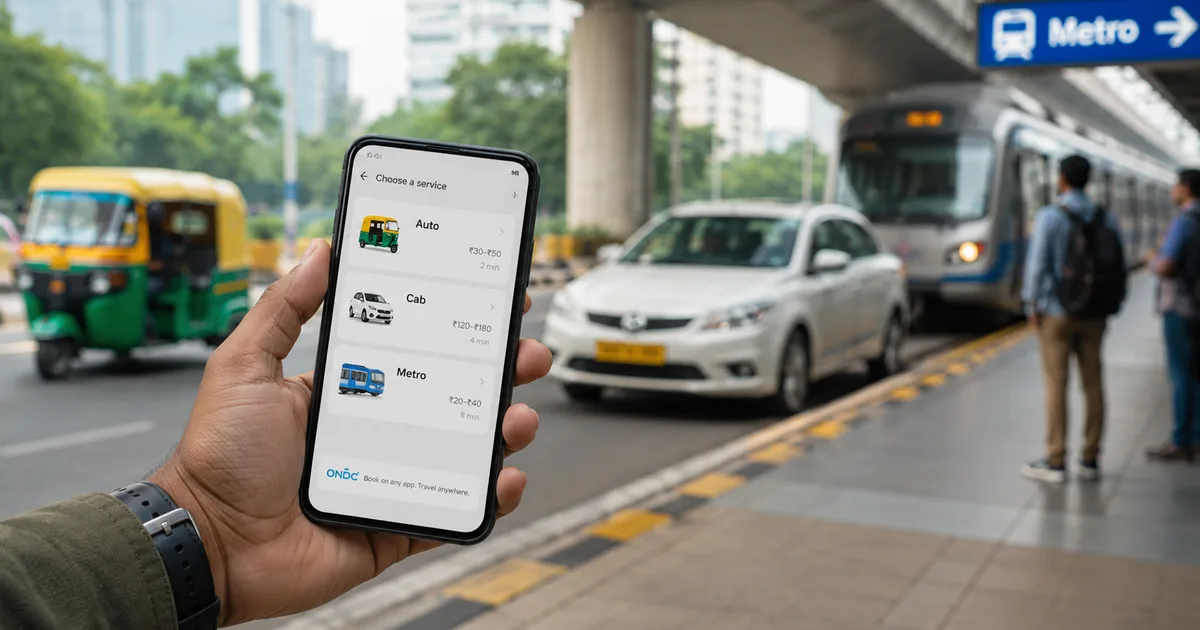
ONDC does the same thing for mobility. I think the UPI analogy is the cleanest way to understand what's actually happening here. On one side, you have "buyer apps," the apps you already use: Paytm, redBus, Rapido, or the newer interoperable app oJi. On the other side are "seller apps," things like Namma Yatri and metro ticketing systems, or local cab and bus operators. ONDC is basically a common language so these two sides can talk without needing custom integrations for every possible combination.
In practice, you open any ONDC-connected app, see ride options from multiple providers with prices side by side, pick what you want, and pay via UPI. No switching between apps. No downloading five different things for five different cities.
(I know this sounds almost too convenient. It is, in the cities where it's fully live. More on that later.)
Who's actually on ONDC for ride-hailing right now
The biggest news in early 2026: Paytm is offering auto-rickshaw bookings through ONDC, as reported by Moneycontrol. Paytm has hundreds of millions of users who already have the app open for payments. Getting access to auto bookings without any extra app is genuinely convenient, and it puts Paytm in direct competition with Ola and Uber for the auto-rickshaw segment specifically.
Separately, Pai Platforms, the new venture from Vijay Shekhar Sharma (Paytm's founder), is testing ride-hailing on ONDC according to Business Standard. So the person who built Paytm is now building a new mobility product on open rails rather than a closed platform. That's a meaningful signal about where serious entrepreneurs think this space is going.
Namma Yatri deserves its own paragraph. It's Bengaluru-born and runs on zero commission, meaning drivers keep everything the passenger pays. The app has since expanded to other cities. As Analytics India Magazine has covered in detail, the model crossed 5 million users and $50 million (roughly Rs. 415 crore at current rates) in cumulative driver earnings. That's real money staying with drivers rather than going to a platform. It's why driver adoption has been strong, and why the app grew without the kind of marketing spend Ola or Uber would need.
Hyderabad now has two ONDC-backed mobility options worth knowing:
- Yaary, a homegrown Hyderabad ride-hailing app on ONDC, covered by The Economic Times
- Mana Yatri, another ONDC-backed cab and auto option in the city, reported by Indiatimes
And then there's oJi, which The Indian Express described as India's first interoperable mobility app. Open it where it's live and you see Namma Yatri prices alongside Ola and Rapido, all on one screen. Pick the cheapest. Done. I've personally wasted embarrassing amounts of time toggling between three apps to find the best auto fare for the same route. oJi cuts that down to about ten seconds.
Metro and bus ticketing: the transit side of ONDC mobility
Ride-hailing gets more attention. But honestly, the public transit integration might have bigger long-term impact for most commuters.
Bengaluru Metro (Namma Metro) is now bookable on 9 different apps via ONDC, confirmed by both The Hindu and Hans India. Before this, you were mostly stuck with the official Namma Metro app or the queue at the counter (NCMC cards were an option too, if you had one). Now you can buy a QR-code ticket from redBus or Rapido, scan it at the gate, and walk through. The official app still works fine, but you're not stuck with it.
Rapido has partnered with ONDC for metro-ride integration in Delhi, according to Mint. The idea is combining a metro journey with a two-wheeler or auto booking to cover last-mile connectivity. In my experience, that stretch from the metro exit to your actual destination is the bit that kills the whole case for taking the metro in the first place. Sorting the whole journey from one app is a real improvement over the current juggling act.
Mumbai's BEST bus service integrated ONDC for cashless ticketing, reported by Mid-day. BEST carries several million passengers every day. Making ticket purchase work through any app a passenger already has, paid via UPI, removes one more friction point from daily commuting. Small thing in isolation, but multiplied across millions of trips it adds up.
Why the old app-per-service model was exhausting
Think about what a Bengaluru commuter using multiple transport modes actually needed: the Namma Metro app for metro tickets, some version of the BMTC app or just cash for buses, Ola or Uber for cabs, a separate app for autos, maybe Rapido for bikes. That's potentially four or five apps just to move around one city on a regular Tuesday.
ONDC doesn't eliminate these services. It lets them connect to a common layer so you access them from wherever you already are. If you have Paytm open to check your balance, you can book your auto from there. If you prefer redBus because you use it for overnight journeys, you can use it for metro tickets in Bengaluru.
For drivers, the structural difference is real. Platforms like Ola and Uber take 20-30% of every fare. Namma Yatri takes zero. At Rs. 1,000 per day in fares (a realistic figure for a busy driver), 25% commission is Rs. 250 gone every single day. On Namma Yatri via ONDC, that Rs. 250 stays with the driver. Over a month, that's Rs. 7,500. Over a year, Rs. 90,000. For a working family running one vehicle, that's not a rounding error. And honestly, I don't think most passengers think about this math until they're on the driver side of it.
Where ONDC mobility is actually available in 2026
Coverage is uneven, and it's worth being honest about that rather than overselling.
- Bengaluru is the most developed, with Namma Yatri, Yaary, metro ticketing on 9 apps, and bus ticketing all on ONDC
- Hyderabad has Yaary and Mana Yatri for cabs and autos via ONDC
- Delhi has Rapido's metro-ride integration on ONDC
- Mumbai has BEST bus ticketing through ONDC
- Other major cities are likely to follow, but aren't fully live yet
If you're in a smaller city or town right now, ONDC mobility isn't really useful to you yet. This is still a Tier-1 city story in 2026. I'm not sure exactly when the rollout reaches smaller cities, though the next year or two seems likely. But let's not pretend it's nationwide.
How to actually start using it
You don't need to do anything special. Check whether any app you already have is ONDC-connected. Paytm, redBus, Rapido, and oJi are the main buyer apps active right now. Open whichever you prefer, look for a rides or mobility section, enter your pickup and drop points, and see what options appear. Pay via UPI. That's genuinely the whole process.
For metro tickets in Bengaluru specifically, look for a "metro" option in connected apps. You'll get a QR-code ticket to scan at the gate, same as buying from the official app, just from whatever app you prefer.
One thing worth knowing: each buyer app on ONDC has its own privacy policy. ONDC itself doesn't store your travel data centrally, but your preferred buyer app does collect location and trip data. With India's DPDP Act rules now in force, apps have clearer obligations around what they collect and retain. But it's still worth checking the privacy policy of whichever app you end up using regularly (a step most people skip, which I get, but it takes two minutes).
For a broader view of ONDC across other areas, the guides section has posts covering ONDC for food delivery, logistics, healthcare, and more. Understanding how the underlying protocol connects to India's broader digital payments infrastructure is also worth your time if you're curious about why all of this is possible now, and the explainers section has the full picture on UPI and open digital networks.
The honest summary: ONDC for mobility is working, particularly in Bengaluru. Metro integration is live and real. Auto-booking through Paytm is up and running. The zero-commission model from Namma Yatri has proven itself at 5 million users. It's not everywhere, and there will be growing pains as more cities come on board. But for daily commuters in the right cities, there are genuinely better options available right now, from apps already on your phone.