Picture this: you're buying handmade pickles from a small seller in Nagpur through some buyer app you just installed. The seller isn't on Amazon or Flipkart. But your order gets picked up, tracked, and delivered to your door in Mumbai, handled by India Post. That's ONDC for logistics in action, and as of 2026, it's becoming a real part of how goods move across India.
Most people know ONDC as the government-backed open network for digital commerce. Fewer realise that logistics is a core part of the network, not an afterthought. And honestly, without a shared delivery layer, small sellers can't compete with big marketplaces that have their own fleets and warehouses. The logistics piece is what makes the whole thing actually work.
What the ONDC logistics network does
Think of it as shared delivery infrastructure that any buyer app, seller app, or courier company can plug into. Under the old model, if a small shop sold on Flipkart, they used Ekart. Sold on Amazon? Amazon Logistics. Locked in, no choice. ONDC breaks that.
On ONDC, a seller on any platform can use Dunzo, Shadowfax, Delhivery, Shiprocket, or India Post, whichever logistics provider has registered on the network. The buyer app sends a request. Available providers respond with quotes and delivery times, and then you or the seller pick one. It's genuinely open. I think that part doesn't get enough credit.
The technical term for courier companies that join is 'logistics network participant.' As of 2026, the number of these participants has grown a lot, and India Post joining is the biggest addition yet.
India Post on ONDC and why it's a bigger deal than it sounds
India Post officially joined ONDC as a logistics partner and delivered its first order through the network. Construction World India and Indian Transport and Logistics both covered the milestone. And then India Post went further. From March 17, 2026, it launched next-day delivery in six cities, a direct shot at private courier players who've owned that space for years.
India Post has over 1.55 lakh post offices across India, the largest postal network in the world, with deep reach into tier 2, tier 3, and rural areas where most private couriers either don't operate or charge significantly more.
For a handloom weaver in a small town trying to sell to buyers in Delhi or Bangalore, having India Post as an ONDC logistics option is genuinely useful. Not symbolically. Practically.
The Department of Posts also signed an MoU with the Ministry of Rural Development to push digital commerce deeper into rural India through the postal network. So this isn't just one headline delivery. It's a longer play.
How to track your ONDC delivery in 2026
There's no separate 'ONDC app' to download. You use whatever buyer app is connected to the network. In 2026, that includes Pincode (PhonePe's shopping app), Paytm, Mystore, Magicpin, and others. Some are general shopping apps. Some are category-specific.
Here's how the flow works after you place an order:
- The seller app confirms your order and initiates a delivery request on the ONDC logistics layer
- A registered logistics provider accepts the job, say Shadowfax or India Post
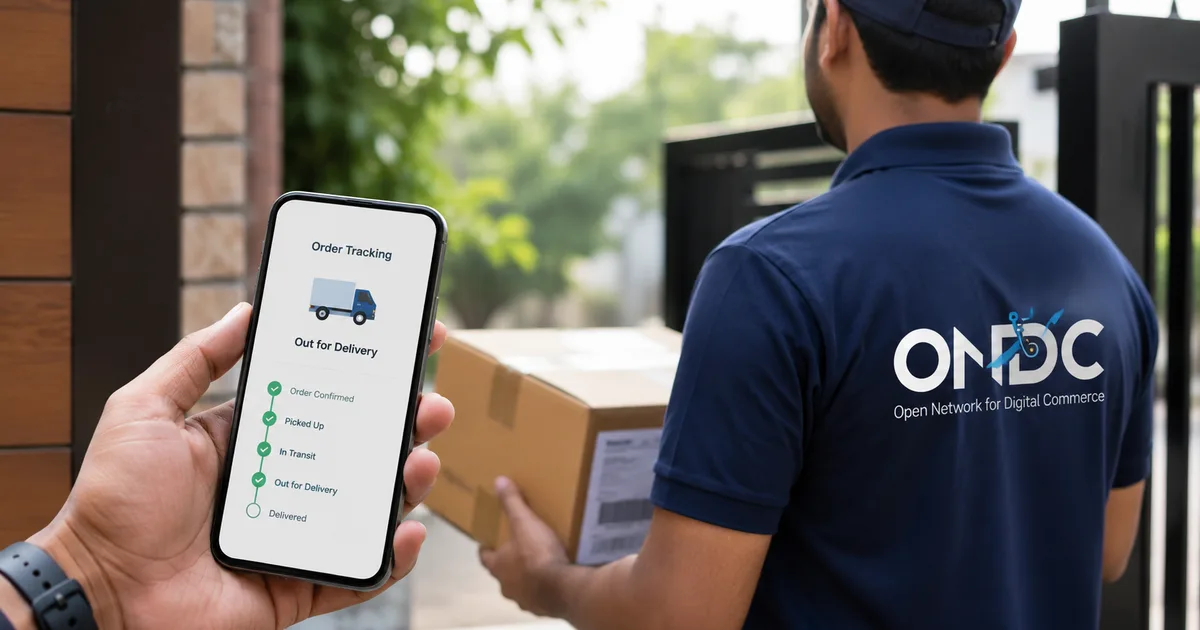
- You get a tracking ID within the same buyer app you ordered from
- Status updates flow through the app directly: picked up, in transit, out for delivery
You shouldn't have to jump to a separate courier website to track your package. The tracking data flows through the ONDC network back to the buyer app (which is the whole point, really). In practice, some apps handle this better than others. The experience isn't uniform yet, and I'm honestly not sure when it'll be consistent across all platforms. But it's noticeably better than it was a year ago.
Booking hyperlocal deliveries through ONDC apps
There's another use case worth knowing about: hyperlocal delivery. This covers same-city or same-day shipments, like sending documents across town, or a local retailer delivering groceries within a 5 km radius.
Some ONDC-connected apps now let you book a delivery the same way you'd book a cab. Enter pickup and drop, see available providers and their rates, confirm, track in real time. It's not uniformly available across India yet. The app you use determines what's on offer in your city. But the infrastructure is there, and more cities are getting coverage as more providers register on the network.
For small business owners, home bakers, boutique sellers, local repair shops, this used to require a dedicated account with a delivery aggregator. Now it can be done through a general business app connected to ONDC's logistics layer. (I know, sounds like it should be more complicated than it is.)
How small sellers and D2C brands actually benefit from ONDC logistics
ONDC logistics is arguably more useful for sellers than for buyers right now. Take a small direct-to-consumer brand, say a homemade snack company in Coimbatore. They used to have to sign separate contracts with Shiprocket or Delhivery, figure out confusing pricing tiers. And then deal with support on their own when shipments went wrong. Or just list on a big marketplace and take whatever terms were on offer.
On ONDC, the seller app gives access to multiple logistics providers through a single interface. Compare rates. If India Post is cheaper for a particular pin code, use India Post. If Shadowfax is faster for the destination, use Shadowfax. In my experience following this space, that kind of choice was previously available only to large sellers with enough volume to negotiate directly with couriers.
The growth numbers back this up. ONDC has seen rapid expansion from D2C brands and small sellers across India, with more pin codes getting coverage every quarter. Zoho, which builds business software used by millions of Indian SMBs, invested Rs 70 crore in ONDC. When a company that works that closely with small Indian businesses puts that kind of money in, they're usually seeing real utility, not just policy promise.
If you're a small business owner figuring out how to get onto ONDC and use its logistics features, our step-by-step guides section has walkthroughs for seller onboarding. And for the bigger picture on how ONDC works, from food and travel to healthcare, the explainers section covers all of those.
What's still being worked out in 2026
ONDC logistics works. But not perfectly, and not uniformly across India.
A few things that are still being sorted out:
- Serviceability gaps: Not every pin code has multiple ONDC logistics options. In smaller towns, you might get only one or two providers to choose from.
- Returns handling: Return logistics on ONDC is more complicated than on Flipkart or Amazon. It varies by seller app and doesn't always work smoothly for the buyer.
- Tracking consistency: Tracking data depends on logistics providers pushing updates to the network reliably. Some do this well. Some are slower than they should be.
- Grievance redressal: If your package is lost or damaged, figuring out who to contact, whether it's the buyer app, the seller, the logistics provider, or ONDC itself, can be confusing. ONDC has an Integrated Grievance Redressal Mechanism (IGRS), but buyer awareness of it is still low.
These are growing pains of a network that's only a few years old, not signs that the model is broken. But if you're using ONDC apps for the first time as a buyer, set your expectations accordingly. Amazon Prime-level speed and consistency isn't there yet across all pin codes. It's getting closer, though.
The bigger picture for Indian buyers and sellers
Basically, ONDC logistics is delivery infrastructure for the parts of Indian commerce the big platforms never really served. The small seller in a tier 3 city. The home business that couldn't meet Amazon's seller requirements. The rural artisan whose products aren't on any major platform. These aren't edge cases. They're a huge chunk of Indian commerce.
For buyers, more sellers means more local and regional products, and often better prices because the seller isn't paying 25-35% marketplace commission per order. For sellers, it means a shared delivery network they can actually access without being a large business first.
The courier industry in India is already growing fast, and ONDC's logistics layer channels a meaningful portion of that volume through an open, competitive network rather than closed platform ecosystems. That's good for competition, and over time, good for prices and availability for everyone.
If you've run into issues with an ONDC transaction, including delivery disputes, the escalation path is ONDC's IGRS portal. And if you're worried about sketchy ONDC seller or delivery scams, which have started showing up as the network grows, our scams section has what to watch out for.