You've probably given your Aadhaar number to at least a dozen different services over the years. Your telecom provider needed it for SIM verification. Your bank wanted it for KYC. Your mutual fund platform, your insurance company, maybe your employer too. That same 12-digit number, sitting in database after database. And India has had some serious data breaches in recent years. So the question worth asking: what actually happens to your Aadhaar number after you hand it over? That's where Aadhaar tokenisation comes in, and understanding it matters more in 2026 than it ever has.
The problem with giving out your real Aadhaar number
Your Aadhaar number is basically a master key to your digital identity in India. It's tied to your bank accounts, your phone number, your PAN, your government benefits, your AePS transactions. If someone has it and can pair it with a fingerprint clone or a social-engineered OTP, they can do real damage.
AePS fraud is well documented. UIDAI has been pushing face authentication as an extra security layer specifically because fingerprint-based fraud has been a real and growing problem. But as MediaNama reported, even face authentication isn't without issues when you look at the AePS fraud data. (Annoying, I know, but that's where things stand.)
The old KYC process meant typing your Aadhaar number into a form or uploading a copy, and that number got stored in the company's systems. Those systems can be breached. Corbado's 2026 research on India's biggest data breaches makes clear this isn't theoretical. Stored identity data is a liability for everyone involved.
And once your Aadhaar number is out in the wild, you can't change it. That's the core problem tokenisation tries to fix.
What tokenisation actually means
Tokenisation isn't a new idea. Your debit or credit card already works this way. When you tap your phone at a store or pay online, the merchant's system never sees your actual card number. It sees a token, a temporary stand-in specific to your device and that transaction. Someone intercepting that data gets a useless string of digits.
The real card number never travels across the wire. Aadhaar tokenisation works on the same principle, but for your identity instead of your payment card.
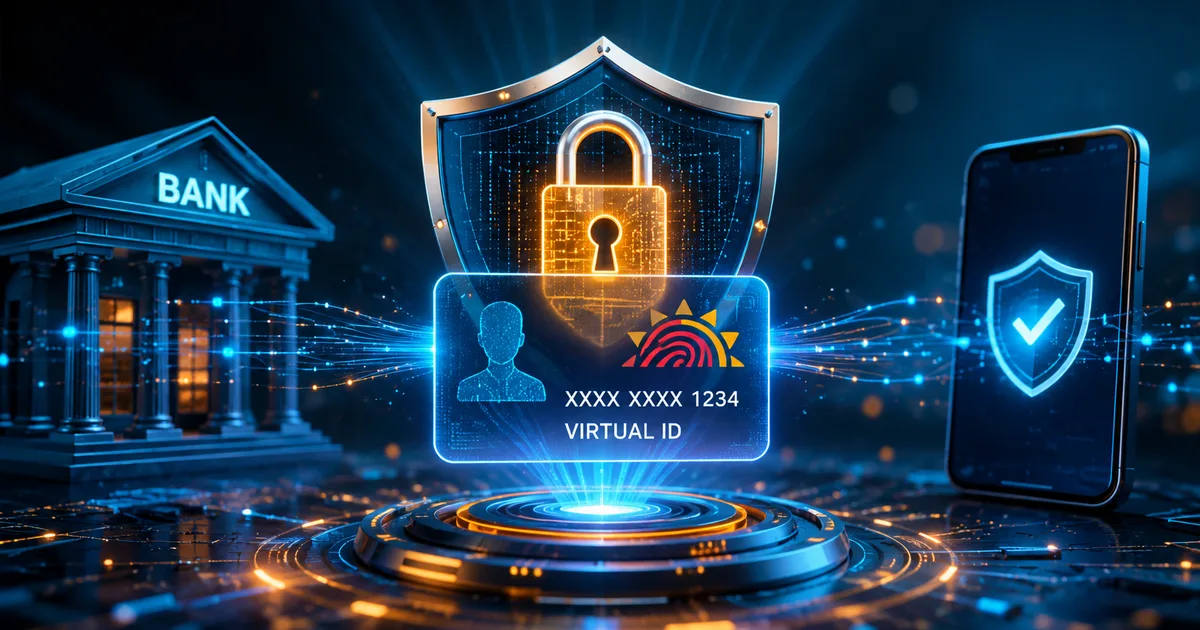
UIDAI has built a system where banks and licensed apps don't need to see or store your actual 12-digit Aadhaar number to verify who you are. Instead, they get a token: a unique reference code that represents you for that specific service provider only. One company gets their token. A different company gets a completely different token for the same person. Neither can use their token to figure out your real Aadhaar number, and neither can combine their tokens to discover they're both dealing with the same person. That's by design, and honestly, it's a smart way to do it.
The Virtual ID: something you can use right now
Before getting into how the backend token system works, there's a simpler tool UIDAI has given you that most people have never heard of: the Virtual ID, or VID.
Your VID is a 16-digit temporary number you generate yourself on the UIDAI website or the mAadhaar app. When any service asks for your Aadhaar number, you give them the VID instead. They use it to authenticate you with UIDAI. UIDAI confirms you're who you say you are. The company never sees your actual Aadhaar number.
And you can revoke the VID and generate a new one any time you want.
I asked around recently and not one person I spoke to had ever used this. If you regularly do KYC on multiple apps and platforms, using your VID is the easiest thing you can do today to cut your exposure.
To generate your VID:
- Go to uidai.gov.in or open the mAadhaar app
- Find "Virtual ID Generation" under Aadhaar services
- Verify with an OTP to your registered mobile number
- Your 16-digit VID is ready to use wherever you'd normally give your Aadhaar number
You can revoke it and create a fresh one at any time. If you think a company mishandled it, just regenerate. The old VID becomes useless.
How the backend token system works for banks and apps
When a bank or licensed fintech app does Aadhaar-based e-KYC, they go through UIDAI's authentication API. You give consent, you verify with an OTP or biometric, and UIDAI returns to the company a token specific to that organisation. Not your Aadhaar number. Not your VID. Just a reference code that UIDAI's system can use to recognise you later, but that the company itself can't decode or reverse-engineer.
There are two varieties of tokens the system can issue:
- Global tokens: Consistent for a user across all interactions with one platform, useful for matching records internally within a single service
- Local tokens: Unique per resident per service provider, so you get a different token on Zerodha than you get on your bank app or your insurance platform
Local tokens are where things get genuinely privacy-protective, and their adoption has been picking up. RBI's strengthened two-factor authentication rules, which came into effect on April 1, 2026, pushed banks and payment platforms to rethink their authentication infrastructure from scratch. Tokenised Aadhaar authentication fits well into that rebuild. Razorpay launched biometric authentication for card payments earlier this year, building on exactly this same underlying logic of separating the authenticating credential from the stored identifier.
Why a data breach no longer has to expose your Aadhaar number
Here's the practical difference this makes. Say a fintech app you've done KYC with suffers a data breach. Under the old system, attackers walking out with that database might have had your actual Aadhaar number. Under a properly tokenised system, they get a token that's only useful for authenticating with that one specific service through UIDAI's API, and even then it requires your consent and a live OTP.
They can't use it to open accounts elsewhere. They can't use it for AePS withdrawals. They can't reverse-engineer it to get your real Aadhaar number.
That's a meaningful improvement. Moving from storing Aadhaar numbers to storing tokens substantially cuts the damage any single breach can cause. It doesn't make data breaches harmless, but it takes your core identity document out of the blast radius. In my experience, that kind of structural change matters more than most people realise until something actually goes wrong.
What you should actually do right now
Most of this tokenisation happens automatically in the background when you use properly licensed apps. You don't need to manually manage tokens. But a few things are worth doing proactively:
- Generate your Virtual ID on uidai.gov.in and use it any time an app or website asks for your Aadhaar number directly
- Lock your Aadhaar biometrics when you're not actively using them for transactions. Go to uidai.gov.in, find "Lock/Unlock Biometrics," and lock them. This stops anyone from authenticating using your fingerprints even if they have your Aadhaar number.
- Download a masked Aadhaar from UIDAI's website for physical verification purposes. It shows only the last four digits and is accepted for most routine identity checks.
- Be suspicious of any app that asks you to simply type your Aadhaar number into a text field without triggering an OTP verification from UIDAI. That's not how legitimate e-KYC works, and the app may not be a licensed Authentication User Agency at all.
For more on what to watch for when apps claim to do Aadhaar verification, the Aadhaar scam and fraud guide on this site covers the patterns in detail. And if you want to understand how your broader financial data moves through official channels, the Account Aggregator framework explainer is worth reading alongside this one.
The bigger shift happening in 2026
Nandan Nilekani, who designed the India Stack architecture that Aadhaar sits within, has been publicly discussing a "finternet" vision where identity, financial assets, and data are all tokenised and interoperable while keeping sensitive details private. CNBC TV18 covered this in the context of gold and real estate becoming tradable through tokenised systems by 2026. Aadhaar tokenisation is one of the foundational pieces of that broader architecture, not a standalone feature.
None of this makes the system perfect. MediaNama's reporting on UIDAI's face authentication push noted that AePS fraud data raises real questions about how robust even biometric authentication is when attackers are motivated. Tokenisation helps a lot with one specific attack vector: database breaches and KYC data theft. It doesn't fix social engineering or physical fraud. The system needs good tokenisation plus strong authentication plus basic user awareness all working together, and I'm not sure we're fully there yet.
What's genuinely encouraging about where things stand in 2026 is that the infrastructure is getting more serious about this. The combination of RBI's new authentication rules, UIDAI's tokenisation framework, and tools like the VID that are available to ordinary users right now is a real step forward. For a look at how DigiLocker fits alongside Aadhaar for document-based identity verification, the DigiLocker guide covers that ground well.
UIDAI's tokenisation system ensures that no two service providers receive the same identifier for the same Aadhaar holder, making it significantly harder to build a cross-database profile of an individual even if one company's data is compromised.