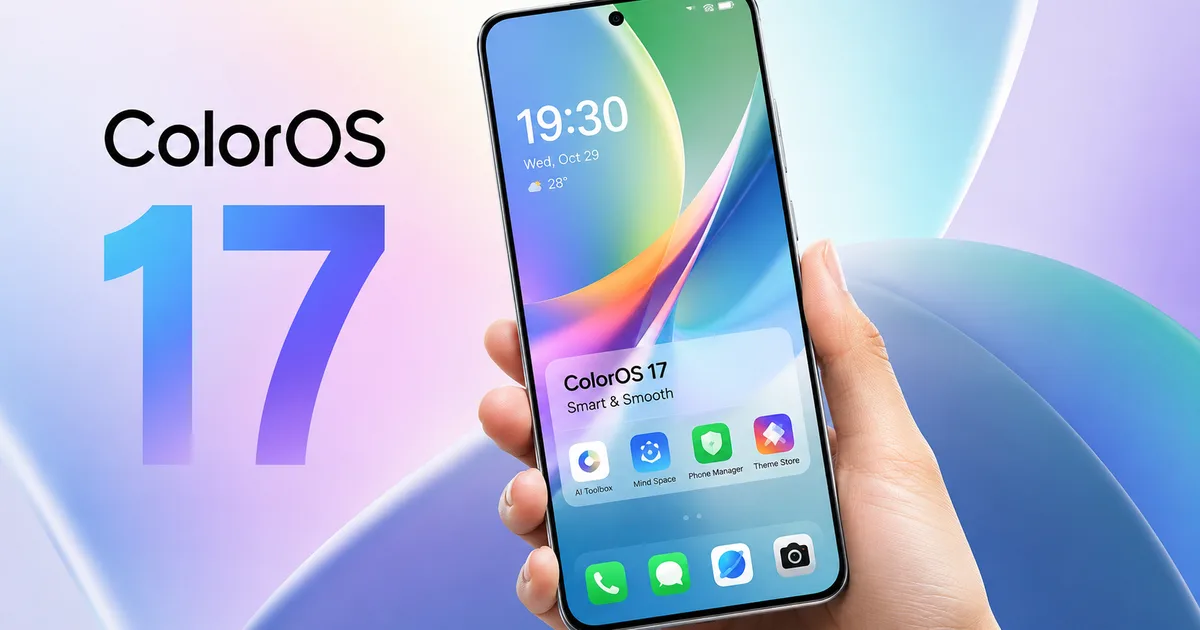
The Oppo ColorOS 17 update 2026 is officially rolling out in its early beta stages. This brings a massive change for the Indian smartphone market. We aren't just talking about a fresh coat of paint for your Oppo Reno. The stakes are incredibly high this year because OnePlus and Realme devices are fully moving into the ColorOS software ecosystem. And if you just bought a new OnePlus phone expecting the classic OxygenOS experience, you might want to sit down.
Things are changing fast.
I've spent the last few days digging through the beta announcements and developer notes. Honestly, this update focuses entirely on fixing the fundamentals. Oppo's software has always had a mixed reputation in India. Sometimes it runs perfectly. Other times it comes loaded with sketchy app stores and push notifications. They're clearly trying to change that narrative now. I think it's about time.
Here is exactly what you get and whether your specific phone made the cut for the Android 17 rollout.
The big shift: OnePlus and OxygenOS are basically gone
We have to talk about the obvious issue before getting into the new features. For years, OnePlus fans in India defended their phones purely based on the clean OxygenOS software. It was the closest thing to stock Android outside of a Google Pixel. But that era is over.
Reports confirm that OnePlus phones will transition entirely to ColorOS 17. The user interface might keep a few OnePlus-specific fonts or red accents. But the underlying engine is pure Oppo. And the same goes for Realme. BBK Electronics is unifying its software across all three brands to save development costs and push updates faster (which makes sense, actually).
Look, for a lot of you, this is going to sting. You pay ₹65,000 for a flagship phone and you expect a specific experience. But from a purely technical standpoint, this unified approach is smart. ColorOS has improved significantly over the last two years. It runs smoother and it kills background apps less aggressively.
If you're a Realme user, this is a direct upgrade. If you're a OnePlus purist, you'll need a few days to adjust to the new notification shade. You can read more about these brand transitions in our latest tech industry news.
Oppo ColorOS 17 update 2026: Top new features
So what actually changed? If you wanted a complete visual overhaul, you'll be disappointed. Oppo is playing it completely safe this year.
Chen Xi, an executive at Oppo, recently went on record to clarify their approach. He explicitly stated that they are prioritizing the actual user experience over cramming in useless new features.
"Oppo is not just chasing a new redesign with ColorOS 17; rather, it is dialling in on performance and making the software run better overall."
I respect that completely. We don't need five new ways to change our lock screen clock. We need phones that don't drop frames when switching between Instagram and WhatsApp.
The liquid acrylic design language
They call the new visual style Liquid Acrylic. In plain terms, it means more translucent menus and softer blur effects behind floating windows. When you pull down the quick settings panel, it doesn't snap into place. It glides.
It feels heavily inspired by iOS. And that's a good thing for general usability. The icons have a bit more depth to them now. They aren't flat, but they aren't overly realistic either. It is a nice middle ground that looks premium on modern OLED screens.
Performance and stability tweaks
This is where the real engineering work happened. Oppo claims they completely rewrote the memory management system.
In India, we abuse our phones constantly. We play BGMI in 40-degree heat and we constantly switch between UPI apps and our cameras. ColorOS 17 handles this better by predicting which apps you actually need kept alive in RAM and which ones can be put to sleep safely.
They also claim a 15 percent reduction in touch latency. I'm not sure exactly why the numbers here are a bit fuzzy, but you probably won't notice this while texting anyway. If you game heavily, the screen feels slightly more responsive to rapid taps.
AI features that actually make sense
Every company slaps "AI" onto their boxes this year. Most of it is garbage. But ColorOS 17 includes a few AI additions that I found genuinely useful.
First is the gallery app. The object eraser is significantly faster now. If you take a photo at India Gate and there are fifty people in the background, the AI scrubs them out with a single tap much more cleanly than before. It fills in the background textures better, so you don't get that weird smudged look anymore.
They also integrated a local AI summarizer into the voice recorder. If you sit through a two-hour college lecture or a boring corporate meeting, the phone generates a text summary with bullet points. Because it happens on the device, you don't need an active 5G connection for it to work.
Privacy with on-device AI
When companies talk about AI, the immediate question is data privacy. Are my photos and voice recordings going to a server in China?
Oppo is heavily pushing the concept of on-device AI for ColorOS 17. The neural processing unit inside modern Snapdragon and MediaTek chips handles the heavy lifting locally.
This matters a lot. If you summarize a confidential work meeting or edit photos of your kids, you want that data staying on your phone. ColorOS 17 adds a new privacy dashboard specifically for AI features. It lets you toggle cloud access off completely. I think it's a smart move.
Gaming performance and BGMI
Mobile gaming is massive in India. If an update breaks BGMI, the backlash on social media is instantaneous.
The ColorOS 17 beta has a revamped Game Assistant. It now gives you granular control over GPU clock speeds if your phone supports it. You can force the screen to stay at 120Hz. And you can lock the brightness so it doesn't randomly dim when the phone gets warm (annoying, I know).
The thermal management kicks in aggressively during long gaming sessions. Instead of letting the phone hit 45 degrees Celsius and then drastically throttling the frame rate down to 30fps, it gently manages the performance. It maintains a stable 60fps at a slightly lower resolution. It's a much smarter way to handle heat.
The bloatware situation: Are we finally getting a clean UI?
One of the biggest complaints Indian users have with Oppo and Realme phones is the sheer amount of pre-installed junk. Hot Apps and random browsers pushing notifications about celebrity gossip. It's exhausting.
Does ColorOS 17 fix this? Sort of.
Oppo promised that users can uninstall almost every pre-loaded app. But they're still there out of the box. You still have to spend the first twenty minutes with your new phone deleting things.
They've tightened down on system-level ads. The push notifications from the default browser seem less aggressive in the beta. We'll only know the reality once the final Indian ROM drops. Basically, Indian software versions traditionally get more monetization features than European versions because hardware margins here are razor-thin. If you buy a ₹15,000 phone, the company makes up the profit by showing you ads.
List of eligible phones in India
Will your phone get the update? Oppo's track record for updates in India has improved, but it's still a bit fragmented depending on whether you bought a premium Find series or a budget A-series.
Here's the master list of devices confirmed or highly expected to receive the ColorOS 17 beta and stable releases.
Oppo phones getting ColorOS 17
- Oppo Find X7 and Find X7 Ultra
- Oppo Find N3 and N3 Flip
- Oppo Reno 12 and Reno 12 Pro
- Oppo Reno 11 and Reno 11 Pro
- Oppo F27 Pro+
- Oppo F25 Pro
- Oppo K12x
OnePlus phones (yes, with ColorOS)
- OnePlus 12 and 12R
- OnePlus Open
- OnePlus 11 and 11R
- OnePlus Nord 4
- OnePlus Nord CE 4 and CE 4 Lite
Realme phones
- Realme GT 6 and GT 6T
- Realme 13 Pro and 13 Pro+
- Realme 12 Pro and 12 Pro+
- Realme Narzo 70 Pro
If your phone isn't on this list, don't panic just yet. This is based on the initial closed beta announcements and historical update patterns. Oppo usually expands the list once the stable version starts rolling out. Check our detailed guides for more updates on specific models.
How the closed beta works in India
The closed beta is currently live for the absolute top-tier flagships. If you own an Oppo Find X7 or a OnePlus 12, you can apply right now through the software update menu in your settings.
I'm going to give you a very strong piece of advice. Don't install this on your primary phone.
Beta software is a mess. Your battery life will likely tank. Your banking apps might completely refuse to open. In my experience, I tested a beta last year and I couldn't make a simple UPI payment at a local chai stall because Google Pay kept crashing. It's frustrating.
Unless you have a secondary device purely for testing, wait for the stable release. The public rollout usually starts around October or November, just in time for the Diwali sales. If you do want to risk it, make sure you back up all your photos and WhatsApp chats to Google Drive first. Also, you can read about common update issues in our scam alerts section to ensure you aren't downloading a fake update APK from Telegram.
The verdict: Evolution, not revolution
I've spent a lot of time criticizing Android skins in the past. But I have to admit, ColorOS 17 is a mature piece of software. They stopped trying to reinvent the wheel every single year.
The Liquid Acrylic design is pleasant. The AI features are quietly useful rather than being forcefully shoved in your face. And the focus on sheer performance is exactly what Indian consumers need, given how heavily we rely on our smartphones for literally everything.
The death of OxygenOS as a distinct entity is still a bitter pill to swallow. OnePlus built its entire brand identity in India on being the fast and clean alternative to mainstream software. Now, they're just another branch of the ColorOS tree.
It makes business sense. It probably even makes engineering sense. But it loses some of the soul that made those early phones so special.
We'll have to see how the stable version performs when it hits millions of Indian devices later this year. Until then, anyone running the beta will have to deal with the battery drain.