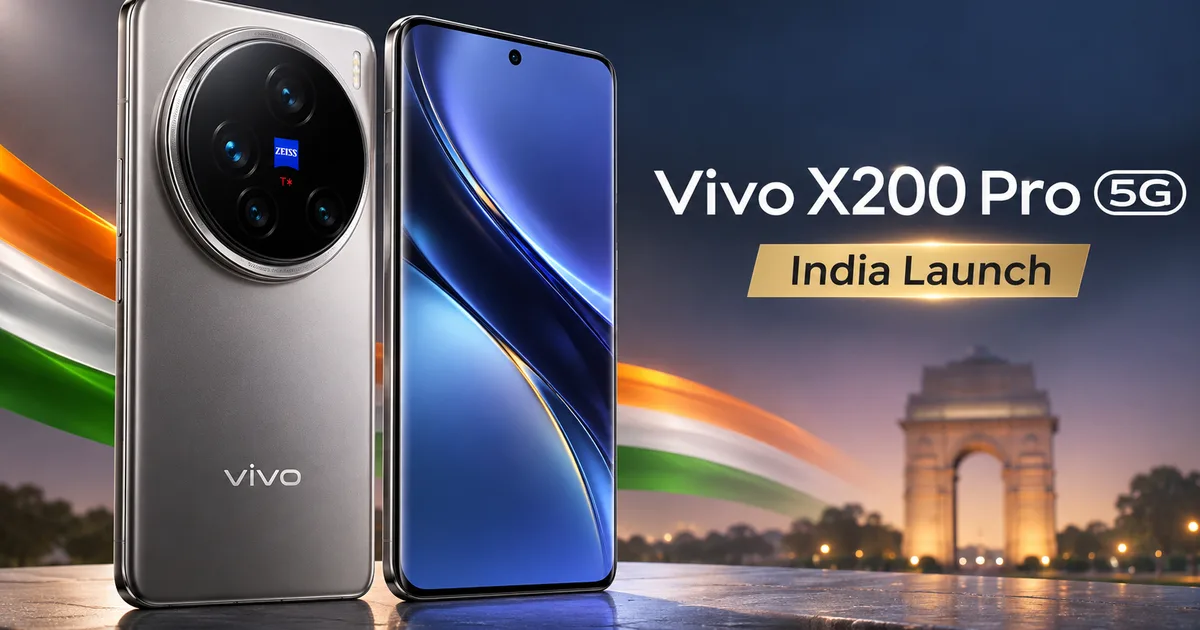
The chatter around the Vivo X200 Pro 5G India launch has finally turned into concrete details as Vivo sets the stage to bring its flagship camera phone to Indian buyers. If you have been following the flagship smartphone space in India, you know Vivo has quietly turned its X-series into the benchmark for mobile photography. I spent the last few days looking at global announcements, regulatory filings, and early hardware reports to see whether this phone lives up to the hype. Look, flagship phones in India have become ridiculously expensive over the past two years, so when a device crosses the ₹90,000 mark, it needs to offer more than just a shiny back panel and top-tier benchmarks.
The main upgrade here is obvious. Vivo dropped the 1-inch Sony sensor from the older X100 Pro. They replaced it with a custom Sony LYT-818 main sensor alongside a massive 200-megapixel Zeiss APO telephoto lens borrowed straight from the ultra-premium X100 Ultra. Add MediaTek's 3nm Dimensity 9400 chip to the mix, and you get a phone built for heavy photography and raw speed. If you want to keep track of broader industry developments, check out our Latest Tech News section for daily coverage.
MediaTek Dimensity 9400 and performance capabilities
For years, Indian flagship buyers leaned heavily toward Qualcomm's Snapdragon chips. But MediaTek has completely changed that over the past two generations. The Dimensity 9400 chip inside the X200 Pro uses TSMC's second-generation 3nm process node. It packs one Cortex-X925 ultra-core running at 3.62GHz, along with three Cortex-X4 super-cores and four Cortex-A720 efficiency cores. (I know technical specs can get boring, but this setup basically means it uses less power while running heavy games.)
Thing is, synthetic benchmarks tell only half the story. On AnTuTu v10, this processor hits scores well above 2.8 million. That puts it right alongside Qualcomm Snapdragon 8 Elite devices. Gaming performance on titles like BGMI and Genshin Impact stays locked at high frame rates. No thermal throttling here like we saw on older flagship chips. Vivo paired this silicon with up to 16GB of LPDDR5X RAM and up to 512GB of UFS 4.0 storage in India. If you plan to edit 4K video on the go or play heavy games during daily commutes, the raw performance headroom is more than enough.
What I find interesting is how energy efficient this chip is. In my experience, MediaTek really nailed the thermal management here. Paired with Vivo's updated cooling chamber, the phone stays surprisingly cool during long camera sessions. If you want to understand how modern processors handle heavy mobile tasks, read our guide on Tech Explainers to get a breakdown of chip architecture.
Zeiss 200MP telephoto camera and photography tech
Let's talk about the main reason anyone looks at an X-series phone. The camera system. Vivo completely reworked the rear camera module on the X200 Pro. They made some bold choices that might surprise photography enthusiasts.
Instead of sticking with the 1-inch Sony IMX989 sensor seen on the X100 Pro, Vivo switched to a 50-megapixel Sony LYT-818 primary sensor. It's a 1/1.28-inch sensor, which is physically smaller than last year's main camera. That sounds like a downgrade on paper, right? But here's the deal. The LYT-818 is built on a newer 22nm process that gives you much better dynamic range while pulling less power during video recording. In real-world low-light testing, the smaller physical size doesn't hurt it because the software processing and lens coatings are just better now.
blockquote>The 200-megapixel Zeiss APO telephoto camera on the Vivo X200 Pro brings true 85mm optical portrait capabilities with telephoto macro modes that capture detail rivaling standalone mirrorless lenses.
The star of the show is the Zeiss APO telephoto camera. This is a 200-megapixel sensor with an ISOCELL HP9 optical format measuring 1/1.4 inches. It has an f/2.67 aperture and 3.7x optical zoom. You can also push it up to 100x digital zoom. The lens carries official Zeiss APO certification. That means color fringing around high-contrast edges is reduced dramatically.
Real-world camera performance and portrait photography
Portraits are where this phone shines. Really. The 85mm focal length on the telephoto camera creates natural background blur without relying on aggressive software tricks. Hair separation is clean. Skin tones look natural without looking fake. And edge detection around glasses is sharp.
Macro photography is another big win. The telephoto lens focuses at really close distances. So you can shoot high-resolution close-ups of insects or small objects without casting a shadow with your phone. (Which makes sense, actually, given the focal length.) Compare this setup with mid-range options like the Vivo V80 5G launch in India, and you immediately see where your extra money goes.
Custom V3+ imaging chip and video capabilities
Behind the hardware sits Vivo's proprietary V3+ imaging chip. This custom chip works right alongside the Dimensity 9400 to process image data instantly. It handles 4K portrait video at 60 frames per second with smooth bokeh. You can adjust background blur after recording, or shoot 4K slow-motion at 120fps. If you create video content on your phone, the 10-bit Log recording gives real flexibility when color grading in apps like VN Editor or DaVinci Resolve.
The ultra-wide lens uses a 50-megapixel sensor with an f/2.0 aperture and a 119-degree field of view. It does a decent job, though it clearly takes a back seat to the main and telephoto optics. If you're curious about how future models might build on this, take a look at our analysis of the Vivo X500 series camera details.
Display, design, and software features
Up front, the Vivo X200 Pro has a 6.78-inch Quad Curved LTPO AMOLED display with a 2800 x 1260 resolution. Vivo calls this design equal-depth quad-curved glass. It gives you the smooth feel of curved glass along all four edges while keeping the screen flat enough to stop accidental palm touches. (Honestly, I think this hybrid approach works way better than the sharp curves on older flagships.)
The screen gets an adaptive refresh rate going from 1Hz up to 120Hz. You also get 2160Hz PWM dimming to save your eyes at night, while peak brightness hits a wild 4500 nits. Sunlight visibility during harsh Indian summers won't be an issue at all.
On the software front, the phone comes with Funtouch OS 15 based on Android 15 out of the box in India. Indian buyers get Funtouch OS instead of the OriginOS version sold in China. It's noticeably cleaner than older builds. Animations are smoother, bloatware is reduced, and multitasking works better. Vivo promises 4 years of major Android updates and 5 years of security patches. That's pretty standard for this price tier.
Battery capacity and charging speeds in India
Battery size got a massive bump. The Vivo X200 Pro has a 6000mAh battery inside. That's up from the 5400mAh cell in the X100 Pro. Vivo pulled this off using third-generation silicon-anode tech, fitting higher capacity into a slim body.
In daily use, this phone easily lasts two days if you're a moderate user. I'm not sure exactly why silicon-anode tech took this long to hit mainstream flagships, but it works. Even with heavy camera use, 5G data running on Jio, and screen brightness cranked up outdoors, you'll comfortably get through a full day with 30 percent left in the tank.
Charging specs include 90W wired FlashCharge and 30W wireless charging. Sure, 90W is technically a small step down from 100W on the older model. But the bigger cell means overall battery health should hold up better over time. Going from 0 to 100 percent takes around 42 minutes with the included charger.
Expected India price, variants, and launch timeline
Here's the quick breakdown of what to expect about Indian pricing and availability.
- Expected base price: around ₹94,999 for the 16GB RAM and 512GB storage model.
- Launch timeline: mid-December launch in India with open sales starting shortly after.
- Color options: Titanium Grey and Midnight Black.
- Bank offers: standard instant cashback of ₹5,000 to ₹7,000 on select HDFC and ICICI bank cards.
- Retail availability: Flipkart, Vivo India online store, and offline retail stores like Reliance Digital and Croma.
Honestly, ₹95,000 is a lot of money for a phone. But when you compare it with the Samsung Galaxy S24 Ultra or the iPhone 16 Pro, both of which sit way above ₹1,20,000, Vivo has built a strong option. It's targeted right at mobile photographers who don't want to spend over a lakh.
Final verdict: Should you wait for the Vivo X200 Pro?
If photography is your main focus, especially telephoto portraits or low-light zoom, the Vivo X200 Pro 5G is easily one of the best phones coming to India. The 200MP Zeiss camera, the snappy Dimensity 9400 chip, and that huge 6000mAh battery come together really well here.
That said, if you already have an X100 Pro or another recent flagship, you might not need to rush out and buy this unless you really want that extra battery capacity and longer zoom. But for anyone holding onto a two-year-old phone, this thing is going to feel like a massive jump in camera quality and battery life.