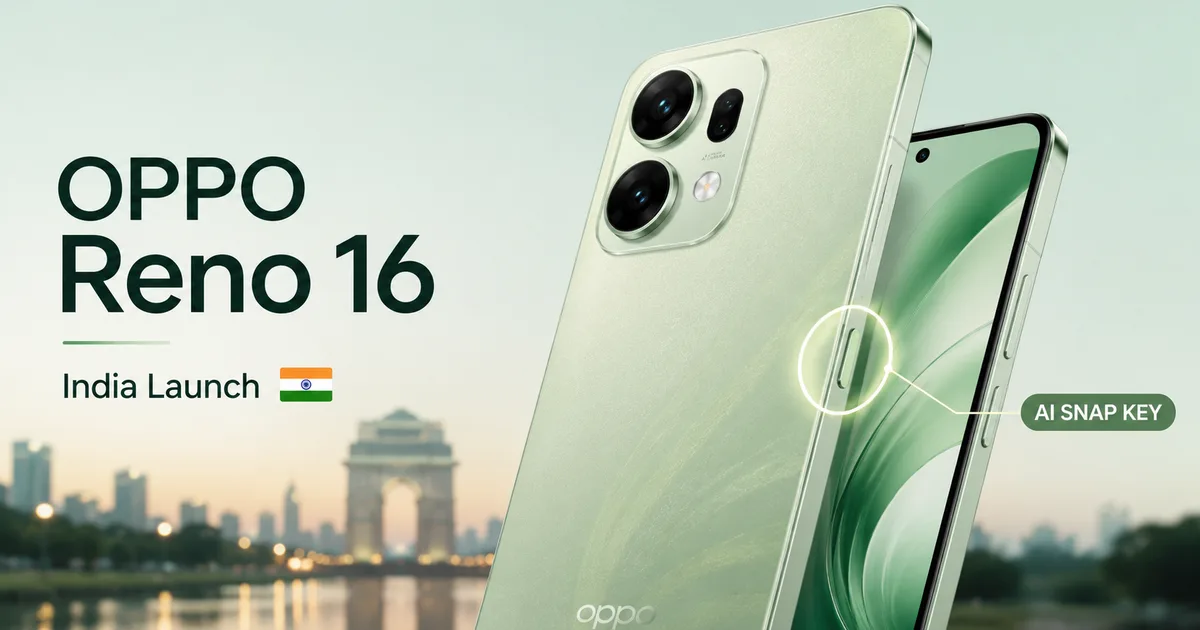
Oppo's confirmed the launch date for its next major smartphone series in India. According to recent reports from Gadgets360 and 91mobiles, we'll see the Oppo Reno 16 series officially launch on July 2, 2026. This lineup's expected to include both the standard model and a more affordable sibling, the Oppo Reno 16c. The big talking point this time around's a physical button on the side of the device called the AI Snap Key.
But there's a catch. Leaks say these phones will cost up to Rs 15,000 more than older models. That's a massive, painful price hike. Honestly, in a market where every single rupee matters, this is a risky move that could backfire. In my experience, Indian buyers don't tolerate high price hikes unless there's a really good reason, so let's see what Oppo has to justify the extra money.
Honestly, is a physical AI shortcut worth your hard-earned money? I've got some thoughts on that.
Expected Oppo Reno 16 price in India and launch dates
Let's talk money first. The standard Oppo Reno 16's rumored to start around ₹59,999 for the base variant. That's a lot. If these leaks are true, Oppo's stepping out of the mid-range zone and straight into the premium category. The company is already running pre-launch deals. Basically, they have this ₹9 privilege pack on their site. You just pay this using UPI to lock in some launch benefits. I think it's a smart setup, and we'll keep updating our news section as official details drop.
It's a clever marketing trick. Really, a ₹9 entry barrier's so low that anyone'll sign up without thinking. But when the phone actually launches on July 2, 2026, the shock of that sixty-thousand-rupee price tag's going to hit hard (which is a classic sales tactic, if you ask me).
So what about the sibling model? The Oppo Reno 16c's expected to be cheaper, and the leaks say it'll cost around ₹36,999. That's still not pocket change. But it is way more manageable for Indian college students and young professionals.
Let's compare this. OnePlus and Xiaomi have serious phones in this price range. Look, if you're spending ₹60,000, you want top-tier hardware and software. Oppo's going to have a hard time proving their new design is worth that kind of cash.
What are the leaked Oppo Reno 16 specifications
To see if this price makes sense, we have to look under the hood. Honestly, the standard model packs some serious hardware. Its screen is a 6.32-inch 1.5K OLED panel with a 120Hz refresh rate. That means scrolling Instagram is incredibly smooth. For power, the phone's got the MediaTek Dimensity 8550 Super chipset. It's a high-performance chip, so you won't face lag while gaming or working. If you ask me, this processor is a beast. If you want to compare other phones in this budget, go read our buying guides.
Then we have battery life. Oppo put a massive 6,700mAh battery in the standard model, and it supports 80W charging. That's huge. Most phones in this price tier stop at 5,000mAh. So you'll easily go two days without ever needing to plug in. For long commutes in cities like Mumbai or Bengaluru, this is a lifesaver.
Now, let's talk cameras. The main back sensor is a 200MP camera. You also get a 50MP camera for selfies on the front. But look, high megapixels don't guarantee good photos. We've seen other brands mess up software optimization despite huge sensors. Oppo usually does portraits well, but we'll have to see how this new setup performs in low light.
Here's a quick breakdown of what the two models offer in terms of screen size, battery, charging speed, and performance:
- Standard model's got a 6.32-inch display, while the C-model's got a larger 6.57-inch screen.
- Standard model uses the Dimensity 8550 Super processor, while the C-model uses the Dimensity 7300.
- Standard model features a 200MP main camera, while the C-model has a 50MP primary camera.
- Standard model's got a 6,700mAh battery with 80W charging, while the C-model's got a 6,500mAh battery with 45W charging.
How the Oppo Reno 16c differs
The cheaper model's got some clear compromises. It has a slightly larger 6.57-inch AMOLED screen but runs on a mid-range Dimensity 7300 processor. Its battery is smaller at 6,500mAh with slower 45W charging. Instead of that 200MP camera, you just get a 50MP sensor. Look, these specs are decent, but they're very similar to what you get in phones under ₹30,000. In my opinion, paying ₹36,999 for a Dimensity 7300 phone is a tough sell. Oppo's banking on design and AI to close the gap.
Understanding the AI Snap Key features
What's this AI Snap Key? It's a new physical button on the side of the Reno 16 series that acts as a quick shortcut for AI tasks. Many brands are adding AI features that feel like gimmicks. But a physical button that makes it easy to save text or record quick thoughts is actually useful in practice. Personally, it reminds me of the Action Button on iPhones, but with a heavier focus on productivity. The button's got three main inputs to help you capture and organize stuff easily.
- A single press lets you save whatever's currently on your screen to a feature called Mind Space.
- A double press opens the Mind Space interface directly on your screen.
- A long press lets you record a voice note quickly.
You can also change these settings if you don't want the AI stuff. Map the button to open the camera, trigger the flashlight, start the translator, or run other tasks. Honestly, that level of customization is pretty neat. It makes the button useful even if you don't care about AI tools. Here's the deal: we don't know how well the software behind this button works. Oppo calls it AI Mind Pilot. If the software's slow or buggy, that button becomes useless. We'll have to wait for the launch to see if it integrates smoothly with daily tasks.
The Indian context: pricing and regulations
Selling a phone for ₹60,000 in India's a tough task. Most buyers prefer Apple or Samsung at this price. Oppo's known for its offline retail shops, and their massive network of stores helped them sell mid-range Reno phones to buyers who want to touch the device first. But the premium segment is a completely different game. I think offline charm won't be enough here. If you want to understand how phone companies price their devices in India, check tech explainers on our website.
Also, there are regulatory rules to worry about. The Indian government is pushing for strict compliance under the DPDP Act to protect user data. Since AI features process personal info, security is a big concern. Oppo claims their AI Mind Pilot does most processing on the device itself. That's important because sending data to cloud servers can trigger privacy issues under current regulations (which is a mess, honestly).
Also, the government's cybersecurity agency, CERT-In, regularly issues warnings about data leaks and app security. Indian users're getting way more aware of these problems now. If a phone's capturing screen content through a physical button, people want clear proof that their private data's safe. I think Oppo's got to be completely transparent about how Mind Space stores your info.
Let's also look at how Indians buy phones today. Thanks to UPI and instant bank discounts, buying a phone's become easy. Most shops and online sites offer no-cost EMI options. This has helped push average prices up. But even with easy finance, a ₹15,000 price jump is huge. I think it will push buyers toward older models or rival brands that offer similar performance for less money.
Design and build quality
The design of the Reno series has always been a major selling point. This new lineup is using a technique called HoloVerse 3D. On the Starry White model, it creates a visual effect that looks like floating stars on the back. It's a nice touch, but design's subjective. Honestly, some users might find it too flashy. The phone's also expected to have great dust and water resistance. Leaks suggest ratings of IP66, IP68, and even IP69 (which is rare for a regular phone, actually). An IP69 rating means it survives high-pressure water sprays. For anyone traveling during the heavy monsoon in Mumbai or Chennai, this is a huge deal.
According to a report by 91mobiles, the steep price increase for the Oppo Reno 16 series's driven by the rising costs of advanced AI chipsets and the inclusion of premium build materials like the physical AI Snap Key mechanism.
Here's some good news: Oppo's still including the charger in the box. With the standard model, you get an 80W SuperVOOC charger. Apple and Samsung have stopped putting chargers in their boxes. I think having a fast charger included is a massive plus for Indian buyers who don't want to spend an extra ₹2,000 on a brick.
Software support and longevity
The Reno 16 series runs ColorOS based on Android 16. Oppo's improved its software updates lately. For a premium phone, you should get at least three to four years of Android updates. Honestly, this matters a lot if you're spending ₹60,000 because you don't want a phone that feels outdated in two years.
Final verdict: is it worth the premium?
If you ask me, Oppo is taking a huge risk here. A physical button and some software tricks are nice features to show off. But they don't change how you actually use your phone every day. If the cameras and performance don't feel like they belong on a ₹60,000 phone, people'll walk away. The launch is close, and we'll see if the risk pays off.