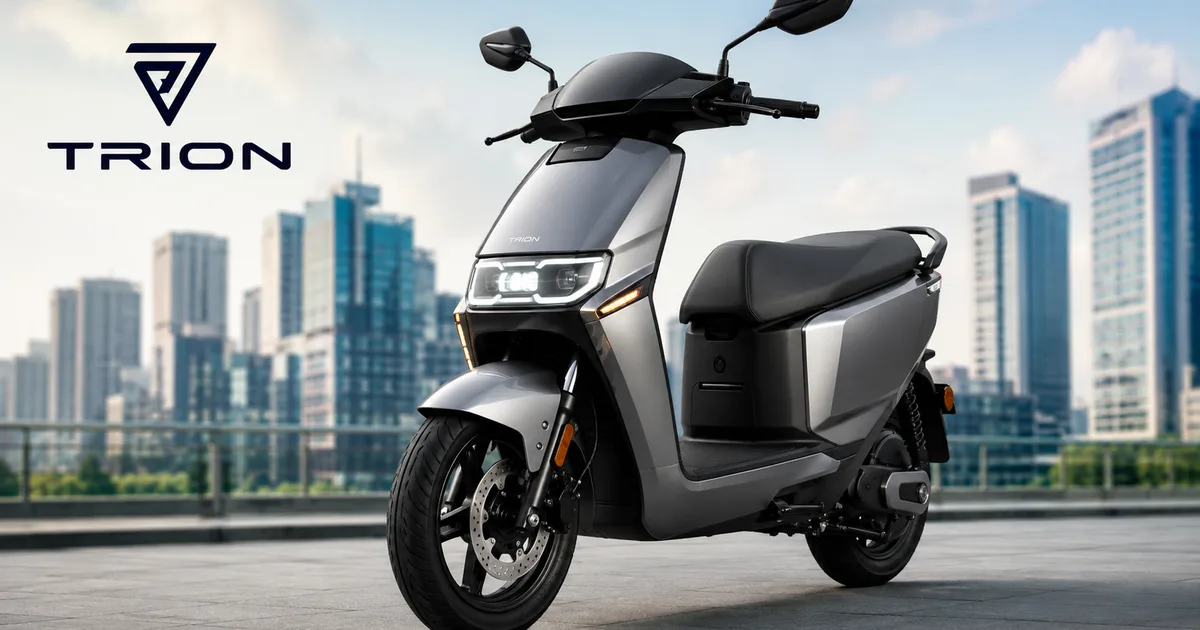
Bengaluru-based startup E3 Electric.AI has officially launched the E3 Trion electric scooter in India. The Trion Electric Scooter India Debut 2026 brings another solid option to a crowded market, starting at Rs. 99,999. I watched the launch closely because, honestly, the Indian EV space needs scooters that actually deliver on what they promise. You have Ather and River dominating the premium segment, and Ola doing its own thing. And now E3 wants a piece of the pie.
The company revealed the Trion on August 6, 2026, dropping multiple variants. They're pushing hard on the AI features and the connected tech angle.
But I'm mostly interested in the claimed 165 km range and the modular architecture.
India's two-wheeler EV market is growing incredibly fast. We still see a lot of generic imported components slapped together, though. E3 claims they are doing things differently from the ground up.
Pricing structure and variants for the E3 Trion
Pricing is where things get interesting. E3 Electric.AI announced a starting price of Rs. 99,999 for the base variant. Before you get too excited about that sub-lakh price tag, you should know there are higher-spec versions too. News reports from BikeWale mention the top-end variant going up to Rs. 1.19 lakh. These prices are likely ex-showroom, Bengaluru. (which makes sense, actually)
I think this strategy is pretty clever.
They get the headline-grabbing under one lakh sticker price. But if you want the fast charger or the bigger battery pack, you'll probably pay more. Factor in insurance and RTO charges, and your actual on-road price in a city like Mumbai or Delhi will look different. It's a classic move to get people in the door.
EV subsidies under the latest government schemes keep changing. The FAME subsidies have seen multiple revisions over the years. The new EMPS (Electric Mobility Promotion Scheme) altered how discounts apply. So that Rs. 99,999 base price might fluctuate depending on your state's specific EV policy. States like Gujarat or Maharashtra sometimes offer extra state-level subsidies that bring the cost down even more.
Compare this to the Ather 450S or the River Indie. The Trion undercuts them slightly on paper. In my experience, that's a deliberate move to get people into showrooms. It competes directly with the Ola S1 Air and the Bajaj Chetak Urbane in this bracket. Those are established names. So E3 really needs to prove this pricing holds up in the real world.
Battery capacity, charging and range reality
Look, range anxiety is still a massive barrier for Indian buyers.
E3 claims the Trion delivers a range of 165 km on a single charge. That's a solid number. Of course, ARAI certified range and real-world range are two different things.
If they claim 165 km, you can realistically expect about 120 km to 130 km in heavy Indian city traffic. Stop-and-go traffic and carrying a pillion rider both drain the battery faster. Honestly, 120 km is still more than enough for a typical daily commute of 30 to 40 km. You could charge it twice a week. You'd be perfectly fine.
They opted for removable batteries. I think this is a huge deal. Many people live in apartments where they can't simply pull an extension cord down to the parking lot. Being able to take the battery out and plug it into a standard 15-amp socket makes EV ownership possible for thousands of urban riders. I don't understand why more manufacturers don't do this. It solves the charging infrastructure problem for a lot of people instantly. Ola faced criticism for non-removable batteries early on. E3 has clearly been taking notes.
The numbers here are a bit fuzzy, honestly.
The exact charging time hasn't been completely detailed yet. Usually, a battery pack capable of this range takes about 4 to 5 hours to charge from zero to 100 percent on a standard home charger. We'll have to see if E3 offers a fast-charging network or a fast home charger as an optional accessory. That could be a game changer for delivery riders who need quick top-ups during the day.
Smart technology and AI features explained
E3 Electric.AI put AI right in their brand name. So naturally, they're pushing the software capabilities of the Trion heavily. The scooter has AI-based connected tech. But what does that actually mean for you on the road?
From the launch details, the AI system handles battery management and predictive maintenance. Basically, the scooter learns your riding style over time. If you ride aggressively with sudden accelerations, the software adjusts the power delivery and battery cooling to prevent overheating. It optimizes the motor output based on the load it senses.
It can also theoretically alert you on your phone before a component fails.
If the sensors detect an anomaly in the motor temperature or battery voltage, the app will notify you to schedule a service before you get stranded on the side of the road. This sounds fantastic on paper. The real test will be whether the software is smart enough to avoid false alarms.
You get a digital dashboard. It connects to your smartphone via a dedicated app. You can expect standard features like turn-by-turn navigation and call alerts. I'm curious to see how smooth the interface is in real life. A lot of startups promise incredible software. But the actual touchscreens often turn out laggy and frustrating to use under direct sunlight. Ather set the gold standard for software UI. E3 has big shoes to fill.
"The integration of AI in two-wheelers is moving from basic Bluetooth connectivity to actual vehicle management. It changes how the scooter performs based on environmental conditions and rider habits."
Design, build quality and modular architecture
The E3 Trion has a family-focused design. It doesn't look like an aggressive sports scooter at all. It just looks practical. The floorboard is flat. It seems wide enough to carry groceries or a standard gas cylinder. That's a must-have for a family scooter in India. We don't just commute on these things. We use them to move our lives around.
They also talk about a modular architecture. This suggests they plan to build multiple types of vehicles on this same underlying platform. For the Trion itself, it might mean you can easily swap out body panels if they get scratched. It could also mean you can attach different accessories like a front rack or a heavy-duty top box without drilling holes in the bodywork.
I appreciate this practical approach. The River Indie proved that a utility scooter can be very popular. E3 seems to be taking a page out of that playbook. The seats look wide and comfortable for two adults. That's another important factor for the Indian market.
Service network, warranty and long-term ownership
This is the biggest hurdle.
You can build a fantastic scooter. But if you don't have a reliable service network, Indian buyers will stay away. E3 Electric.AI is a new player. They're starting their rollout in Bengaluru.
If you buy a Trion today, you need to know their service centers will be limited initially. You won't find a mechanic on every corner who knows how to fix an AI-powered electric scooter. They'll probably offer doorstep service for minor issues. That has become the industry standard for EV startups. But for major repairs involving the motor or battery pack, you'll have to rely on their official hubs.
I'm not sure exactly why they haven't announced the warranty terms yet. You should look for at least a 3-year or 30,000 km warranty on the battery and motor. Anything less is sketchy in 2026. Make sure you read the fine print about battery degradation. Some companies only replace the battery if it drops below 70 percent capacity within the warranty period.
Another thing to consider is spare parts availability. With modular architecture, replacing a broken mirror or a cracked side panel should theoretically be cheap and fast. But that depends entirely on their supply chain management. If you crash your scooter, you don't want to wait three months for a replacement fender to arrive from the factory. That would be a mess.
Financing options and buying process
E3 will likely tie up with major banks and NBFCs to offer financing options. Since EV loans often come with slightly lower interest rates due to government push for green mobility, you can expect decent EMI schemes. You can probably finance up to 80 or 90 percent of the on-road price through public sector banks like SBI or private lenders like HDFC.
The buying process will almost certainly be digital-first. You'll book it online. Maybe you'll do the documentation through an app and get the scooter delivered right to your door. Just make sure your Aadhaar is linked to your mobile number. Most RTO registrations now require OTP verification via DigiLocker. The process is much smoother than it was five years ago. But it still requires some patience. (annoying, I know)
Who should buy the E3 Trion?
If you ask me, if you live in Bengaluru and want a tech-heavy scooter that looks practical, the Trion is worth a test ride. The Rs. 99,999 starting price makes it very competitive against the base models of Ather and Bajaj.
The removable battery is the biggest selling point for apartment dwellers. And the claimed 165 km range gives you a lot of breathing room for weekend errands across the city.
But there are risks. E3 is an unproven brand. You're essentially paying to be a beta tester for their first-generation product. If you need absolute peace of mind and a massive service network right now, you might want to wait a year to see how these scooters hold up on Indian roads, or check out our latest news on established players. Or head over to our explainers section to understand the tech better before deciding.
I'll try to get my hands on a review unit soon. We need to see if the AI features actually work or if they're just marketing buzzwords. Until then, approach it with cautious optimism.
Booking details and timeline
Bookings are expected to open shortly after the August 6 launch. Deliveries usually take a few weeks to begin, prioritizing the Bengaluru market first. They'll likely require a token amount of around Rs. 999 or Rs. 1,999 to reserve a scooter. You can typically do this directly through the E3 Electric website.
- Base variant starts at Rs. 99,999
- Top variant might go up to Rs. 1.19 lakh
- Deliveries begin in Bengaluru first
- National expansion expected later in 2026
- Financing requires standard KYC via Aadhaar and PAN
They plan to expand to other major cities like Delhi and Mumbai later this year. If you're outside Karnataka, you might have to wait a few months before you can even take a test ride. Check the tools section on our site to compare EV ranges if you're cross-shopping right now.