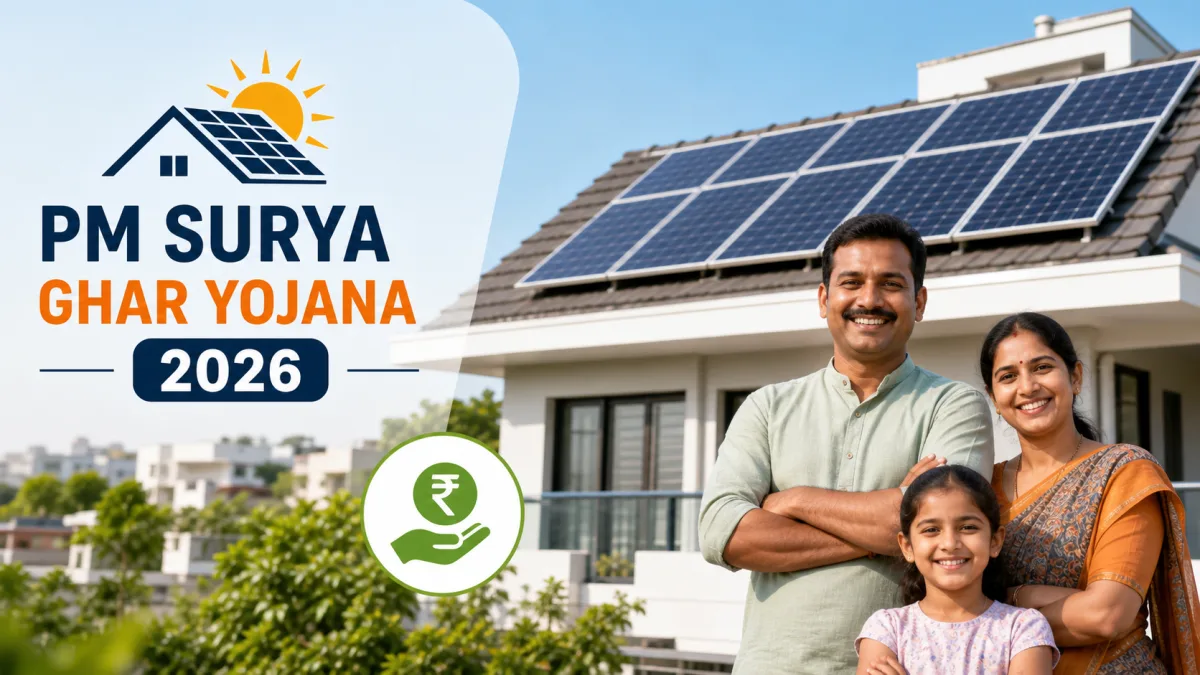
Look, I get it. Every summer, that electricity bill lands in your inbox, and it feels like a personal attack. Air conditioners are running constantly, and the meter just keeps ticking. But then you hear about PM Surya Ghar Yojana 2026. Suddenly, free electricity doesn't sound like a scam anymore. It sounds like a plan.
Thing is, government schemes can be a headache to navigate. The paperwork and the endless wait. But I spent the last week digging into the PM Surya Ghar Muft Bijli Yojana, and honestly, the process is getting smoother. I think the numbers here are a bit fuzzy, but the World Bank just threw $890 million into this project. They mean business. The goal is to hit 1 crore households by 2027. And states like Bihar and Jammu & Kashmir are already setting aggressive monthly targets.
So, you want to cut your electricity bill down to zero? You want to know how the PM Surya Ghar Yojana 2026 actually works for a normal person living in India? Grab a chai and let's go through the entire application process step-by-step. I'll show you exactly what to click and how to avoid the usual roadblocks.
What Is The PM Surya Ghar Yojana 2026?
Basically, the government is paying you to put solar panels on your roof. It's a massive push for rooftop solar energy. You generate your own power. And if you produce extra, you can sometimes feed it back to the grid. It's clean energy, sure. But more importantly for most of us, it means massive savings. In my experience, these savings add up fast.
The PM Surya Ghar Muft Bijli Yojana aims to reduce electricity bills by providing subsidies for installing rooftop solar systems, targeting 1 crore Indian households.
The scheme isn't entirely new, but the push in 2026 is massive. With states like West Bengal announcing plans for 2 lakh rooftop systems and local electricity boards rushing to clear pending applications (like the 3,531 cases pending in Tamil Nadu recently), the momentum is real. You can check out more details on our guides page if you want the deep history. But what matters right now is getting you registered.
How Much Subsidy Do You Actually Get?
Let's talk numbers.
The subsidy amount depends on the capacity of the solar plant you install. Here's the breakdown:
- For systems up to 2 kW: You get a subsidy of ₹30,000 per kW. That means a 2 kW system gets you ₹60,000 off.
- For systems between 2 kW and 3 kW: You get ₹30,000 per kW for the first 2 kW, plus ₹15,000 for the additional capacity. So, a 3 kW system maxes out at a ₹78,000 subsidy.
- For systems above 3 kW: The maximum subsidy is capped at ₹78,000. Going bigger won't get you more government money.
Most middle-class Indian homes running a couple of ACs and standard appliances will do fine with a 2-3 kW system. But check your average monthly consumption on your latest electricity bill to be sure. I'm not sure exactly why people overcomplicate this step.
Before You Start: What You Need
Don't just jump into the portal blindly. Gather your documents first. If you pause halfway to find a piece of paper, the session might time out. Then you'll have to start over. I hate when that happens.
- Your latest electricity bill. You need the consumer number printed on it.
- A scanned copy of the electricity bill. Make sure it's clear and readable.
- Your Aadhaar card, linked to your active mobile number.
- Bank account details (a canceled cheque or passbook copy) — this must be in the name of the person on the electricity bill. The subsidy goes directly into this account via Direct Benefit Transfer (DBT).
- A smartphone or computer with internet access.
If the electricity bill is in your landlord's name, you can't apply for the subsidy directly. Not unless they agree to it and the money goes to their account. The name on the bill and the bank account must match. I think you should sort this out with your landlord early on (which makes sense, actually). Keep that in mind to avoid headaches later.
Step-by-Step Guide to Apply for PM Surya Ghar Yojana
So here is the exact process. Follow these steps carefully.
Phase 1: Registration on the National Portal
- Open your browser and go to the official portal: pmsuryaghar.gov.in. Do not use random links forwarded on WhatsApp. We cover how dangerous those are in our scams section. Stick to the official government URL.
- On the homepage, look for the 'Apply for Rooftop Solar' button. Click it.
- You'll see a registration form. First, select your State from the dropdown.
- Next, select your Electricity Distribution Company (DISCOM). This is the company that sends you your monthly bill — like Tata Power, BESCOM, MSEDCL, or your local state board.
- Enter your Electricity Consumer Number exactly as it appears on your bill.
- Click 'Next'.
- Now, enter your mobile number. Make sure it's an active Indian number because you'll get an OTP.
- Enter your email ID. It's optional but highly recommended for updates.
- Follow the portal instructions to complete the registration. You'll need to enter the OTP sent to your phone.
Phase 2: Submitting the Application
- Once registered, go back to the homepage and click 'Login'.
- Enter your Consumer Number and the registered mobile number to log in.
- You'll see a dashboard. Find the 'Apply for Rooftop Solar' link and click it.
- Fill out the application form. You'll need to provide details about your roof — roughly how much space you have. A 1 kW system usually needs about 100 square feet of shadow-free area.
- Upload the scanned copy of your recent electricity bill. Ensure the file size is within the specified limit (usually under 2MB).
- Submit the application. You'll get an application reference number. Save this. Write it down. Take a screenshot. You will need it to track your status.
Phase 3: Approval and Installation
This is where you have to wait a bit.
The DISCOM has to approve your application first. They need to ensure your local transformer can handle the load.
- Wait for the 'Technical Feasibility Approval' from your DISCOM. You'll get an alert on the portal or via SMS. Don't buy anything before this approval.
- Once approved, you need to select a vendor. The portal has a list of registered vendors for your state. Only use registered vendors. If you use a random local electrician, you won't get the subsidy.
- Contact a few vendors, get quotes, and choose one. They will install the solar panels, the inverter, and the necessary wiring.
- After installation, the vendor will submit the installation details on the portal.
Phase 4: Inspection and Subsidy Release
- Once the installation details are submitted, you need to apply for a net meter through the portal. The net meter keeps track of how much electricity you draw from the grid and how much you feed back into it.
- Your local DISCOM will send an official to inspect the installation and set up the net meter.
- After the inspection is clear and the net meter is installed, a 'Commissioning Certificate' will be generated on the portal.
- Log back into the portal. Go to the bank details section. Submit your bank account details and upload a canceled cheque.
- Wait. The subsidy will be credited directly to your bank account within 30 days.
Common Roadblocks and How to Handle Them
I wish I could tell you the process is flawless. It's not. Here are a few things that might trip you up. Honestly, it can be a mess sometimes.
Pending Applications
Sometimes, applications get stuck. In Tamil Nadu recently, over 3,500 applications were pending. If your application is stuck at the feasibility stage for weeks, you need to act. Don't just wait endlessly. Visit your local DISCOM office with your application reference number. If you ask me, a polite in-person inquiry often gets the file moving much faster than online complaints.
Vendor Issues
Some vendors might try to upsell you. They might push for a 5 kW system when you only need 3 kW. Stick to your budget. And negotiate the installation costs. The subsidy covers the panels and basic setup. But vendors sometimes charge extra for structural mounting if your roof is a bit sketchy. Get everything in writing before they start work.
State vs. Central Schemes
Here's a weird wrinkle. In some states, local free electricity schemes conflict with the central one. For example, Karnataka's Gruha Jyothi scheme gives 200 units of free electricity. Some residents there are calculating if investing in rooftop solar is worth it when they already pay nothing for basic usage. If your state has a massive free electricity scheme, do the math. If you consume way more than the free limit, PM Surya Ghar is still a fantastic investment. If you barely use 100 units, maybe hold off.
Why You Shouldn't Wait
Honestly, the best time to apply is right now.
The government has serious funds allocated, but schemes change and waiting lists get longer. The World Bank's backing means the money is there today. The PM has been actively promoting this. He is sharing success stories of the initiative's impact across India.
We talk a lot about tools and tech that make life easier. But sometimes, the best tech is the one that sits on your roof and quietly knocks ₹3,000 off your monthly expenses for the next 25 years. That's real money back in your pocket. Go find your electricity bill and open the portal.