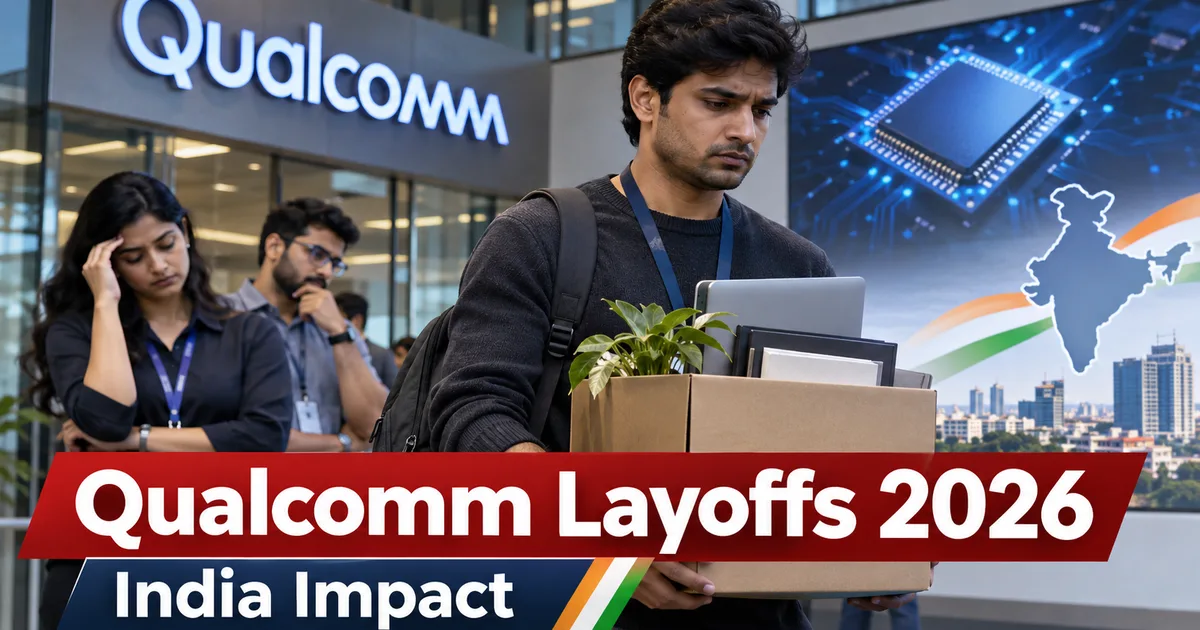
Next time you scroll through Flipkart or Amazon India looking for a new smartphone, check the processor line in the specifications. You'll almost certainly spot the name Snapdragon. Whether you look at a budget Xiaomi phone, a mid-range OnePlus, a Vivo handset, or a flagship Samsung Galaxy, Qualcomm designed the processor inside it. That's why the Qualcomm layoffs 2026 caught so many engineers off guard. Notices began rolling out in November 2026, and tech hubs in Bengaluru and Hyderabad are feeling the heat.
Losing a job is brutal. If you ask me, it's easily the most stressful thing that can happen to a tech career.
Seeing a semiconductor giant cut staff while pulling in billions in sales feels confusing on the surface. But look at the numbers. The pressure is obvious. Smartphone sales are slowing down, and memory parts cost way more right now (annoying, I know). Big phone makers are also busy building their own custom silicon. That leaves Indian engineers in design centres caught right in the middle of this corporate shift.
What Qualcomm actually does behind your phone screen
Most folks assume Qualcomm runs giant factories with humming machinery spitting out tiny black chips. They don't. Qualcomm is what the industry calls a fabless semiconductor firm. That distinction explains almost everything about why their hiring and firing cycles swing so wildly.
Think of Qualcomm as an architectural design firm rather than a construction crew. Its engineers sit in offices across San Diego and Hyderabad, plus tech hubs in Bengaluru and Chennai. They write code and draft micro-circuit layouts all day. Once a blueprint is ready, they send the digital files off to specialized manufacturing foundries like TSMC in Taiwan or Samsung in South Korea. Those third-party foundries handle the messy, capital-heavy work of etching silicon in cleanrooms. Then come the sales. Qualcomm packages the finished chips for brands like Motorola or Vivo, and collects royalties every single time a phone connects to 4G or 5G networks.
In my experience talking to hardware engineers in Hyderabad who spent years testing these wireless modems, the work is incredibly demanding. It's meticulous. But when smartphone sales stall worldwide, an architectural firm doesn't need as many drawing boards.
Why Qualcomm is cutting jobs in late 2026
Corporate filings tell the real financial story. Qualcomm recorded $332 million in restructuring charges during its 2026 fiscal year, according to its annual financial report. That's a huge jump compared to the $39 million reported just twelve months earlier. The company confirmed it. Almost all that cash went straight toward severance packages. Even wilder, roughly $235 million of those charges hit in the fourth fiscal quarter alone, which is about 71 percent of the full-year restructuring tab.
The timing ties directly to an internal memo sent on October 19 by Qualcomm CEO Cristiano Amon. In that message, Amon told staff that the company would carry out a global, performance-focused headcount reduction following annual employee reviews, with notices starting in November. He framed the move around shifting technical requirements:
"As we have expanded the business, so have the competencies and skills we require. We must have the right people in the right roles so they can perform at their best and the company can continue to succeed."
Here's the thing: calling layoffs performance-focused is an old corporate tactic. If you ask me, it allows leadership to reduce overhead without explicitly admitting that consumer demand collapsed. Four specific pressures forced Qualcomm into this corner:
- Handset chip revenue plummeted 26 percent down to $5.14 billion during the latest quarter as global consumer phone upgrades slowed down.
- Rising prices for external memory chips squeezed profit margins for phone makers, which forced them to order fewer premium processors.
- Apple continues developing its own internal cellular modems to replace Qualcomm components in future iPhone models, which threatens billions in annual licensing revenue.
- General smartphone saturation meant customers in major markets now wait three to four years before replacing their existing devices.
Curiously, Qualcomm reported around 57,000 employees globally at the end of September 2026, up from 52,000 a year earlier. The contrast is strange. I'm not sure exactly why management let hiring swell so late in the cycle, but it makes sense when you see where the money went. Basically, the company was hiring aggressively in artificial intelligence servers and automotive computing while quietly trimming staff from mature smartphone units.
Qualcomm India job cuts: how Bengaluru and Hyderabad teams are affected
India is one of Qualcomm's largest engineering footprints outside the United States. The company has sprawling research and development campuses in Hyderabad's HITEC City, alongside major tech park setups in Bengaluru and Chennai. Thousands of Indian engineers work on wireless modem firmware, multimedia software, multimedia drivers, and testing automation.
Between 600 to 1,200 jobs in India are on the line during this November reduction cycle. The numbers here are a bit fuzzy because Qualcomm hasn't published a formal public census broken down by Indian office locations (which makes sense, actually, given the panic it would cause). That keeps anxious employees refreshing internal Slack channels and blind forums all day. But team leaders on the ground confirm that software validation, quality assurance, build engineering, and legacy modem testing divisions are seeing the heaviest impact.
Look, hardware design jobs in India used to be considered bulletproof. In my experience, while IT services companies regularly hire and fire in mass waves, semiconductor product firms had a solid reputation for steady employment. That comfort has evaporated. Similar cuts happened recently during the Microsoft layoffs in October 2026. Hardware and cloud giants are cutting costs aggressively.
Hyderabad feels this sharply. The Telangana capital has pitched itself as the main chip design destination in India, attracting major investments with dedicated tech zones. When hundreds of high-earning silicon design engineers lose their income simultaneously, the ripple effect hits fast. It touches local housing rentals and retail spending in the Cyberabad corridor within weeks.
Severance packages and support for Indian employees
What happens to an engineer in Bengaluru or Hyderabad who receives an exit notice this month? Fortunately, multinational semiconductor companies generally give packages that exceed the bare minimum statutory requirements in India (at least on paper).
Under Indian labor regulations, including the Industrial Disputes Act and the Payment of Gratuity Act, companies must settle accrued gratuity for employees with continuous service and provide statutory notice pay. Qualcomm's separation package goes further. Affected staff and local HR consultants point to several specific provisions:
- Severance pay ranging between two to four months of basic salary, with additional weeks added based on total years of completed service.
- Full salary payout in lieu of the formal sixty-day or ninety-day contractual notice period.
- Extension of corporate group medical insurance coverage for departing employees and their families for three to six months.
- Professional outplacement assistance, including resume workshops and recruiter networking, to help engineers transition into new positions.
These terms resemble the separation structures seen during Oracle job cuts across Indian offices earlier in the year. I think the severance package softens the blow, but finding a comparable VLSI or embedded software role in India right now takes longer than it did two years ago. Most competing chipmakers have slowed external hiring. Displaced engineers now face months of interview rounds.
The pivot from smartphone silicon to automotive and artificial intelligence
Qualcomm isn't going out of business, but it's steering capital toward new markets because mobile phones can't guarantee twenty percent annual growth anymore. The company is basically wagering its entire future on two distinct fields: connected vehicles and artificial intelligence.
In the automotive space, Qualcomm produces the Snapdragon Digital Chassis. This computing platform powers modern digital dashboards, assisted driving cameras, infotainment screens, and telematics units. Indian automakers like Tata Motors and Mahindra already integrate connected car tech into their popular SUVs, and Qualcomm wants to supply every electronic brain inside those vehicles. Auto division revenue has been climbing steadily. That's completely different from the slump dragging down mobile handsets.
Meanwhile, Qualcomm launched Snapdragon X processors to take on Intel and AMD in Windows laptops. You can read more about how chip architectures are adapting to on-device neural processing on our tech explainers hub. Building AI chips is completely different. It takes new software stacks, specialized compilers, firmware tools, and machine learning researchers. In my experience, pivots like this are always messy. That explains the brutal hiring-and-firing paradox. Qualcomm is letting go of engineers who tested 4G and 5G smartphone modems while frantically hiring specialists who train neural models and write automotive firmware.
What this means for Indian smartphone users and engineers
If you're an everyday smartphone user in India, there's no reason to panic about your current phone. It'll keep getting updates. And new Snapdragon handsets will hit shelves right on schedule. But phone makers are feeling the pinch of rising memory prices and premium processor costs. Honestly, don't be shocked if upcoming mid-range phones from OnePlus and Xiaomi, plus Realme and Vivo, launch with ₹2,000 to ₹4,000 higher price tags (annoying, but true).
For Indian tech professionals, the takeaway is sobering. Hardware engineering was long viewed as insulated from the turbulence affecting web developers and IT consultants. That insulation is gone. If you ask me, sticking strictly to mature smartphone protocols is a trap. Expanding your skillset into embedded machine learning, automotive AUTOSAR standards, kernel architecture, or RISC-V design is no longer optional. It's necessary.
We'll track the exact numbers as severance discussions conclude across Hyderabad and Bengaluru. Keep an eye on our latest tech news tracker for real-time updates on corporate restructuring and hiring shifts across the Indian tech sector.