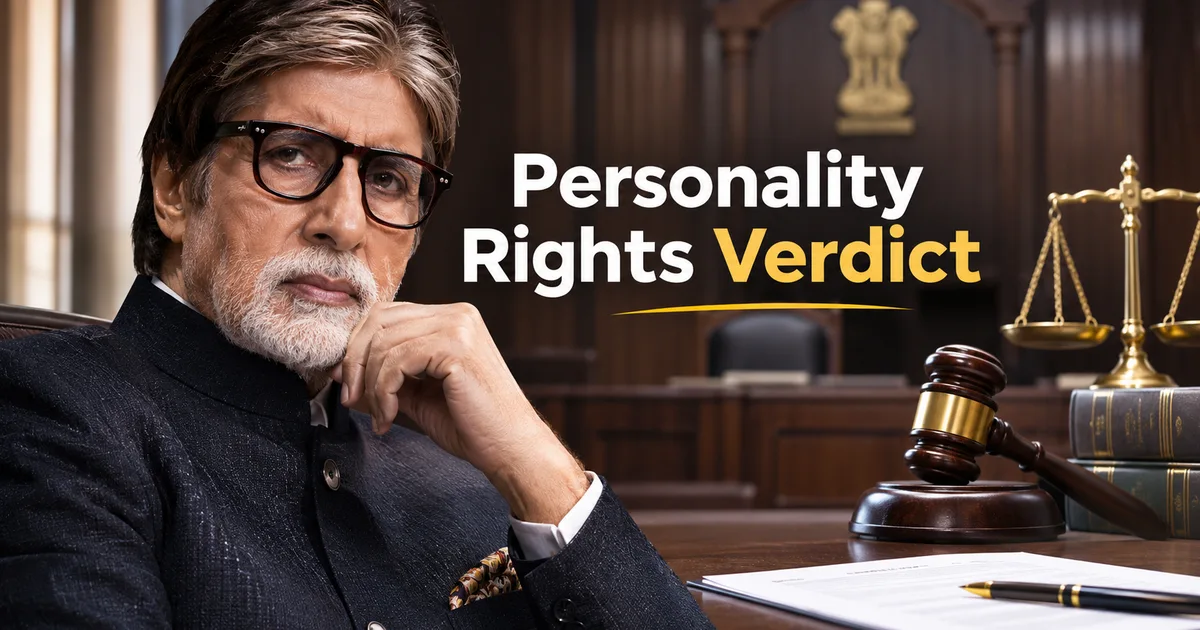
Think about the last time you got a forwarded voice note on WhatsApp that sounded suspiciously like Amitabh Bachchan congratulating you on winning a Kaun Banega Crorepati lucky draw. Or maybe you scrolled past an Instagram ad where a cloned version of his famous baritone was peddling herbal hair oil or promising ₹50,000 lottery winnings. That deep, unmistakable voice is everywhere on the Indian internet. But if you've been watching the courts lately, the Amitabh Bachchan personality rights verdict from the Delhi High Court has finally drawn a hard line in the sand.
On November 5, 2026, the court turned a temporary order into a permanent wall.
Justice Purushaindra Kumar Kaurav decreed the veteran actor's commercial lawsuit. It's final. No one can use his voice, name, photograph, or likeness without explicit permission anymore. The whole case targeted everything from roadside t-shirt sellers printing his face to sketchy AI audio generators that clone voices in five seconds flat. If you build apps or just try to dodge daily scams in India, this ruling changes how our courts look at identity.
If you ask me, it's about time.
What the Delhi High Court order actually decided
To understand where things stand, you have to rewind to November 2022. Back then, Bachchan's legal team, led by Senior Advocate Sandeep Sethi, rushed to court because lottery scammers and sketchy app developers were using the actor's face and voice to make a quick buck. The court gave him an interim injunction right away.
Then things dragged on. Indian court cases usually take time, after all. But on October 9, 2026, Justice Kaurav gave everyone a firm nudge. He made it clear that if settlement talks went nowhere and Bachchan still wanted to fight it out, he'd need to show up in court in person. That worked. Less than a month later, on November 5, 2026, the court closed the main lawsuit because four defendants decided to settle directly with the superstar.
The businesses that settled were a pretty mixed bag:
- Rajat Nagi had built an Android app called Amitabh Bachchan Video Call that let users pretend they were on a video call with the superstar. He took down the app and promised never to repeat it.
- Manoj Publications had printed a general knowledge quiz booklet with Bachchan's face plastered across the cover to drive sales. They stopped printing it.
- Tamatina, an online home decor brand, had been selling commercial wall posters featuring his face. They agreed to pull the listings.
- Mahesh Patel had registered the web domain amitabhbachchan.in back in the day. He deleted the domain in November 2022 and showed he made zero money from it.
All four defendants signed off on Bachchan's exclusive publicity and privacy rights. The promise binds them and their business partners. In return, Bachchan dropped his claim for financial damages against them. (Honestly, that makes sense, since chasing money through our civil courts can easily drag on for another decade.) In my experience, taking the win on rights and walking away from damages is almost always the smarter call in India.
Four other defendants didn't even bother to show up. Swag Shirts, Rana Partab Singh, Raghu Sharma, and the domain registrar Dynadot ignored the court summons completely. Their right to file a written defence was shut down way back on September 25, 2023. So Justice Kaurav passed an ex-parte decree against them on the spot.
How the ruling tackles AI voice clones and deepfakes
Generative voice models flipped the whole piracy game upside down between 2022 and 2026. A decade ago, ripping off a celebrity meant hiring a mimicry artist for a local radio ad or printing blurry photos on Diwali firecracker boxes down in Sivakasi. Now? You can just grab an open-source audio model or pay ₹1,500 on some website. Feed it three minutes of clean KBC clips from YouTube, and boom, you get an Amitabh Bachchan voice clone that sounds freakishly real reading any script you type.
I tested a few speech synthesis tools recently for our tech explainers hub, and the output is honestly terrifying. You don't need a recording studio. In fact, if you ask me, anyone sitting with a basic laptop can generate a voice note that easily fools your grandparents in thirty seconds flat.
Scammers across India jumped right on this. They churn out fake voice notes where "Bachchan" congratulates you on winning a ₹25,000 cash prize, then asks for a ₹1,200 "processing fee" via UPI to some random phone number. It works because people trust that voice. They have heard it in movie halls and state polio campaigns for fifty years.
Justice Kaurav saw right through the game. The court pushed its permanent injunction out to cover unidentified infringers too, known as John Doe orders in Indian legal circles. That part is huge. If someone spins up a shady Telegram bot tomorrow peddling Bachchan voice packs or launches a scam ad on YouTube, Bachchan's lawyers won't have to start a brand new lawsuit from scratch. They can just hand this decree directly to social media platforms or telecom companies to get the links taken down immediately.
Basically, it gives his team a real weapon against scammers hiding behind VPNs and fake numbers. (Which makes a lot of sense, honestly, given how fast these channels pop up and disappear.)
What personality rights in India actually protect
You might wonder why India even needs personality rights when copyright and trademark laws already exist. It's a fair question. The difference comes down to what you actually own. Copyright covers finished creative work like a recorded song or a film script, while trademarks protect brand logos on commercial packaging. But neither law protects your face or your distinctive voice.
India doesn't have any specific law called The Personality Rights Act. Not yet, anyway. Instead, our judges built these protections piece by piece out of common law, leaning heavily on Article 21 of the Constitution and its guarantee of life and personal privacy.
In this verdict, the Delhi High Court went back to its older ruling in Titan Industries Ltd. v. M/s Ramkumar Jewellers. That case gave us a simple definition:
The right to control commercial use of human identity is the right to publicity.
Look, if you build a public name that carries commercial value, no one else gets to piggyback on it to sell stuff without your say-so. It's your property. I think that's only fair. You get to decide whether your voice sells biscuits or stays completely off the air.
We saw the same boundary-pushing in the recent Kriti Sanon personality rights case, where judges cracked down on AI-generated photos. We saw it again when the family had to fight vicious rumors in the Aaradhya Bachchan personality rights case. Courts are making one thing very clear: ripping off someone's image without consent isn't okay just because new apps make it easy.
Why fake KBC lottery calls and scam apps forced court action
Celebrities lose ad deals when fake products hit the market. That hurts their pockets, sure, but regular folks across small-town India lose their actual life savings. Take that "Amitabh Bachchan Video Call" app built by Rajat Nagi. It looked like harmless fun at first glance. But tons of people across India grab apps like that from third-party APK sites or even the Google Play Store, thinking they're the real deal. Once installed, these sketchy apps harvest your private contacts and bombard you with intrusive ads.
And then you've got the lottery rackets. Scammers use Bachchan's face and cloned voice notes on WhatsApp to push fake KBC prize draws. They demand advance processing fees, tricking victims into scanning a UPI QR code or wiring money straight into mule accounts.
Honestly, the numbers here are a bit fuzzy because so much online fraud never gets reported to the police. Even so, state cyber cells log thousands of lottery complaints each year. People feel embarrassed after sending ₹10,000 or ₹25,000 to an account just because an audio clip sounded like a superstar.
Real lotteries don't ask you for advance cash to hand over a prize. (Annoying that this still needs saying in 2026, but it does.) If you or your relatives run into one of these scams, file a complaint on cybercrime.gov.in or call 1930 straight away. And our guide over at the cyber fraud and scam hub explains how to freeze stolen funds within that first golden hour before fraudsters empty the account.
Does this ruling kill mimicry, comedy, and memes?
Every time a court drops a ruling like this, creators start panicking. Stand-up comics wonder if they can still pull off a Bachchan impression on stage, and meme makers worry about posting parodies online. The short answer? Real comedy is completely safe. The Delhi High Court order specifically targets unauthorised commercial exploitation and deceptive passing off.
Under Section 52 of our copyright law, we already have clear fair dealing exceptions for caricature and parody. When a comedian tosses out a loud "Hain!" and adjusts an imaginary collar under the spotlights, nobody gets hauled into court. The crowd knows it's an impression.
The real trouble starts when imitation turns into outright deception. If some software clones an actor's voice so well that people actually think he endorsed a sketchy betting app or a dubious housing project, that's illegal. Intent matters. Context matters too. In my view, sneaking around with cloned voices to make money without permission crosses the line every single time.
What this means for everyday internet users and digital identity
This ruling is great for big Bollywood stars who can afford senior advocates in the High Court, but it leaves a massive question hanging for the rest of us. What happens when a college student finds her face pasted onto an explicit deepfake video? Or when a retired teacher gets a call from an extortionist using his son's cloned voice to demand emergency cash?
A superstar has the money to get permanent injunctions and John Doe orders. Most people don't. India's Digital Personal Data Protection Act of 2023 deals with personal data, but our laws still don't give regular citizens a quick way to stop non-consensual voice cloning before the damage is done.
Until Parliament amends our tech laws to handle generative clones head-on, decisions like this are the only real roadmap we have. For now, the Delhi High Court made one thing very clear: your voice and your face belong to you alone. No slick software gives anyone the right to profit off your identity.
So keep an eye on your digital footprint.